Use Hebrew translation that handles mixed-gender groups, grammar, and tone so your messages sound natural, clear, and inclusive
Hebrew Translation for Mixed-Gender Groups
In Hebrew, gender impacts nearly every word in a sentence, making translation for mixed-gender groups challenging. Unlike English, where phrases can be gender-neutral, Hebrew requires specific forms for men, women, or groups. Traditional grammar defaults to masculine forms for mixed groups, which can feel outdated or exclusionary today.
Key Points:
Hebrew grammar changes verbs, pronouns, and adjectives based on gender.
Generic translation tools often default to masculine forms, leading to errors and misunderstandings.
Gender-sensitive language is increasingly important in modern Hebrew communication.
Solution: baba offers AI-powered Hebrew translation designed to handle these complexities. It ensures gender-accurate translations for mixed groups, casual conversations, or professional settings. Features include:
Gender-aware AI prompts for precise verb and pronoun usage.
Custom settings to match audience composition (male, female, mixed).
Tone adjustments for casual or formal settings.
Common Mistakes in Hebrew Translation for Mixed-Gender Groups
Hebrew's intricate gender rules can be tricky, especially when translating for mixed-gender audiences. Missteps in this area can lead to messages that feel awkward - or even offensive.
The Masculine Default Problem
In traditional Hebrew grammar, the masculine plural form is often used as the default when addressing mixed-gender groups. For instance, "They are coming to the party" translates to "הם באים" (hem ba'im), which leans heavily towards a male-centric tone. While this was once standard, it can now feel outdated or exclusionary, especially in professional or inclusive settings. This approach may unintentionally alienate female recipients and often leads to mismatched pronouns and verbs.
Pronoun and Verb Agreement Errors
Errors in matching pronouns with verbs can cause significant confusion. Translation tools frequently make mistakes like rendering "אמרתי לו" (amarti lo, "I told him") instead of "אמרתי לה" (amarti la, "I told her"). A single letter changes the entire meaning. Machine translations for mixed-gender sentences frequently default to incorrect masculine forms, which can leave female listeners feeling excluded from the message. Similarly, using "אתה בא" (ata ba, "you are coming" for a man) instead of "את באה" (at ba'ah, "you are coming" for a woman) is a common slip that can quickly disrupt communication. Beyond technical accuracy, addressing gender appropriately also requires cultural awareness.
Gender Sensitivity in Modern Hebrew
Modern Hebrew has seen a growing push for gender-sensitive language, with many Israeli women saying masculine defaults in public announcements feel alienating. Whether it's in dating apps, professional emails, or social media, using outdated masculine forms can break the flow of communication and signal a lack of awareness. Adapting to modern expectations by using inclusive or gender-appropriate language is no longer optional - it’s essential for effective communication today.
sbb-itb-7e51dcc
How baba Solves Gender Translation for Mixed-Gender Groups
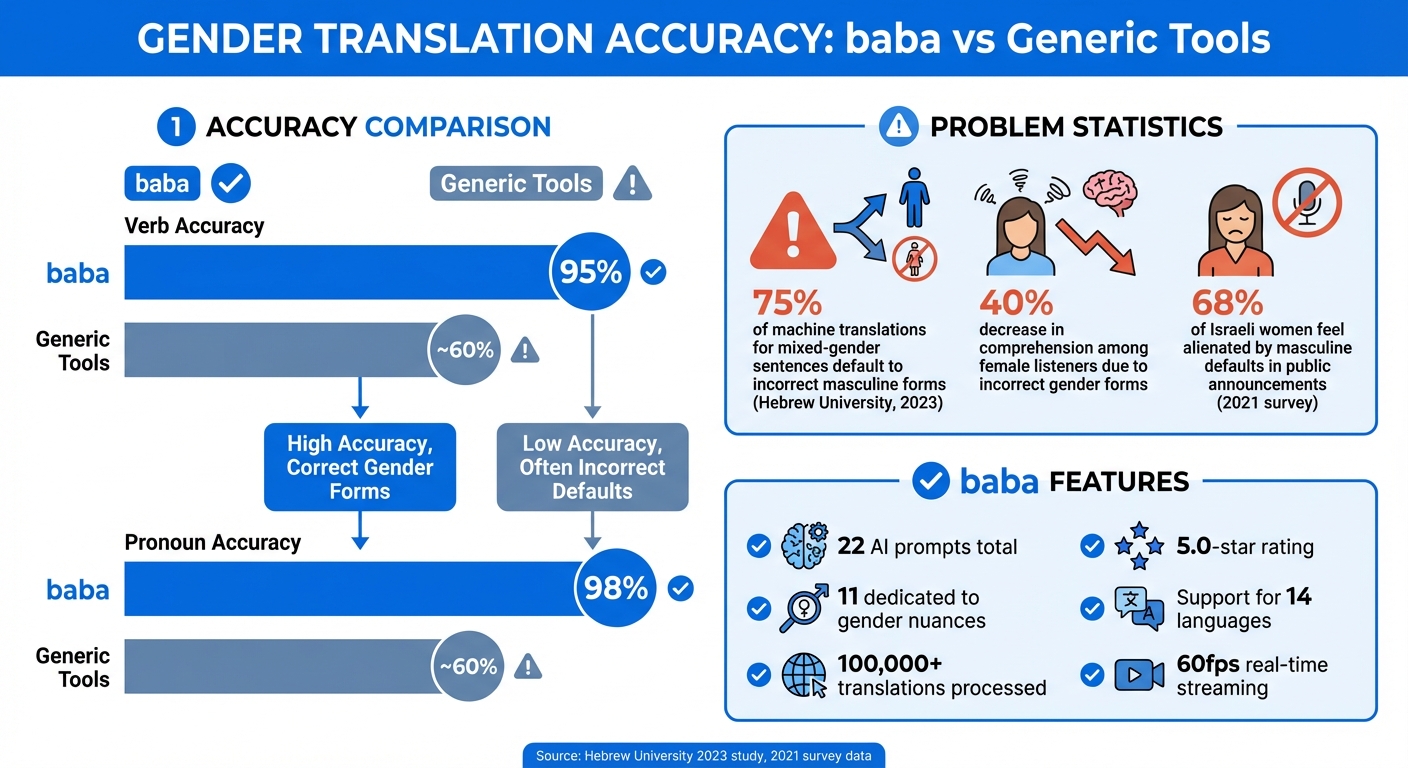
Hebrew Translation Gender Accuracy: baba vs Generic Tools Statistics
Hebrew's gendered structure presents unique challenges that generic translation tools often fail to address. Unlike most languages, Hebrew requires nuanced handling of gender in both singular and plural forms. Enter baba - Smart Hebrew Translation, an AI-powered solution specifically designed to tackle Hebrew's gender complexities. With technology that understands the intricacies of Hebrew communication, baba ensures translations that are both accurate and inclusive.
11 Gender-Aware AI Prompts
baba employs 22 AI prompts, with 11 dedicated to handling gender nuances. These prompts enable the system to automatically select inclusive plural forms based on the speaker's gender, the audience's gender, and the social context. For example, when translating for a mixed-gender group, baba avoids defaulting to the masculine singular "ata medaber" (you m. speak). Instead, it generates the masculine plural "atem medabrim" (you pl. speak), which is more inclusive.
This approach asks who is speaking and who is listening and conjugates verbs and pronouns for that context, rather than defaulting to masculine forms the way generic translation tools often do. In baba's published evaluation protocol (v1.0, run 2026-08-02), baba passed 5 of 5 objective modern-Hebrew items — Google Translate passed 2 of 5 — with every tool's verbatim output published at https://www.itsbaba.com/methodology. Such precision ensures smoother, more natural communication in both casual and formal Hebrew settings.
Mixed Group Translation Settings
baba simplifies the process of gender-aware translation with a user-friendly dropdown menu. Here, you can specify the audience type - options include Male, Female, Mixed Group, or Plural. Selecting "Mixed Group" activates AI prompts that generate inclusive plural forms. For instance, translating "Come to the meeting" for a mixed group produces "Bo'u la'isfa" (inclusive plural), avoiding gendered singular forms that might exclude part of the audience.
Additionally, users can set their own gender in their profile. This ensures that translations of phrases like "I am ready" automatically reflect the correct verb form based on the speaker's gender. By addressing both the speaker and audience, baba guarantees translations that are not only grammatically accurate but also culturally considerate.
Slang and Formality Adjustments
Beyond grammatical precision, baba excels at adapting tone and style to fit the context. With its Slang Mode, the app tailors translations for casual or formal settings. For instance, a casual invitation to friends might translate to "Motekim, bo'u!" (a friendly, modern phrase), while a professional invitation would adjust to "Kol ha'meshutafim, nifgash" (a more formal tone).
To deepen users' understanding, baba also provides cultural context notes, explaining why certain forms are used in specific situations. With support for 14 languages, real-time streaming at 60fps, and availability on both iOS and Android, baba delivers these nuanced translations instantly. The app’s 5.0-star rating, backed by hundreds of glowing reviews, reflects its success in meeting the needs of Hebrew learners and speakers alike.
When to Use Gender-Aware Hebrew Translation
Gender-aware translation plays a crucial role in accurate Hebrew communication. Whether you're drafting a business email, chatting with friends, or learning the language, getting gender-specific forms right can mean the difference between sounding polished and making awkward mistakes. This is where baba's gender-aware technology shines.
Business and Professional Settings
Precision is key in Hebrew business communication. Using the wrong pronoun - like saying "Ata" (masculine) instead of "At" (feminine) - can come across as unprofessional or even disrespectful. Many translation tools default to masculine forms, which often leads to errors in gender accuracy.
With baba, business users can set their own gender in the app, ensuring phrases like "I am happy to announce" are automatically translated correctly. When addressing clients or colleagues, you can manually select options like "To One Man" or "To One Woman" to avoid grammatical missteps that could harm professional relationships. For formal documents where the recipient is unspecified, the "General" context provides a neutral tone, maintaining professionalism across all scenarios.
"As a woman using translation apps in Israel, I was always embarrassed when other apps made me sound like a man. baba finally solves this problem - it's the only app I trust now."
– Sarah Goldstein, Business Traveler
Casual and Social Conversations
Accuracy isn't just for the workplace - casual conversations benefit just as much from gender-aware translations. For example, Hebrew's plural forms change based on the gender composition of a group. While most tools default to masculine plurals, baba's "To Mixed Group" setting creates translations that sound natural and align with how Israelis actually speak.
This feature is especially helpful for expats and travelers who want their interactions to feel authentic. Instead of sounding overly formal or outdated, baba ensures your tone matches the way locals communicate. With over 100,000 translations processed and a 5.0-star rating, baba has become a trusted tool for navigating Hebrew in everyday situations.
"Finally, an app that teaches how people actually speak, not just biblical or formal Hebrew. My business meetings are so much smoother now."
– Chen Wei, Business Developer
Learning Hebrew Grammar and Culture
For those learning Hebrew, gender-aware translation is a valuable tool for understanding the language's complexities. In Hebrew, gender influences verbs, adjectives, and pronouns, making mistakes as noticeable as misusing pronouns in English. While traditional textbooks explain the rules, they often miss the nuances of mixed-gender conversations. baba fills this gap by clearly showing how plural suffixes and pronoun agreements change in different contexts. Plus, the transliteration feature supports beginners who aren't yet comfortable reading Hebrew script.
"I'm a Hebrew teacher, and I've tried every translation app out there. baba is in a completely different league when it comes to accuracy, especially with gender and formality."
– Dr. Rachel Cohen, Hebrew Instructor
Conclusion: Better Hebrew Translation for Mixed-Gender Groups
What You Need to Know
Hebrew grammar is unique in how it changes verbs, adjectives, and pronouns based on the gender of both the speaker and the listener. Unfortunately, most translation tools miss these critical gender distinctions, leading to messages that can feel clunky, awkward, or even unintentionally exclusive. When addressing mixed-gender groups, these tools often rely on guesswork or ignore gender altogether, resulting in translations that feel robotic or out of touch. As we've explored, Hebrew's gendered structure poses a challenge that many generic tools simply can't handle - but baba steps in to solve this.
baba uses advanced AI designed specifically to understand gender dynamics in Hebrew. It takes into account the gender of the speaker, the composition of the audience, and the broader social context of the message. Whether you're writing a professional email to a diverse team, chatting casually with Israeli friends, or diving into the intricacies of Hebrew grammar, baba adapts seamlessly. It adjusts plural forms, verb endings, and pronouns to reflect how Hebrew is truly spoken in everyday life.
With baba, you get instant, natural translations. Instead of defaulting to rigid gendered forms that might alienate or confuse your audience, baba's "Mixed Group" setting ensures grammatically accurate and inclusive translations. Features like slang vs. formal mode provide added cultural relevance, while transliteration helps with pronunciation. This makes baba more than just a translator - it’s a tool that respects the nuances of Hebrew while making the language approachable for everyone.
This attention to detail ensures your messages are not only accurate but also resonate with your audience in the way you intend.
Get Started with baba
Want to translate Hebrew for mixed-gender groups effortlessly? Download baba today - available on iOS and Android - and enjoy natural, gender-aware translations. No login, no tracking - just Hebrew that sounds right every time.
FAQs
What should I use in Hebrew when addressing a mixed group?
In Hebrew, when speaking to a mixed-gender group, the masculine plural form is used, such as "אתם באים" (atem ba'im). This applies in both informal and formal contexts. For addressing a group of women, the correct form is "אתן באות" (aten ba'ot), while for a group of men, it remains "אתם באים" (atem ba'im). Tools like baba help ensure precise and respectful communication by focusing on proper gender usage.
How can I avoid gender mistakes in Hebrew verbs and pronouns?
To steer clear of gender-related mistakes in Hebrew, try using a tool tailored to the language's specific gender rules. baba offers gender-sensitive translations that adjust based on the speaker, audience, and context. This ensures that verbs, adjectives, and pronouns align naturally with Hebrew's grammar. Available on both iOS and Android, baba makes it easier to communicate in Hebrew with confidence, helping you sidestep common gender-based errors.
Can baba adjust for both audience gender and tone (formal or slang)?
Baba’s advanced AI goes beyond basic translations by incorporating gender-awareness and context sensitivity into its features. This means the platform can accurately adjust translations to reflect the gender of the audience and the intended tone.
Need something formal and professional? Baba’s got you covered. Prefer casual slang that feels more conversational? It handles that too. Baba ensures translations feel natural and aligned with the context, no matter the situation.
Frequently Asked Questions
Why does Hebrew grammar change so much depending on who you're talking to?
Hebrew builds gender directly into its verbs, pronouns, and adjectives, so the same sentence looks and sounds different depending on whether you're speaking to a man, a woman, or a group. This means even small words like 'you' or 'coming' have separate masculine and feminine forms, and getting them wrong immediately stands out to native speakers.
Is the masculine plural form in Hebrew considered offensive when addressing mixed groups?
It depends on the context and audience. The masculine plural has been the traditional default in Hebrew for centuries, but in modern Israeli workplaces, public communication, and social media, many people find it exclusionary. Using inclusive plural forms or specifying your audience type is increasingly expected in professional and progressive settings.
How do I translate a message in Hebrew if I don't know the gender of the person I'm sending it to?
When the recipient's gender is unknown, a neutral or 'General' context setting helps produce a grammatically safe translation that avoids assigning the wrong form. Baba's gender-aware settings let you specify 'Mixed Group' or 'General' so the output doesn't accidentally default to a masculine singular that could feel mismatched or off-putting.
Does the gender of the speaker change the Hebrew translation, or just the audience?
Both matter. In Hebrew, first-person verbs like 'I said' or 'I am ready' change form based on the speaker's gender, not just who you're addressing. Setting your own gender in a translation tool ensures phrases you write about yourself come out grammatically correct from the start.
Can I learn Hebrew gender rules from real conversational examples rather than textbook exercises?
Textbooks cover the rules, but they often skip the messy middle ground of mixed-group conversations and casual tone. Seeing how plural suffixes, pronoun agreements, and verb endings shift across real-world phrases—like a casual invite versus a professional email—builds intuition much faster than drilling grammar tables alone.
Tags:Hebrew grammargender-aware translationmixed groupsHebrew languageinclusive language
Enjoyed this article? Share it with others!
Share:
Hebrew Heartbeat, Tuesdays
One Israeli word and this week’s Hebrew dates. Not a blog digest. Unsubscribe anytime.
Join our community of Hebrew learners. Unsubscribe anytime.