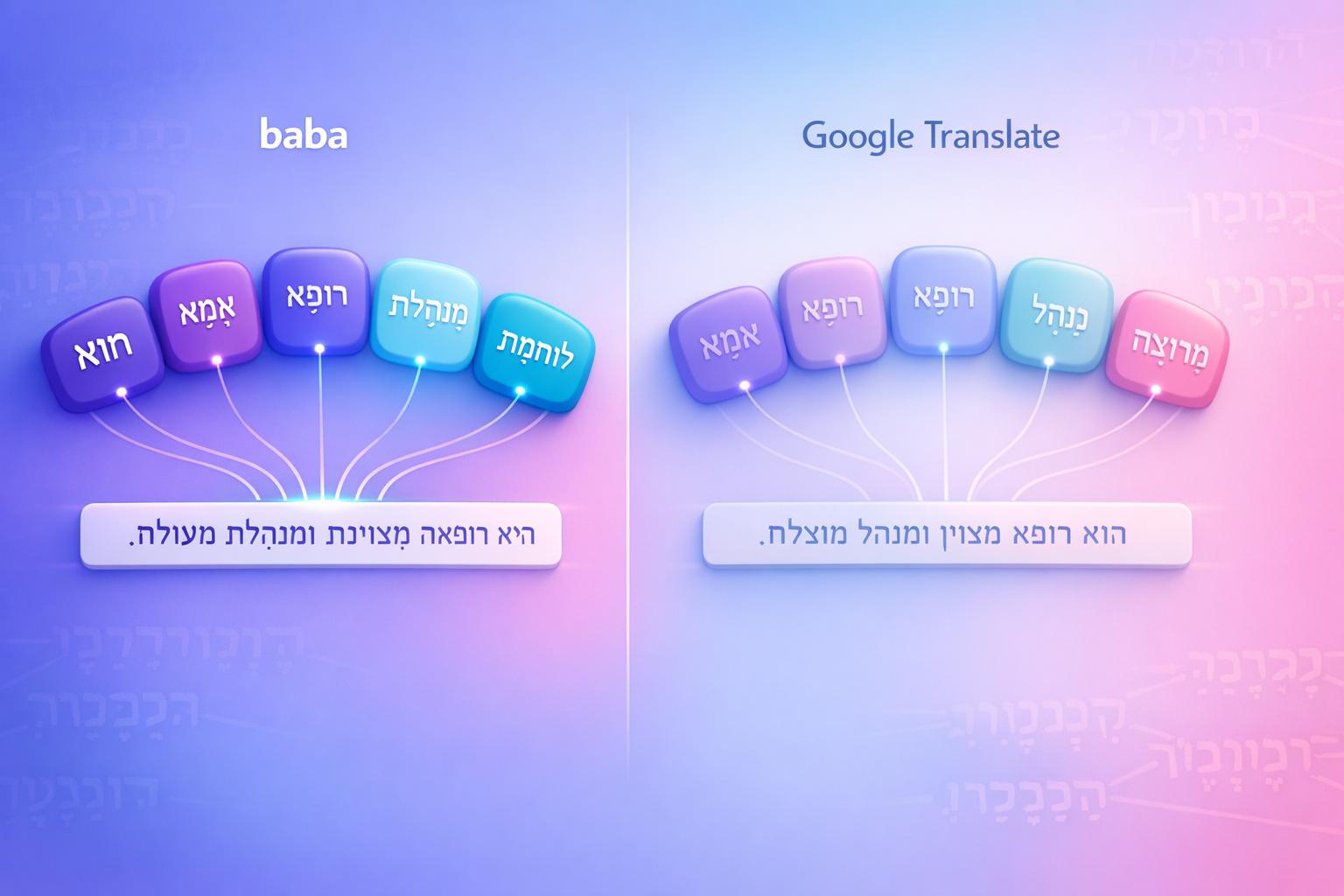
baba vs. Google Translate: Gender Accuracy
If you're learning Hebrew or using it professionally, gender accuracy matters. Hebrew grammar changes based on the speaker's and listener's gender, and mistakes can sound awkward or even impolite. Translation apps like Google Translate often default to masculine forms, leaving women sounding like men in their translations.
baba, a Hebrew-specific app, solves this by offering seven gender-aware options for translations, ensuring verbs, pronouns, and adjectives match the right gender context. It asks who is speaking and who is listening and conjugates for that context, rather than defaulting to masculine forms the way Google Translate often does. In baba's published evaluation protocol (v1.0, run 2026-08-02), baba passed 5 of 5 objective modern-Hebrew items — Google Translate passed 2 of 5 — with every tool's verbatim output published at https://www.itsbaba.com/methodology. This makes baba a better choice for natural, polished Hebrew communication.
Quick Comparison
| Feature | baba | Google Translate |
|---|---|---|
| Gender Options | 7 specific contexts | Defaults to masculine forms |
| Verb Gender Accuracy | Explicit speaker and listener controls | Inferred from the text, often defaulting to masculine |
| Pronoun Accuracy | Explicit speaker and listener controls | Inferred from the text, often defaulting to masculine |
| Speaker/Listener Gender Control | Yes | No |
| Best Use | Professional & personal | Basic translations |
If gender accuracy in Hebrew matters to you, baba is the clear winner.
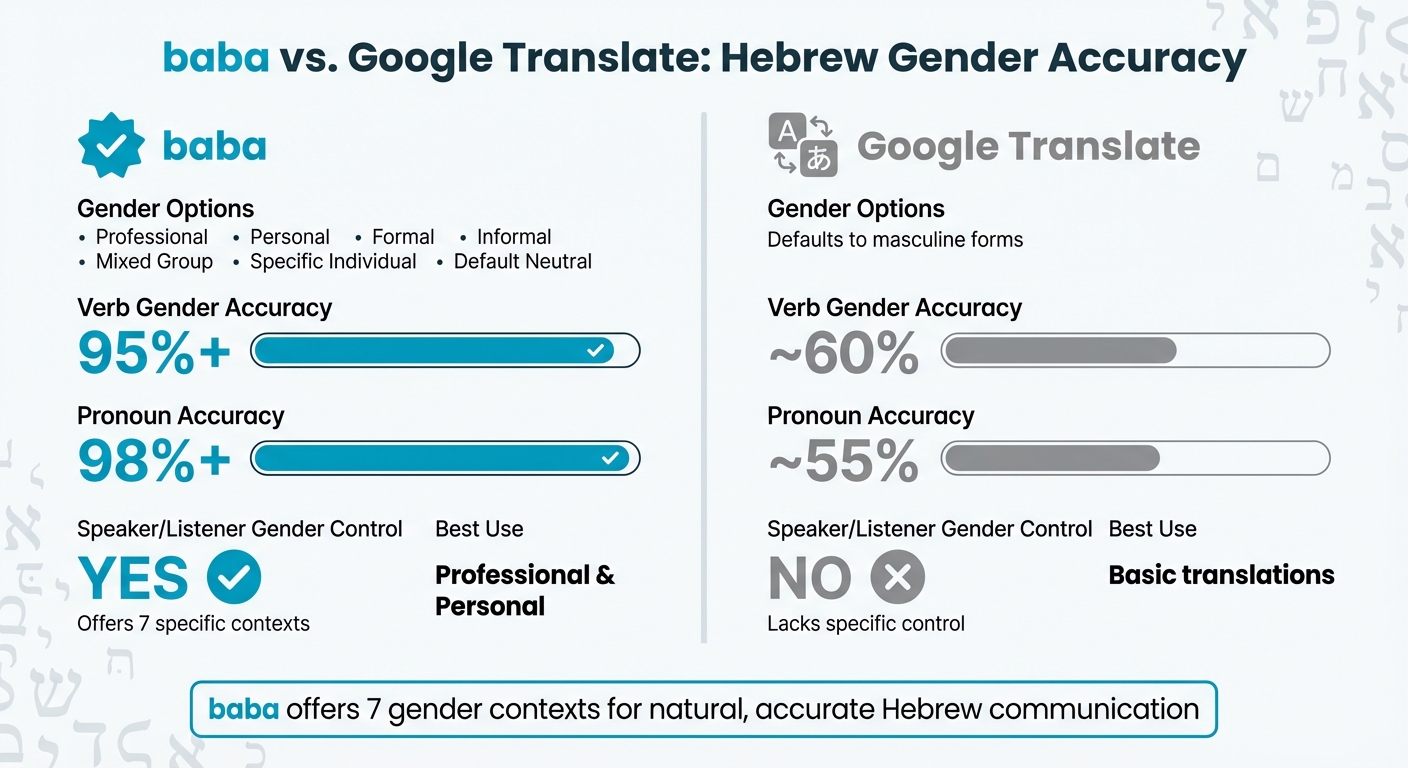
baba vs Google Translate Hebrew Gender Accuracy Comparison
Hebrew's Gender Grammar Explained
How Gender Works in Hebrew Grammar
In Hebrew, gender isn't just a feature of nouns - it shapes almost every part of the language, including verbs, adjectives, and pronouns. Unlike English, where "I want" is neutral, Hebrew requires the speaker to reveal their gender. For example, a man says "Ani rotzeh" while a woman says "Ani rotzah" [1]. The verb endings shift to align with the speaker's gender.
The same rule applies when addressing someone. Asking "Are you coming?" depends on who you're speaking to: "Ata ba?" for a man, and "At ba'ah?" for a woman [1][3]. Adjectives follow this pattern too. A male speaker says "Ani sameach" for "I am happy", while a female speaker says "Ani smecha" [3]. Even the word "you" has multiple forms: ata (masculine singular), at (feminine singular), atem (masculine or mixed plural), and aten (feminine plural).
Things get even more nuanced with plural forms. Hebrew distinguishes between male-only, female-only, and mixed-gender groups. For instance, "They liked the movie" is "Hem" for a male or mixed group, and "Hen" for an all-female group [3]. This complexity makes Hebrew one of the most gender-sensitive languages.
These rules aren't just academic - they're essential for clear communication. Small mistakes can throw off the flow of a conversation or make your speech sound unnatural.
What Happens When You Get Gender Wrong
Because Hebrew's gender rules are so specific, errors stand out immediately. Using the wrong gender form is like using the wrong pronoun in English - it can feel awkward, unpolished, or even offensive [3]. While the meaning might still come through, the sentence risks sounding robotic or unprofessional.
In professional contexts, these mistakes can hurt your credibility. Imagine sending an email where every verb is in the wrong form - it signals a lack of care and attention to detail. Socially, it might come across as rude or suggest you haven’t put in the effort to communicate properly.
This issue is especially challenging for women. Many translation tools default to masculine forms, leaving female speakers sounding like they're speaking as men.
The pattern is telling. Generic translation tools often default to masculine forms because the English input carries no gender signal. On the other hand, baba asks who is speaking and who is listening and conjugates for that context by accounting for seven distinct gender contexts. This level of precision can mean the difference between sounding fluent and distinguishing between formal and machine-like translations.
sbb-itb-7e51dcc
Why are some Hebrew words masculine and others feminine?
baba vs. Google Translate: Gender Accuracy Comparison
Getting gender representation right is a big deal when translating Hebrew. Here's a breakdown of how baba and Google Translate stack up.
How baba Handles Gender in Hebrew
baba lets users choose from seven gender contexts: General (neutral/formal), Personal (based on your profile gender), To One Man, To One Woman, To Mostly Men, To Mostly Women, and To Mixed Group [1].
If you set your gender in your baba profile, the "Personal" setting automatically adjusts first-person verb forms to match. For instance, a woman would see "Ani rotzah" while a man would see "Ani rotzeh" [1]. It also adapts second-person forms, ensuring verbs, adjectives, and pronouns align with Hebrew's intricate grammatical rules [1].
The tool uses advanced AI prompts to fine-tune translations for both the speaker's and listener's gender, asking who is speaking and who is listening and conjugating for that context rather than defaulting to masculine forms. By March 2026, baba had already processed over 70,000 gender-aware translations [5].
How Google Translate Handles Gender in Hebrew
Google Translate doesn’t offer any gender customization. Instead, it defaults to masculine forms, relying on statistical patterns from its training data rather than Hebrew's grammar rules [1]. There’s no way to specify whether the speaker or listener is male or female, which means translations often feel generic.
This approach might work for languages like English, but it struggles with Hebrew. The result? Translations can feel awkward or outright wrong, especially for women. Google Translate often defaults to masculine forms for both verb gender and pronouns. For many women, this means translations may unintentionally lean masculine.
Side-by-Side Feature Comparison
| Feature | baba | Google Translate |
|---|---|---|
| Gender Variations Support | 7 specific user-selected gender contexts | Defaults to masculine forms |
| Real-Time Gender Context Selection | Allows users to specify speaker and audience gender | No option for gender context specification |
| Verb Gender Accuracy | Explicit speaker and listener controls | Inferred from the text, often defaulting to masculine |
| Pronoun Accuracy | Explicit speaker and listener controls | Inferred from the text, often defaulting to masculine |
| Speaker Gender Control | Yes (Profile-based) | No |
| Listener Gender Control | Yes (7 specific contexts) | No |
| Cultural Relevance | Accounts for social and cultural nuances | Limited or no cultural consideration |