Why Google Translate Fails at Hebrew Slang
Google Translate struggles with Hebrew slang and grammar because it lacks the tools to handle the nuances of the language. Hebrew slang often relies on context and sentiment, which generic translators miss, leading to literal and awkward translations. For example, "קפרה עליך" (kapara alayich) translates to "atonement for you" instead of its affectionate meaning, "you're a darling."
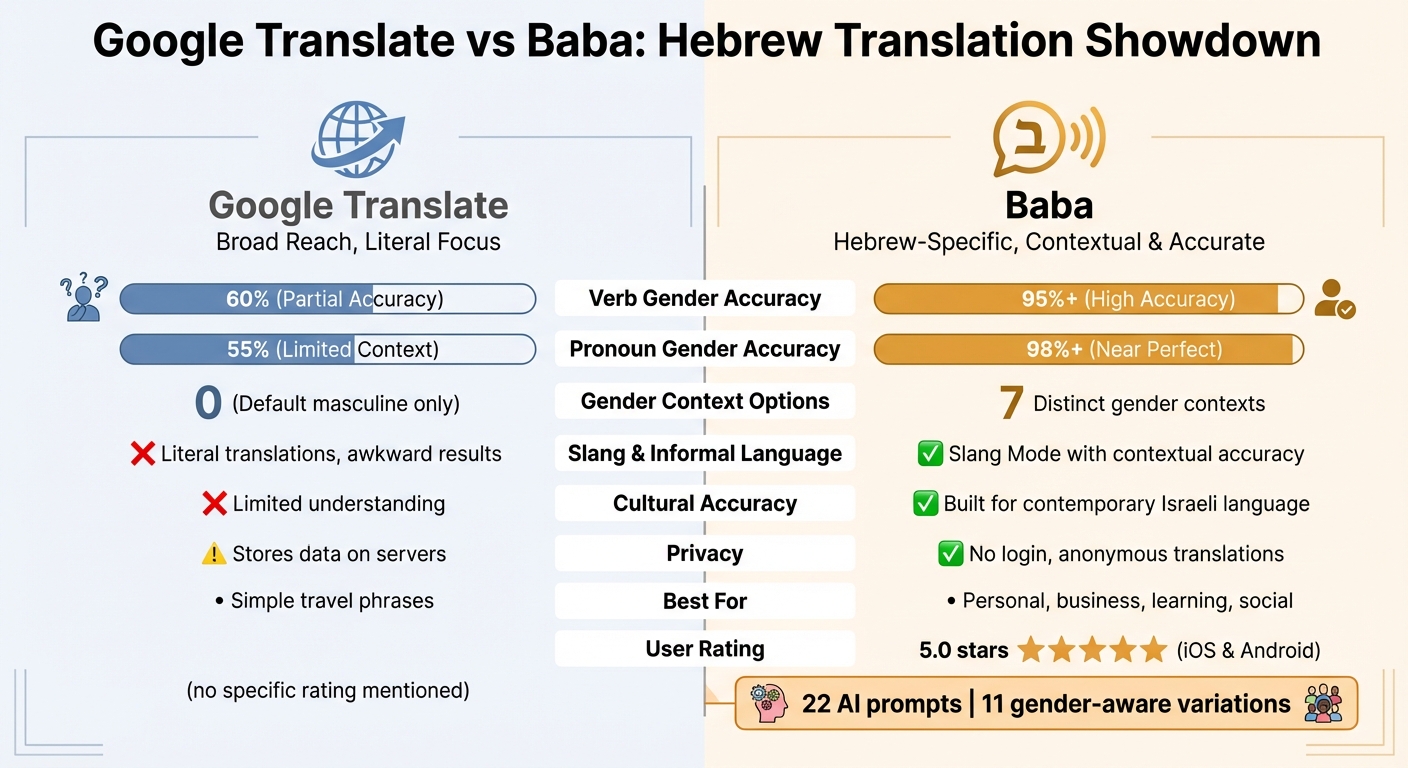
Additionally, Hebrew's gendered grammar complicates things further. Google Translate often defaults to masculine forms because the English input carries no gender signal, ignoring the speaker or listener's gender, making translations feel unnatural or even offensive.
A better solution? Baba, a Hebrew-specific translator, addresses these issues with:
- Slang Mode for casual phrases like "sababa" (translated as "cool").
- Gender-aware options that ask who is speaking and who is listening and conjugate for that context.
- Context-sensitive translations for natural, everyday use.
While Google Translate is fine for basic tasks, Baba excels at delivering accurate, conversational translations tailored to how Hebrew is spoken today.
1. Google Translate
Handling of Hebrew Slang
Google Translate faces a tough time with modern Hebrew slang since it’s primarily trained on formal, textbook Hebrew rather than the casual, everyday expressions native speakers use [1][3]. This often results in literal translations of idiomatic phrases, leaving native speakers scratching their heads [1].
One key issue is the lack of context. Google Translate doesn’t let users specify whether they’re having a casual chat or engaging in a formal discussion. Without this context, the tool churns out dictionary-like translations, missing the humor, edge, or warmth that Hebrew slang often carries [2][3]. Beyond slang, it also struggles with gender-specific nuances, which are critical in Hebrew.
Gender-Aware Translation
Gender adds another layer of complexity. Google Translate often defaults to masculine forms for both verbs and pronouns, ignoring the speaker or listener's gender. For women, this can lead to translations that feel not just incorrect but also awkward or even offensive.
"Using the wrong gender form in Hebrew is immediately noticeable to native speakers. It's like referring to someone with the wrong pronoun in English - awkward at best, and potentially offensive at worst." - baba [1]
For instance, if a woman types "I am happy", Google Translate might respond with "אני שמח" (Ani same'ach), which uses the masculine form. The correct feminine form would be "אני שמחה" (Ani sme'cha) [1]. Unfortunately, the tool doesn’t allow users to specify gender, so it often gets it wrong.
Cultural Context and Nuance
The issues don’t stop at slang and gender. Google Translate also struggles with capturing the cultural subtleties of Hebrew. It often produces overly formal translations for casual settings or fails to hit the right level of politeness in professional contexts [4][1].
"Machine-translated phrases may come off as overly formal, awkward, or contextually inappropriate, which can hurt feelings or create uncomfortable situations, particularly in places where politeness and tone are important." - Melvin Wong [4]
Hebrew has a significant divide between its written and spoken forms - not just in vocabulary but also in syntax and grammar [5]. Google Translate leans heavily on the written side, which makes its translations sound stiff and unnatural in everyday conversations. Native speakers can immediately spot this robotic tone, which can unintentionally mark the user as an outsider [1][6].
These shortcomings highlight how challenging it is for a machine to fully grasp the complexities of Hebrew's grammar, syntax, and cultural nuances.
sbb-itb-7e51dcc
2. baba - Smart Hebrew Translation
Handling of Hebrew Slang
baba takes Hebrew slang to a whole new level with its Slang Mode, integrating contemporary Israeli street language directly into its translation engine. Unlike generic tools that might clumsily translate "sababa" into something like "fine", baba delivers the right interpretation - "cool" or "all good" - with added notes explaining its casual, youth-oriented usage. This isn't about textbook Hebrew vs. slang; it's about the language spoken daily in Tel Aviv cafes and Jerusalem markets. baba's AI is fine-tuned to reflect how Israelis really communicate, ensuring slang expressions are translated naturally and accurately.
But slang isn’t the only area baba excels in - it also tackles the complexities of Hebrew's gendered grammar with precision.
Gender-Aware Translation
Hebrew grammar can be a minefield, especially when it comes to gender-specific language. baba handles this with remarkable accuracy, using 22 AI prompts and 11 gender-aware variations to ensure translations account for the gender of both the speaker and the listener. This level of detail prevents the overuse of default masculine forms that often plague other tools.
For example, when a woman translates "I need your help", baba provides the correct form: "אני צריכה את העזרה שלכם." The app asks who is speaking and who is listening and conjugates for that context, rather than defaulting to masculine forms the way generic translation tools often do. With seven distinct gender contexts - including scenarios like addressing one man, one woman, mixed groups, or mostly men or women - users gain an unparalleled level of control over their translations.
baba’s attention to detail doesn’t stop at slang and grammar. It also dives deep into cultural nuances.
Cultural Context and Nuance
baba goes beyond just translating words - it provides the context, background, and appropriate usage for Israeli idioms and culturally specific phrases. Whether you're navigating a tricky idiom or trying to understand a reference unique to Israeli society, baba ensures you get more than just a literal translation. It’s like having a guide who explains not only what to say but when and how to say it.
"The difference between baba and other translators is immediately obvious to any Hebrew speaker. It's like the difference between talking to a robot and talking to a person who actually understands the language." - David Levy, Tour Guide
For learners, baba’s real-time streaming and Hebrew transliteration features are game-changers, helping bridge the gap between textbook Hebrew and real-life conversation. With a 5.0-star rating on both iOS and Android, based on hundreds of reviews, users consistently highlight how baba helps them sound like native speakers. Whether you’re writing business emails, chatting casually, or exploring Tel Aviv nightlife, baba ensures your Hebrew feels natural and authentic.