Hebrew for Beginners
Everything you need to start reading, speaking, and understanding Hebrew, from the alphabet to your first conversations.
Translate, hear pronunciation, and learn Hebrew at your own pace
How Do I Start Learning Hebrew as a Beginner?
Start by learning a handful of everyday phrases with their transliteration (English-letter pronunciation), then pick up the Aleph-Bet a few letters at a time. You do not have to master the 22-letter alphabet before you speak. The fastest path for most beginners: learn 10 to 15 phrases this week, read each one in Hebrew script and transliteration side by side, and translate real sentences you actually need as you go.
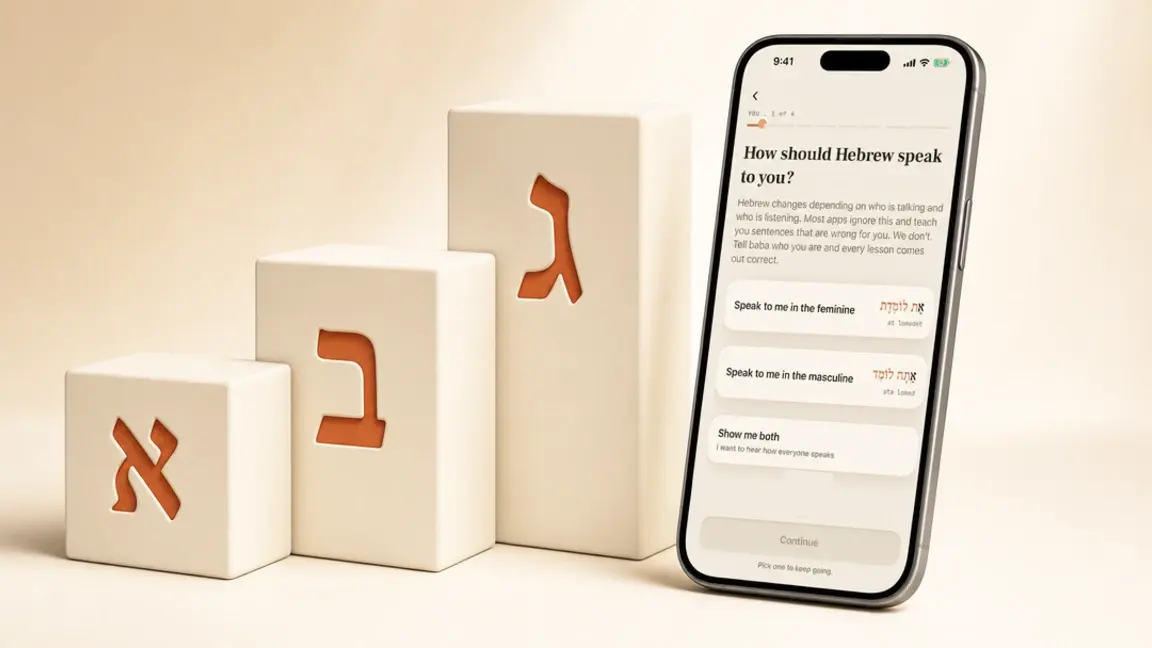
baba is an AI Hebrew app for iOS and Android, free to start, that translates text, plus voice, camera photos, and PDFs on Pro, across 10 languages. It is gender-aware, includes curated Israeli slang and idiom support, and shows the Hebrew script with transliteration on every result, so beginners can read and speak from day one. Get baba free.
Why Learn Hebrew?
Hebrew is spoken by over 9 million people, primarily in Israel, and by millions more in Jewish communities across New York, London, Los Angeles, and globally. It is also the language of the Torah, the Talmud, and thousands of years of Jewish culture.
Travel to Israel
Navigate markets, restaurants, and conversations with locals, not just tourist areas.
Jewish Heritage
Connect with prayers, holidays, and cultural texts in their original language.
Business & Tech
Israel is a global tech hub. Hebrew opens doors to one of the world's most innovative ecosystems.
The Hebrew Alphabet (Aleph-Bet)
Hebrew has 22 letters, all consonants, written right-to-left. Vowels are added as small marks under or over letters (called nikud), but most modern Hebrew, in newspapers, texts, and speech, drops the vowels entirely.
The Good News: You don't need to memorize the alphabet before using Hebrew. baba's transliteration shows you how to pronounce every word in English letters, so you can start speaking Hebrew today while learning the letters over time.
א
Aleph
Silent (glottal)
ב
Bet / Vet
B or V
ג
Gimel
G (as in "go")
ד
Dalet
D
ה
He
H
ו
Vav
V or long vowel (O/U)
ז
Zayin
Z
ח
Chet
CH (guttural, like Bach)
ט
Tet
T
י
Yod
Y (also vowel: I/EE)
כ / ך
Kaf / Chaf
K or CH (guttural)
ל
Lamed
L
Showing the first 12 of 22 letters
What Hebrew Phrases Should Beginners Learn First?
These 12 phrases will cover most basic situations: greetings, politeness, travel, and emergencies. Each one includes the Hebrew script, pronunciation (transliteration), and meaning.
שלום
Shalom
Hello / Goodbye / Peace
תודה
Toda
Thank you
בבקשה
Bevakasha
Please / You're welcome
כן / לא
Ken / Lo
Yes / No
מה שמך?
Ma shimcha?
What is your name? (to male)
נעים להכיר
Na'im lehakir
Nice to meet you
אני לא מבין
Ani lo mevin
I don't understand (male)
דבר לאט
Daber le'at
Speak slowly (to male)
איפה...?
Eifo...?
Where is...?
כמה זה עולה?
Kama ze ole?
How much does this cost?
עזרה!
Ezra!
Help!
תודה רבה
Toda raba
Thank you very much
Want more Hebrew phrases with audio pronunciations?
Browse the complete Hebrew Phrases library →Why Does Hebrew Change Form for Men and Women?
Because Hebrew is a grammatically gendered language: every noun is masculine or feminine, and verbs, adjectives, and pronouns change form to match the speaker and the listener. This is the most common source of mistakes for beginners, which is why "I love you" looks different depending on who is speaking.
Male speaker saying "I love you"
אני אוהב אותך
Ani ohev otcha
ohev = masculine form of "love"
Female speaker saying "I love you"
אני אוהבת אותך
Ani ohevet otcha
ohevet = feminine form of "love"
baba solves this automatically. Our HebrewCore™ Gender Intelligence™ applies the correct gender form based on your settings, so your Hebrew is grammatically correct from the start. Learn more about gender-aware Hebrew translation →
How Do You Pronounce Hebrew as a Beginner?
Most Hebrew sounds map closely to English and are learnable in a few hours of practice. Only a few (the guttural "ch" and "ayin") have no English equivalent, and beginners can soften or skip them at first. Here is what is easy and what is tricky.
ח / כ (ch)
A guttural sound made in the throat, like clearing your throat. Think of the German "Bach" or Scottish "loch." No English equivalent.
ע (ayin)
A glottal consonant, often silent for beginners, but native speakers produce it from the throat. Don't worry about this one at first.
צ (tsadi)
The "ts" sound in "pizza" or "cats." Common in Hebrew words.
ר (resh)
A rolled or guttural R, similar to French. Some Israelis pronounce it as a soft R; don't stress about it.
All other letters
Straightforward: B, D, G, H, K, L, M, N, P, S, T, V, Y, Z all sound close to their English equivalents.
Tip: Use baba's transliteration feature to see how every word is pronounced in English letters. baba's HebrewCore™ engine gives you accurate transliteration, not just a phonetic guess, because it understands the context and vowel sounds behind each word.
Free Tools to Practice Hebrew Right Now
Start using Hebrew today, with no class, no tutor, and no subscription required.
baba Translator App
Translate any English phrase to Hebrew instantly. See the Hebrew text, transliteration, and cultural context all at once.
Hebrew Phrases Library
Phrases organized by category: greetings, travel, food, emotions, slang, and more. Each with transliteration.
Hebrew Date Converter
Convert dates between the Hebrew and Gregorian calendar. A great way to practice Hebrew numbers and months.
Hebrew Name Generator
Find the Hebrew equivalent of your name or explore Hebrew names and their meanings.
Hebrew Beginner FAQ
How long does it take to learn basic Hebrew?
Most beginners can hold basic conversations in Hebrew within 3-6 months of consistent study. Reading Hebrew fluently takes longer (1-2 years), but with transliteration tools like baba you can communicate before you fully master the alphabet.
Is Hebrew hard to learn for English speakers?
Hebrew has a different alphabet, reads right-to-left, and has grammatical gender. However, modern Israeli Hebrew has relatively simple grammar compared to other Semitic languages. The biggest hurdle for most people is the alphabet, which baba's transliteration feature helps bridge.
What is the Hebrew alphabet called?
The Hebrew alphabet is called the Aleph-Bet (אָלֶף-בֵּית), named after its first two letters: Aleph (א) and Bet (ב). It has 22 letters, all consonants. Vowels are typically indicated by small marks (nikud) or inferred from context.
What is the best free app for learning Hebrew?
baba is the best free Hebrew translator app for beginners: it gives you the translation, the Hebrew script, and the pronunciation (transliteration) all at once. This combination makes it the fastest way to start reading and speaking Hebrew from day one.
Does baba help you learn Hebrew?
baba is primarily a translator, but many users use it as a learning tool. You get the Hebrew text, the transliteration (pronunciation guide), and the translation simultaneously, which trains pattern recognition faster than flashcards alone. It's especially useful for picking up phrases contextually.
Keep Learning Hebrew
- Download the baba appFree Hebrew translator for iOS and Android, no login required.
- Learn Hebrew with an appHow baba helps you go from your first word to real conversations.
- Best apps to learn Hebrew (2026)A side-by-side comparison of the top Hebrew learning apps this year.
- Best Hebrew translators guideWhich Hebrew translator gets gender, slang, and context right.
Related Guides
- Hebrew for Traveling to IsraelPhrases for taxis, markets and restaurants, plus how to read signs and menus.
- Israeli SlangYalla, sababa, achi and the idioms Israelis actually use, with what they mean.
- Hebrew GrammarGender, the seven verb patterns, conjugation and nikud, explained without jargon.
- Hebrew CultureThe holidays, customs and phrases that explain why Israelis say what they say.
Try what you read here in the baba Hebrew translator, which sets the gender for who is speaking and who is listening, or compare the Free and Pro plans.
Get the free Hebrew translator to practice what you learn
Download baba on iOS and Android
Ready to Start Speaking Hebrew?
Download baba and practice everything you just learned, instantly.
No login required · Translate, transliterate, and learn