Legal Compliance in Hebrew AI Translations
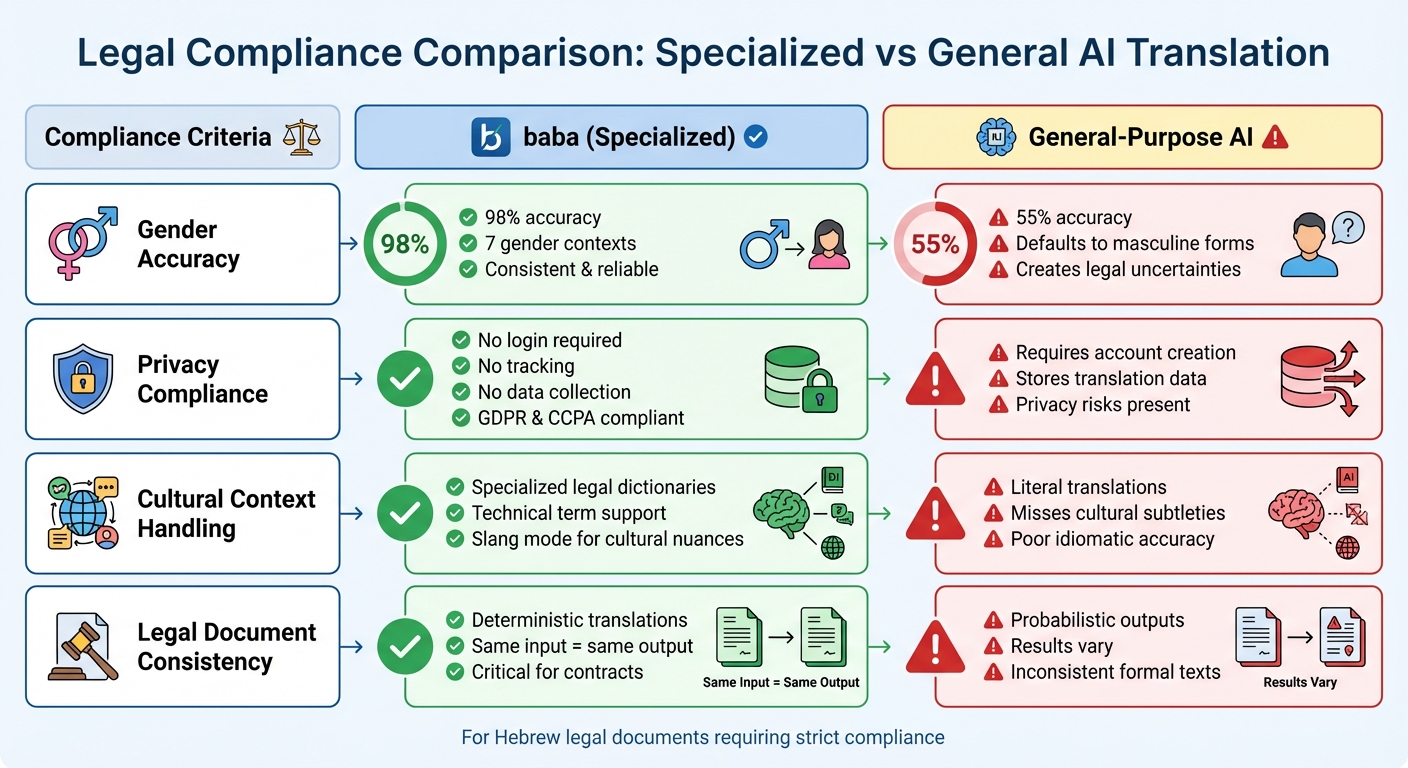
Translating Hebrew for legal and professional use demands precision. Why? Errors in gender grammar, privacy breaches, or cultural missteps can lead to legal risks, fines, or damaged trust. General AI translators often fail in these areas, but tools like baba are designed specifically to meet these challenges.
Key Takeaways:
- Gender Accuracy: Hebrew grammar requires verbs and pronouns to match gender. baba asks who is speaking and who is listening across seven gender contexts, avoiding common errors in legal documents.
- Privacy Protection: baba ensures compliance with GDPR, CCPA, and Israeli privacy laws by offering anonymous use with no data tracking.
- Cultural Relevance: baba uses specialized legal dictionaries and modern Hebrew slang to ensure translations are accurate and professional.
- Legal Document Consistency: baba’s deterministic system ensures identical translations for repeated inputs, critical for contracts and compliance.
For translating Hebrew legal documents, baba outperforms general-purpose AI translators in accuracy, privacy, and reliability.
1. baba - Smart Hebrew Translation
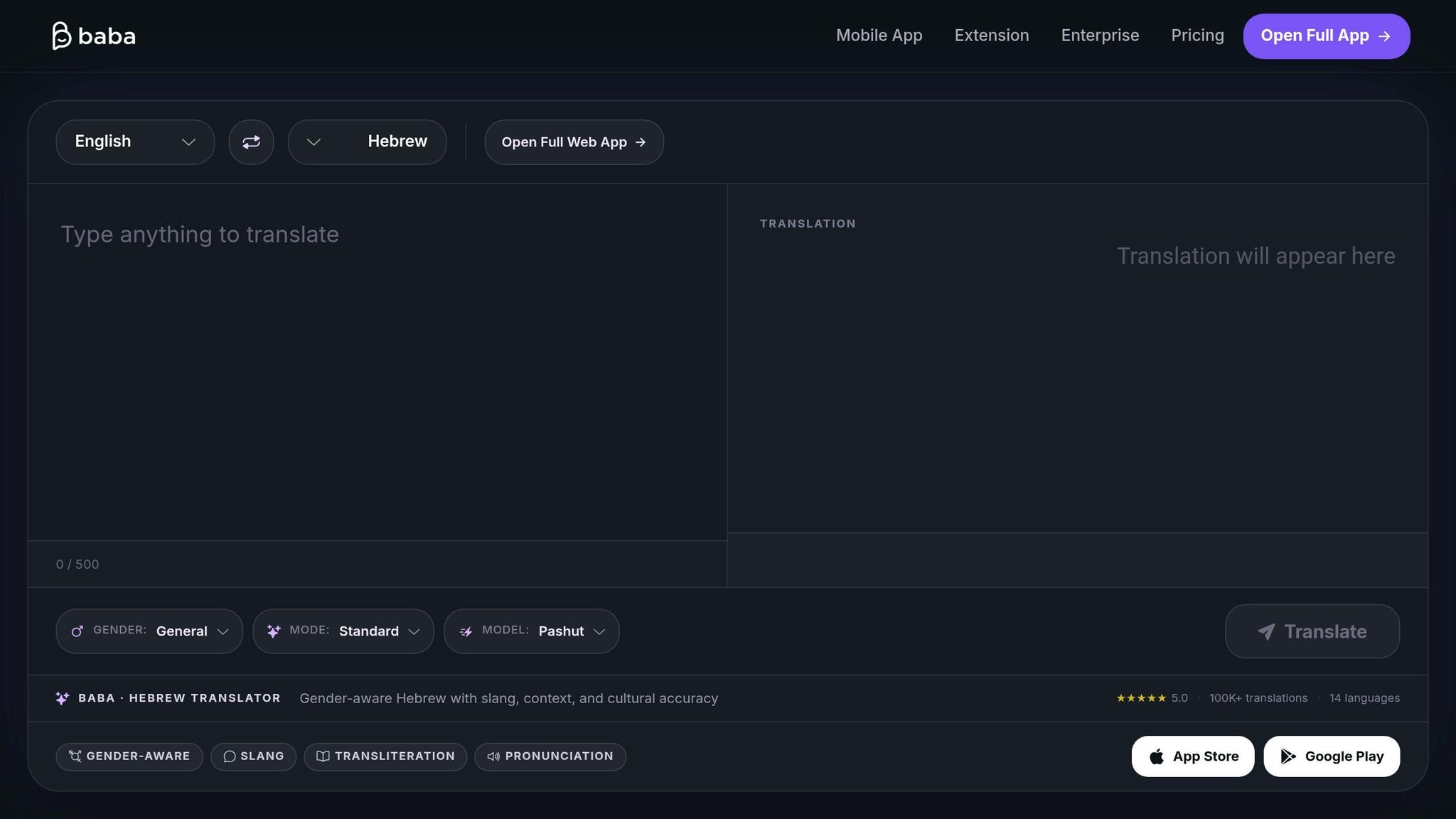
baba tackles the unique challenges of translating Hebrew for legal and professional settings with precision and reliability.
baba is an AI-powered translation app available on iOS and Android. It’s specifically designed to address the complexities of Hebrew, particularly in legal contexts. With features like gender accuracy, strict privacy measures, attention to cultural nuances, and consistency in legal documents, baba stands out as a solution tailored for Hebrew translation needs.
Gender Accuracy
Hebrew’s grammar is heavily gendered, which can lead to serious errors in legal documents if verbs, adjectives, or pronouns don’t align with the intended gender. baba resolves this by offering seven distinct gender contexts: General, Personal, To One Man, To One Woman, To Mostly Men, To Mostly Women, and To Mixed Group. This ensures translations are precise and contextually appropriate.
The app’s architecture is built to ask who is speaking and who is listening and conjugate pronouns and verbs for that context, rather than defaulting to masculine forms the way general-purpose tools often do. In baba's published evaluation protocol (v1.0, run 2026-08-02), baba passed 5 of 5 objective modern-Hebrew items — Google Translate passed 2 of 5 — with every tool's verbatim output published at https://www.itsbaba.com/methodology. For legal documents that demand neutrality, the "General" context provides formal, gender-neutral translations.
Privacy Compliance
Handling sensitive legal information requires rigorous privacy protections, and baba meets the mark. Its privacy framework complies with GDPR, CCPA/CPRA, and the Israeli Privacy Protection Law (Amendment 13, effective August 2026) [5]. Users can translate anonymously without creating an account.
Key privacy features include TLS/SSL encryption for data in transit, encrypted storage for sensitive data, and bcrypt password hashing for optional accounts. Translation data is processed securely under strict contractual agreements, with a retention period limited to 90 days after account deletion. Financial records are retained for seven years, as required by law [5]. Additionally, users can access, correct, or delete their data, with EEA/UK users benefiting from "Right to be Forgotten" protections.
Cultural Context Handling
Legal and business translations require more than just word-for-word accuracy - they demand cultural and contextual relevance. baba’s AI uses specialized legal dictionaries to detect subject matter and apply the correct terminology [1]. It can differentiate between formal and informal requests, ensuring the tone matches the professional setting.
Native Hebrew speakers have rated baba’s translations highly for sounding natural and appropriately formal. The app also includes a curated database of Hebrew slang and idiomatic expressions, ensuring translations convey meaning naturally and effectively.
Legal Document Accuracy
Consistency is critical in legal translations, where even minor changes can lead to significant consequences. baba’s deterministic system ensures that translating the same clause multiple times yields identical results, maintaining the integrity of legal standards.
With over 100,000 translations processed [1], baba’s legal dictionaries cover fields like medicine, law, and technical terminology. Its gender-aware design prevents masculine defaults that could introduce unintended bias or ambiguity in documents like employment contracts, healthcare records, or government forms. By avoiding these pitfalls, baba helps organizations steer clear of costly legal or financial errors caused by inaccurate translations.
sbb-itb-7e51dcc
2. General-Purpose AI Translators
While generic AI translators support Hebrew, they often stumble when faced with specific challenges in legal translation, such as gender accuracy, privacy concerns, cultural nuances, and maintaining consistency in documents.
Gender Accuracy
Hebrew's grammatical structure, which heavily relies on gender distinctions, often confounds general-purpose translation tools. These systems often default to masculine forms because the English input carries no gender signal. This can lead to errors, such as using masculine verb forms in sentences meant to be feminine, which creates ambiguity in legal contexts [7]. Moreover, these tools frequently require manual corrections and may even switch genders within the same paragraph [4]. Hebrew legal professionals have reported encountering gender-related errors in AI-translated contracts, with gender inaccuracies among the most commonly cited issues.
Privacy Compliance
Generic AI translators often compromise privacy, especially when handling sensitive legal documents. Many platforms require users to create accounts and store translation data, which can pose significant risks. For example, some systems retain translation histories or prompts for extended periods, which can violate strict legal retention standards. This is particularly problematic for organizations dealing with confidential materials like contracts, medical records, or government forms. Such practices may conflict with regulations like GDPR, which emphasizes data minimization, or CCPA, which grants users the right to opt out of data retention. Unlike platforms designed with privacy in mind, generic systems leave data trails that could jeopardize sensitive information.
Cultural Context Handling
Generic translators also struggle to accurately interpret Hebrew slang and idiomatic expressions. For instance, phrases like "sababa" or "yalla" are often mistranslated, leading to a loss of meaning [6][7]. These systems often struggle with naturalness in such cases. In legal documents, this lack of precision can obscure critical details or lead to misunderstandings.
Legal Document Accuracy
Consistency is essential in legal translations, yet generic AI translators often produce inconsistent results due to their probabilistic nature [4]. Error rates in translating gendered verbs and formal legal terms remain a common problem. The absence of specialized legal dictionaries and validation processes further compounds these issues. In a notable 2023 case, pronoun mismatches in an AI-translated contract led to disputes in US–Israeli business agreements [8][9]. Such inconsistencies can create compliance risks, particularly in regulated industries [8][10]. These challenges highlight the limitations of general-purpose tools and the importance of tailored solutions for legal translation.