How AI Translation Tools Handle Your Data
AI translation tools process your text on remote servers, which can expose sensitive information like legal documents or medical records to privacy risks. Many tools use your data to train AI models, making it nearly impossible to remove once incorporated. Encryption protects data during transmission, but storage and usage policies vary widely. Some tools retain data for months or years, while others process it temporarily. Free services often share data with third parties or use it for model improvement, which could lead to breaches or compliance issues with regulations like GDPR or HIPAA.
For safer options, look for tools that:
- Encrypt data in transit and at rest.
- Offer "no-training" guarantees.
- Allow control over data storage locations.
- Comply with privacy laws like GDPR and CCPA.
- Provide clear retention and deletion policies.
For example, baba – Smart Hebrew Translation prioritizes privacy by not requiring logins, avoiding tracking, and adhering to strict data protection laws. Always review privacy policies and choose tools that align with your data security needs to avoid exposing sensitive information.
How AI Translation Tools Process Your Data
Data Transmission and Cloud Processing
When you click "translate", your text is sent to cloud-based servers over the internet. These servers, powered by providers like OpenAI, Anthropic, or Google, handle the translation. Your text moves through these networks, where machine translation models process it and send back the results.
To keep your data safe during transit, secure tools use encryption protocols like HTTPS and TLS/SSL. However, encryption only protects data while it’s being transmitted - it doesn’t control how it’s processed or stored once it reaches the server. What happens to your data after translation depends on the provider.
Storage and Retention Policies
Different providers handle translated data in different ways. Many enterprise-grade APIs use in-memory processing, meaning your text is temporarily held for translation and then discarded. For instance, Microsoft states that its Translator processes text in memory without retaining it [4].
On the other hand, consumer-facing tools like baba have different practices. According to baba's policy, account information and translation history are kept for 90 days after account deletion for backup and legal compliance. Usage data is typically stored for 12–24 months, while financial records are retained for up to seven years to meet legal obligations [1].
| Data Type | Typical Retention Period | Purpose |
|---|---|---|
| Account Information | Active + 90 days | Service maintenance & backup |
| Translation History | Active + 90 days | User access & quality assurance |
| Usage/Log Data | 12–24 months | Analytics & security monitoring |
| Financial Records | 7 years | Legal & tax compliance |
These policies impact both the privacy and reliability of your data.
Use of User Data for AI Training
Another factor to consider is how providers use your data for AI training. Many consumer-grade tools repurpose submitted text to improve their models. For example, baba's privacy policy states:
We use your translation data and other usage data to train, refine, and improve our AI models, including large language models (LLMs) and other translation algorithms.
Once your data is used to train these models, it becomes part of the system and cannot be removed - even if you delete your account [1].
Enterprise tools often offer "no-training" guarantees to ensure your content remains private. For instance, OpenAI doesn’t use API-submitted data for training by default. However, it may retain data for up to 30 days to monitor for abuse before securely deleting it [5]. As Robert Janoska, Sales and Project Manager at SNAP Innovation, explains:
If you're not paying to use an AI service, then the fee is essentially the data you share with it [6].
sbb-itb-7e51dcc
Privacy Risks of AI Translation Tools
Data Leaks and Unauthorized Access
When translation tools store queries and logs over time, they create a potential goldmine of sensitive information. If breached, this data could be exposed, compromising the privacy of users.
A bigger concern is the permanent inclusion of data in AI training models. Once your text becomes part of the training dataset, removing it is nearly impossible. As Baba Magic LLC explains:
"Once your data has been incorporated into our AI training datasets or models, it may not be possible to extract, isolate, or delete that specific data from the trained models, even if you delete your account." [1]
Weak internal controls further heighten this risk. Without measures like role-based access or single sign-on systems, employees might misuse these tools, translating or exporting sensitive documents without leaving any trace [2]. Some providers retain user content for manual safety reviews, which adds another layer of vulnerability.
The situation worsens when data is shared with third parties.
Third-Party Data Sharing
Most translation tools don’t process text locally. Instead, they rely on external AI providers like OpenAI, Anthropic, or Google. This means your data passes through multiple companies, each with its own security protocols and privacy policies [1]. Even if providers claim to "anonymize" data, there’s still a chance of re-identification when combined with other datasets [3]. On top of that, translations often cross international borders, exposing them to foreign data laws and potential government access [3].
Metadata sharing is another concern. Translation tools frequently share information with cloud hosting services, analytics providers, and payment processors, increasing the risk of exposure [1]. Free tools are particularly risky - they often have vague terms about third-party access and may default to settings that allow your data to be stored and reused for "product improvement" [2] [3].
These privacy risks are especially alarming for industries bound by strict regulations.
Risks for Sensitive Industries
For sectors like healthcare, legal, and finance, unsecured translation tools can lead to severe consequences. These industries must comply with stringent regulations, such as HIPAA, GDPR, and FERPA, but many public translation tools fall short of meeting these standards [3].
| Industry | Primary Risk | Relevant Regulation |
|---|---|---|
| Healthcare | Exposure of Protected Health Information (PHI) | HIPAA [3] |
| Legal | Disclosure of litigation strategies or client privilege | Professional Conduct Rules [3] |
| Finance/Corporate | Leak of trade secrets or proprietary data | GDPR, CCPA [3] |
| Education | Exposure of student records or assessments | FERPA [3] |
Mirela Lungu from PoliLingua highlights the stakes for healthcare:
"Using tools that don't qualify as HIPAA-compliant translation services can expose sensitive PHI and result in legal action, regulatory penalties, and a loss of patient trust." [3]
Corporations face additional risks, such as losing intellectual property. Translating internal communications or technical documents with public tools could unintentionally expose trade secrets if the provider logs or reuses the input [3]. Financial records tied to translation services are often retained for up to seven years, creating a long-term trail that could also pose risks [1].
What Are The Privacy Risks Of AI's Unclear Data Use? - AI and Machine Learning Explained
How to Choose a Secure AI Translation Tool
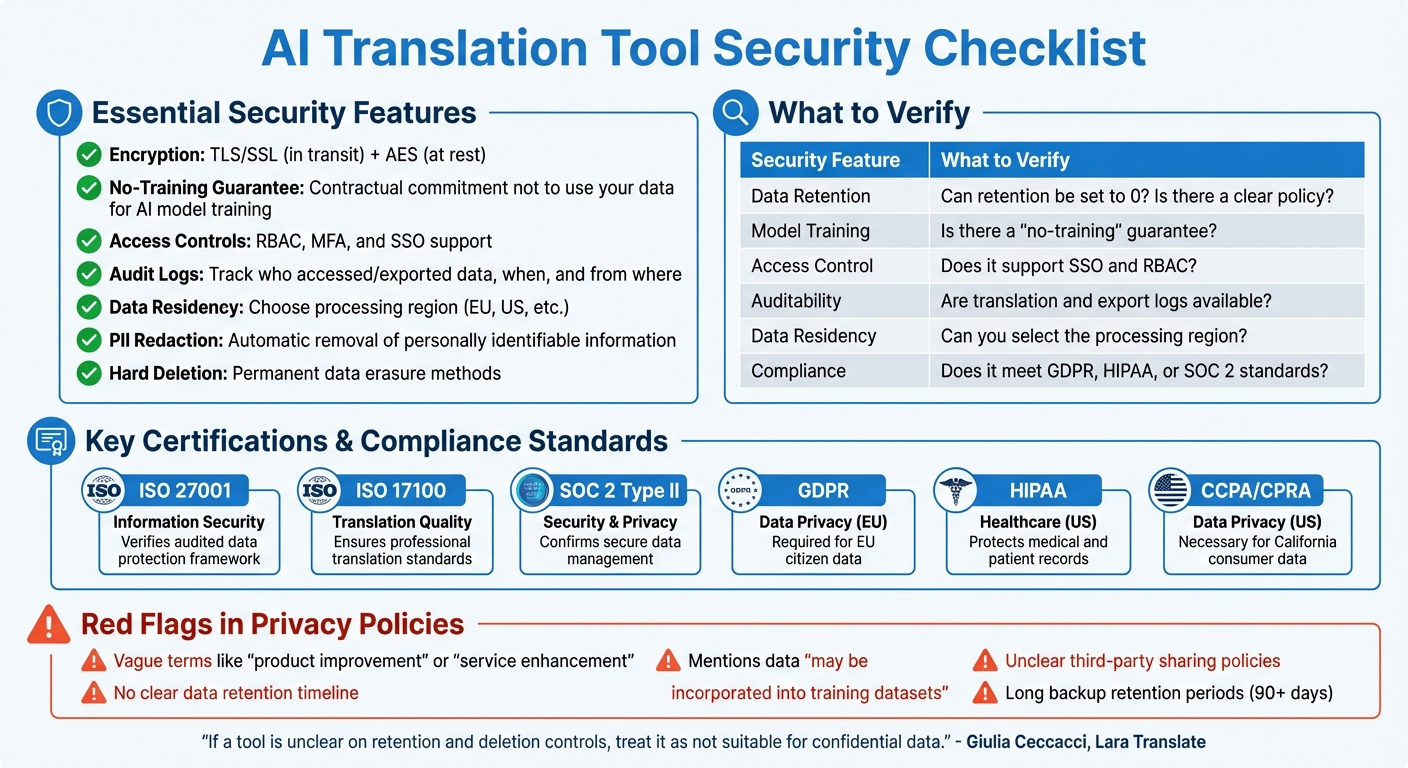
AI Translation Tool Security Checklist: Key Features and Compliance Standards
Picking the right AI translation tool is crucial to keeping your sensitive data safe.
Security Features to Look For
Start by ensuring the tool encrypts your data during both transmission and storage. Look for encryption protocols such as TLS/SSL for data in transit and AES for data at rest [1][2].
Check if the vendor provides a contractual "no-training" guarantee. This ensures your data won't be used to train AI models, as data used for training cannot be erased later [2][3].
Access controls are another must-have. Features like Role-Based Access Control (RBAC), Multi-Factor Authentication (MFA), and Single Sign-On (SSO) help limit who in your organization can access sensitive translations. Audit logs are equally important - they track who accessed or exported data, when, and from where [1][2].
If you're in a regulated industry, data residency options are critical. The tool should let you decide where your data is processed and stored, whether that's in the EU, US, or another region. Some tools even offer automatic redaction of personally identifiable information (PII) before processing [2][3].
Finally, confirm the vendor uses "hard deletion" methods to permanently erase your data [4].
As Giulia Ceccacci from Lara Translate explains:
"AI translation can be secure for confidential document translation security needs if your vendor offers encryption in transit, clear retention and deletion controls, 'no training on your content' options, strong access controls, and audit logs." [2]
| Security Feature | What to Verify |
|---|---|
| Data Retention | Can retention be set to 0? Is there a clear policy? |
| Model Training | Is there a "no-training" guarantee? |
| Access Control | Does it support SSO and RBAC? |
| Auditability | Are translation and export logs available? |
| Data Residency | Can you select the processing region? |
| Compliance | Does it meet GDPR, HIPAA, or SOC 2 standards? |
Once you've reviewed the technical features, take time to read the vendor's privacy policy.
Reading Privacy Policies
A privacy policy reveals how a vendor handles your data. Look for terms like "product improvement" or "service enhancement", as these often indicate the vendor may store or analyze your content for their own purposes [3]. Free tools are especially prone to vague terms and may default to settings that allow data reuse [2][3].
Understand how long data is retained after deletion. Some vendors keep backups for up to 90 days or more before fully erasing your data [1].
Pay close attention to clauses about AI training. If the policy mentions that your data "may be incorporated into training datasets", assume that removing it later will be nearly impossible [1].
Giulia Ceccacci advises:
"If a tool is unclear on any of these [retention and deletion controls], treat it as not suitable for confidential data." [2]
After confirming the privacy policy is clear, check for certifications that demonstrate the vendor's commitment to security.
Certifications and Compliance Standards
Certifications provide independent verification that a tool meets strict security standards. ISO 27001 is a key certification for information security management, ensuring the vendor has audited processes to protect your data [7][8]. For translation-specific needs, look for ISO 17100 (translation services) and ISO 18587 (post-editing of machine translations) [7][8].
Another important certification is SOC 2 Type II, which confirms that a provider securely manages data to protect client privacy [2]. Make sure the vendor can provide independent security reports [2].
For region-specific compliance, GDPR is mandatory for handling EU citizen data, while HIPAA applies to healthcare data in the US [7][3]. California residents should look for CCPA/CPRA compliance [3][1], and educational institutions should ensure compliance with FERPA for student records [3].
| Certification | Focus Area | Why It Matters |
|---|---|---|
| ISO 27001 | Information Security | Verifies an audited data protection framework |
| ISO 17100 | Translation Quality | Ensures professional translation standards |
| SOC 2 Type II | Security & Privacy | Confirms secure data management |
| GDPR | Data Privacy (EU) | Required for EU citizen data |
| HIPAA | Healthcare (US) | Protects medical and patient records |
| CCPA/CPRA | Data Privacy (US) | Necessary for California consumer data |
According to tolingo:
"Key standards include ISO 27001 (information security) and ISO 17100 (translation services). They guarantee audited processes." [8]
For Hebrew translation, baba – Smart Hebrew Translation is a standout choice. It takes a privacy-first approach with no login required, no tracking, and no data collection. The app is compliant with both GDPR and CCPA and is available on iOS and Android [1].
