Hebrew for Beginners: Read Menus, Street Signs, and WhatsApp Messages Instantly
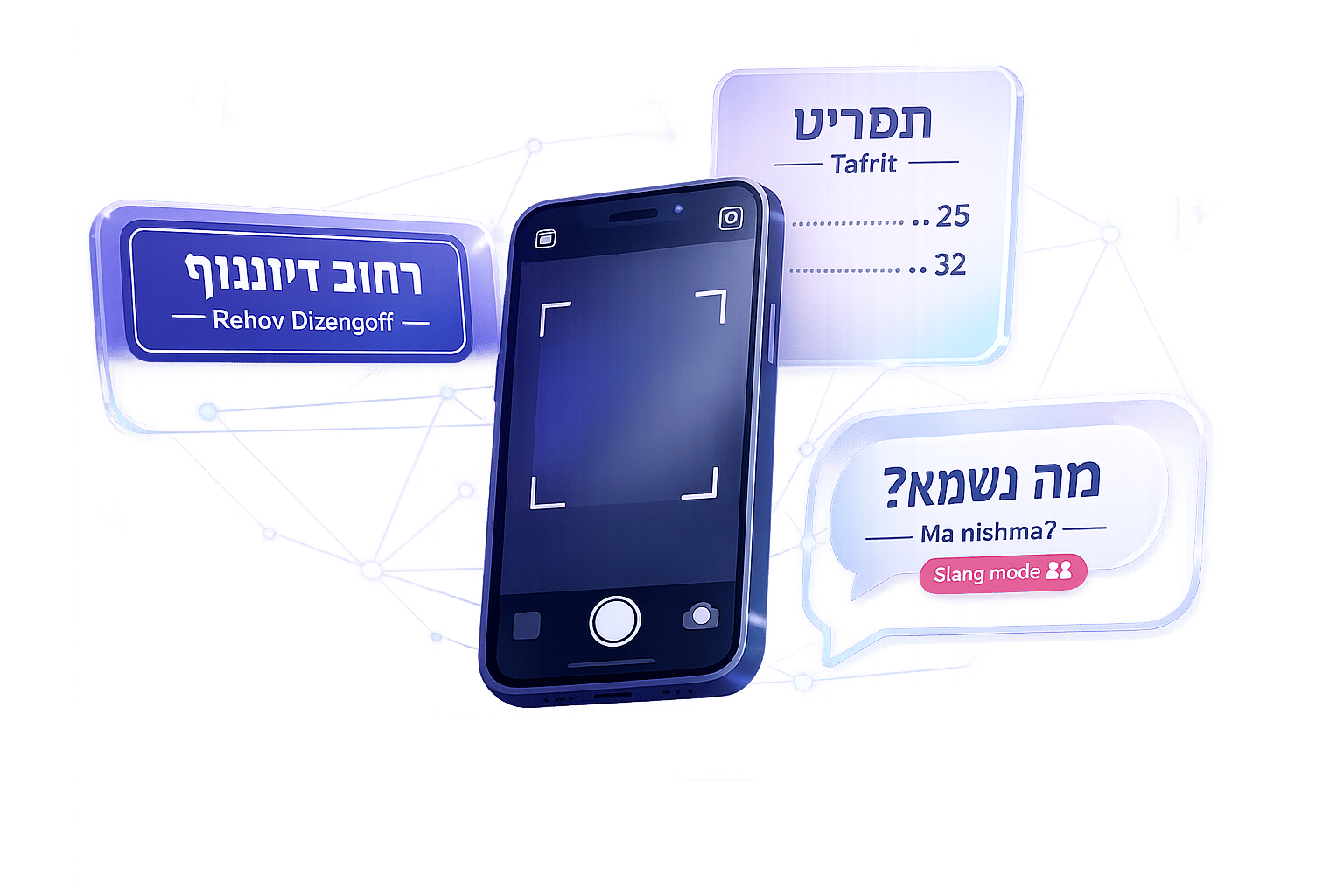
Want to read Hebrew menus, street signs, or WhatsApp messages without years of study? You don’t need to master the language to navigate everyday Hebrew. With tools like baba, you can instantly translate Hebrew text and understand its unique grammar, slang, and cultural nuances. Here's how baba helps:
- Menus: Translate food terms, understand creative dish names, and pronounce orders confidently.
- Street Signs: Decode common words like "entrance" (knisa) or "stop" (atzor) with ease.
- WhatsApp Messages: Handle abbreviations, slang, and mixed-language texts with baba’s Slang Mode.
- Gender-Specific Grammar: Adjust translations for accurate gender forms (e.g., rotzeh vs. rotzah).
Baba’s features include camera scanning, transliteration, text-to-speech, and context-aware translations. Available on iOS and Android, baba simplifies Hebrew for travelers, learners, or anyone curious about the language. Download it today and start reading Hebrew instantly.
Lesson 6: Hebrew WORDS Reading Practice | Crash Course in Hebrew Reading & Pronunciation
sbb-itb-7e51dcc
Hebrew Text Basics for Beginners
Hebrew Alphabet Guide: 22 Letters with Pronunciation and Final Forms
Before you can make sense of a menu or street sign, it’s important to understand how Hebrew works. The good news? Hebrew is a structured and consistent language with only a few exceptions [7]. Once you grasp its core principles, you’ll start spotting patterns everywhere.
Hebrew Letters and Pronunciation
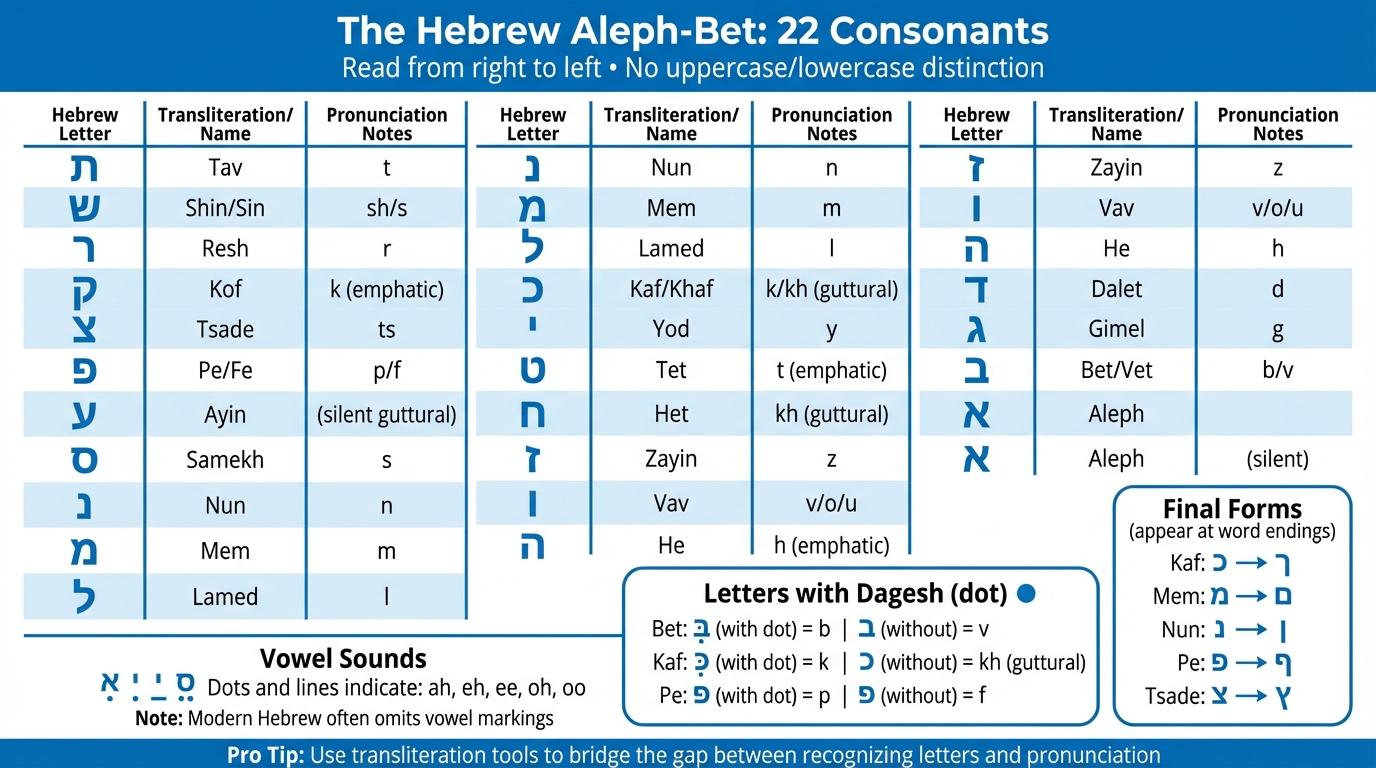
The Hebrew alphabet, known as the Aleph-Bet, consists of 22 consonants [9][10]. Unlike English, Hebrew doesn’t differentiate between upper and lower case letters, and it’s read from right to left [8][9]. It might feel unusual at first, but you’ll adjust with practice.
Some letters take on a different form when they appear at the end of a word. These "final forms" include Kaf (ך), Mem (ם), Nun (ן), Pe (ף), and Tsade (ץ) [9][10]. Recognizing these variations is crucial for reading unspaced text, such as menus or signs.
A small dot called the dagesh can change the pronunciation of certain letters. For example:
- Bet (בּ/ב): "b" with the dot, "v" without.
- Kaf (כּ/כ): "k" with the dot, "kh" (a guttural sound, like in "Bach") without.
- Pe (פּ/פ): "p" with the dot, "f" without [8][10].
Vowel sounds are represented by dots and lines beneath or around the letters, indicating sounds like "ah", "eh", "ee", "oh", and "oo" [9][10].
This is where baba’s transliteration feature becomes a lifesaver [1]. Instead of struggling with שָׁלוֹם, you’ll see "Sha-lom" written out in Latin letters. It’s a great way to bridge the gap between recognizing Hebrew letters and confidently pronouncing words - perfect for ordering food or navigating directions.
Common Word Patterns in Hebrew
Once you’re familiar with the letters and their sounds, the next step is understanding how Hebrew words are formed. Hebrew words are built around three-letter roots (shoresh), which carry the core meaning [8][2]. For instance, the root אכל (a-k-l) means "eat" and appears in related words like מסעדה (restaurant), אוכל (food), and לאכול (to eat). Spotting these roots can help you infer meanings, even if you don’t know the exact word.
Gender and plurality also play a big role. Hebrew modifies verbs and adjectives based on gender and number [3][4]. Here’s a quick guide:
- Masculine plural typically ends in "-im" (ים-).
- Feminine plural ends in "-ot" (ות-).
- Feminine singular words often end in "-ah" (ה-) or "-et" (ת-) [4].
This is where baba’s Gender Intelligence stands out. By setting your profile, verbs like "want" automatically adjust from rotzeh (masculine) to rotzah (feminine) [1][3]. While standard translators often default to masculine forms because the English input carries no gender signal, baba asks who is speaking and who is listening and conjugates for that context, accounting for these subtle but essential patterns in everyday conversations.
Reading Hebrew Restaurant Menus
Walking into an Israeli restaurant and facing a Hebrew menu can feel intimidating. But with a few key food words and the right tools, ordering becomes much easier.
Basic Food Words in Hebrew
Learning a handful of key Hebrew menu terms can make a big difference. These words pop up everywhere, from street food vendors to upscale restaurants in Tel Aviv:
| Hebrew | Transliteration | English |
|---|---|---|
| תפריט | tafrit | Menu |
| סלט | salat | Salad |
| מרק | marak | Soup |
| מים | mayim | Water |
| בשר | basar | Meat |
| חומוס | khumus | Hummus |
| חריף | kharif | Spicy |
| קינוח | kinu'akh | Dessert |
| חשבון | kheshbon | Bill/Check |
| כשר | kasher | Kosher |
Many of these words are easy to spot once you know them. For example, salat (salad) and khumus (hummus) look and sound similar to their English equivalents, making them easier to remember. Recognizing these terms can help you navigate menus quickly and order with confidence.
When placing an order, it's helpful to use the Hebrew gender rules. Men say Ani rotzeh (אני רוצה), while women say Ani rotzah (אני רוצה) to indicate "I want."
Translating Menus with baba
For those moments when you're unsure, baba's translation features can be a game-changer.
Instead of struggling to type Hebrew characters or guessing what a dish might be, baba’s camera translation feature overlays English translations directly onto the menu. This tool even deciphers slang and cultural references for dishes like "שקשוקה" (shakshuka) or "סביח" (sabich) [5][6]. Whether you’re at a casual falafel stand or an upscale restaurant, baba makes translating menus straightforward.
What sets baba apart is its ability to grasp context and local slang. For example, when you see "שקשוקה" (shakshuka), baba doesn’t just translate it as "eggs in tomato sauce." It explains that it’s a beloved Israeli breakfast dish with North African roots. Similarly, with "סביח" (sabich), baba clarifies it’s a pita sandwich filled with fried eggplant, hard-boiled eggs, and tahini.
For modern dishes with quirky names or regional twists, baba’s Slang Mode is especially helpful. It decodes trendy menu descriptions that traditional dictionaries might miss. This is particularly useful in Tel Aviv, where restaurants are known for their creative, playful menu language.
If you want to nail the pronunciation before ordering, baba’s text-to-speech feature is a handy tool [1]. Hearing "שקשוקה" pronounced as "shahk-SHOO-kah" can give you the confidence to order like a pro.
"baba finally translates Hebrew the way people actually speak. It understands slang, context, and gender, so I don't sound like a scholar from 1820!" - Zach Margs, Content Creator [1]
Whether you're exploring a bustling market in Jerusalem or enjoying a trendy café in Jaffa, baba takes the stress out of ordering. Best of all, it works instantly - no login required [1]. Available on both iOS and Android [5][6], baba is ready to help you dive into Israeli dining with ease.
Understanding Hebrew Street Signs
Navigating Israeli streets can feel tricky if you’re unfamiliar with Hebrew. But street signs in Israel are designed with helpful visual cues, like red circles for prohibitions and triangles for warnings, making them easier to understand even if you’re just starting to learn the language. With a bit of practice and tools like baba, decoding these signs becomes much simpler.
Common Street Sign Words
Here are some key Hebrew words you’ll frequently encounter on street signs, along with their meanings and types:
| Hebrew | Pronunciation | English Meaning | Sign Type |
|---|---|---|---|
| כניסה | Knisa | Entrance | Informational |
| יציאה | Yetzia | Exit | Informational |
| אין כניסה | Ein Knisa | No Entry | Regulatory |
| עצור | Atzor | Stop | Regulatory |
| זהירות | Zehirut | Caution / Watch out | Warning |
| חנייה | Chaniya | Parking | Informational |
| החנייה אסורה | Ha-chaniya asura | Parking is forbidden | Regulatory |
| סכנה | Sakana | Danger | Warning |
| עבודות בכביש | Avodot BaKvish | Road Works | Warning |
| תן זכות קדימה | Ten Zchut Kadima | Yield / Give Way | Regulatory |
| רחוב | Rechov | Street | Informational |
These words pop up often, so you’ll start recognizing them quickly. For example, Knisa (entrance) and Yetzia (exit) are hard to miss in places like parking garages or malls. And Atzor (stop) is easy to remember, thanks to its familiar red octagonal sign.
Scanning Signs with baba
With baba, understanding Hebrew street signs becomes effortless. Just point your phone at a sign, and its OCR technology will instantly translate the text. The app’s context-aware feature ensures accurate translations, especially for official signage, avoiding unnecessary slang or informal phrasing.
Need help pronouncing street names? Use baba’s text-to-speech tool to learn how to say names like "רחוב דיזנגוף" (Rechov Dizengoff) correctly. Plus, you can download offline packs to translate signs even when you don’t have internet access - a lifesaver when exploring remote areas or unfamiliar neighborhoods.
Compatible with both iOS and Android, baba transforms confusing Hebrew signs into clear, actionable information in seconds. Now that street signs are no longer a mystery, let’s dive into how baba can simplify reading Hebrew in your WhatsApp messages.