
What Is Hebrew Gender Translation, and Why Does It Break So Many Apps?
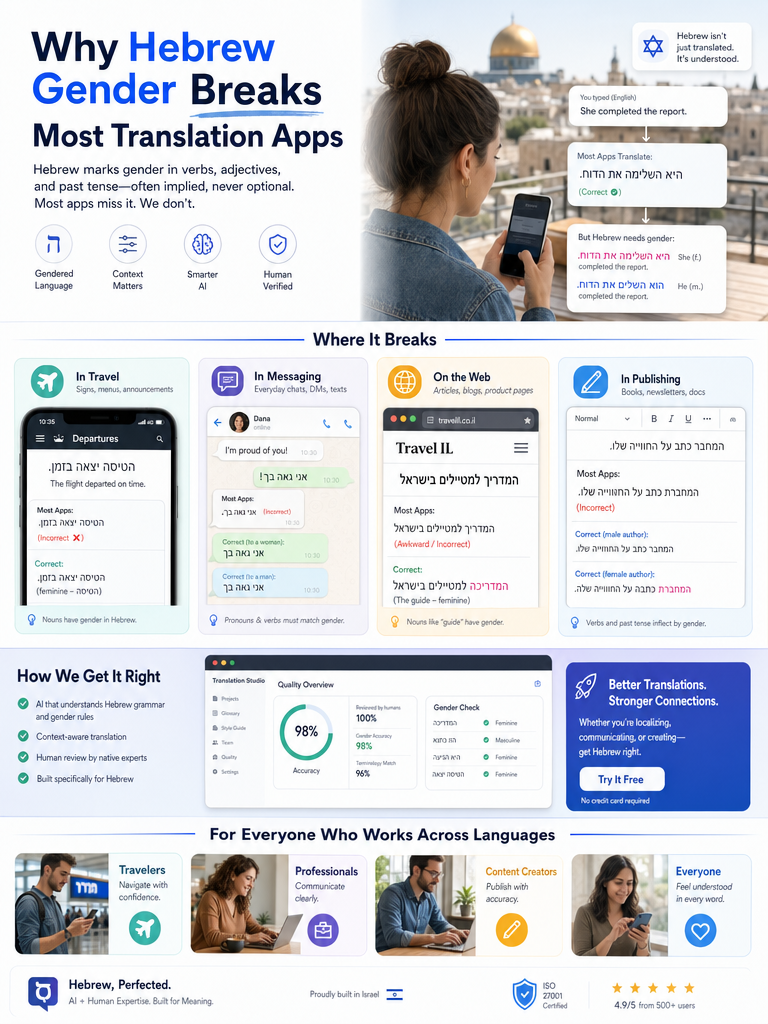
Hebrew gender translation is the work of choosing the correct masculine, feminine, or mixed grammatical forms when moving a sentence between English and Hebrew — and it's where most translation tools quietly fall apart. Hebrew bakes gender into verbs, adjectives, pronouns, and even how you address the person across from you, so a single English sentence like "Are you tired?" has at least two valid Hebrew translations depending on who you're talking to.
The reason apps break is structural, not lazy: English usually hides gender, Hebrew almost always reveals it. As one Reddit thread on r/LearnHebrew put it, "You have to translate gender to gendered languages. And you have to degender them when you translate to languages without grammatical genders." That means English→Hebrew translation has to invent information the source never gave, while Hebrew→English has to throw information away cleanly without losing meaning.
In practice, this shows up everywhere a real person actually uses translation:
- A WhatsApp message to a female friend that comes back in masculine forms and reads like it was written to a man.
- A café sign translated literally that addresses a mixed crowd in masculine plural by default.
- A travel phrase like "I'd like to order" that ignores whether the speaker is a woman or a man.
- A professional email where the closing line misgenders the recipient.
Hebrew translation isn't a vocabulary problem — it's a context problem, and gender is the part of context English-trained models guess at most often. That guess is usually masculine, and that's where the awkwardness, the misidentification, and the "robotic" feel come from (Source: baba — Why Hebrew AI Struggles with Gender).
Why Do Translation Apps Default to Masculine Hebrew?
Most translation apps default to masculine Hebrew because masculine forms are statistically dominant in their training data and serve as the grammatical "unmarked" option when no gender signal exists in the source. According to baba's analysis in Why Hebrew AI Struggles with Gender, generic tools default to masculine forms while gender-aware models meaningfully improve accuracy and tone.
The mechanic is straightforward. When an English sentence enters the system, the model has to fill in gender slots that English never marked. With no signal, it picks the most frequent pattern it saw during training — and across Hebrew corpora, masculine singular and masculine plural dominate. The result is a translator that sounds fine to a male speaker addressing a male listener and slightly off to everyone else.
The opposite direction has its own failure mode. Hebrew→English requires removing gender — collapsing את and אתה into "you," merging gendered verbs into a single English form. Done cleanly, the English reads natural. Done poorly, the system either invents pronouns ("he said" when the speaker was female) or produces stilted phrasing.
Here's how the same English prompt fans out in Hebrew depending on who's speaking and listening:
| English source | Speaker → Listener | Natural Hebrew |
|---|---|---|
| "Are you tired?" | Anyone → man | אתה עייף? |
| "Are you tired?" | Anyone → woman | את עייפה? |
| "I'm going home" | Male speaker | אני הולך הביתה |
| "I'm going home" | Female speaker | אני הולכת הביתה |
| "Thanks, you're the best" | → mixed group | תודה, אתם הכי טובים |
A non-Hebrew-first system sees one English input and produces one Hebrew output. A Hebrew-first system asks: who's speaking, who's listening, and is the audience one person, a group, or mixed?
Tip: If your translation app never asks you to specify speaker or listener gender, assume it's defaulting to masculine forms — and double-check anything you're sending to a woman, a mixed group, or a professional contact you haven't met.
Which Parts of Hebrew Grammar Change by Gender?
Gender in Hebrew isn't a tag attached to nouns — it propagates through almost every part of the sentence. Verbs, adjectives, pronouns, imperatives, and second-person address all shift form, which is why word-by-word dictionary tools produce sentences that are technically "translated" and practically broken.
The grammar zones where errors cluster:
- Verbs. Past, present, and future tense conjugations all carry gender. הולך / הולכת (going), כתבתי is gender-neutral but אתה כתבת / את כתבת is not.
- Adjectives. Every adjective agrees with its noun. גדול / גדולה / גדולים / גדולות — same word, four endings.
- Pronouns. "You" splits into אתה (m.) / את (f.) / אתם (m. pl. or mixed) / אתן (f. pl.). There is no neutral "you."
- Imperatives. "Come here" is בוא to a man, בואי to a woman, בואו to a group. Tools that issue commands — directions, recipes, instructions — get this wrong constantly.
- Second-person address in signs and ads. Hebrew advertising often uses second person, which forces a gender choice that English signs never have to make.
- Plural groups. Even a group of 99 women and one man takes masculine plural in traditional grammar.
For a deeper breakdown of how this plays out in feelings and personal speech, see Gender Differences in Hebrew Emotional Phrases and the conjugation primer in Hebrew Conjugation Patterns Every Student Should Memorize.
By the numbers: A single English sentence with one verb, one adjective, and a "you" can require three independent gender decisions in Hebrew — and getting any one of them wrong makes the whole sentence sound off.
Speaker Gender vs. Listener Gender vs. Group Gender
Every Hebrew translation involves at least three separate gender questions, and a tool that confuses them produces sentences that are grammatically self-contradictory.
- Speaker gender — affects first-person verbs and adjectives. "I'm hungry" becomes אני רעב (m.) or אני רעבה (f.).
- Listener gender — affects second-person pronouns, verbs, and imperatives. The same compliment to a male and female friend uses different words.
- Group gender — affects plural address. A mixed-gender team, an all-female class, and an all-male staff each get different plural forms.
A literal translator sees "you" and picks one. A context-aware translator asks which "you" you mean — and that single distinction is the difference between Hebrew that sounds native and Hebrew that sounds like a default. For mixed audiences specifically, see Hebrew Translation for Mixed-Gender Groups.
What Goes Wrong When Hebrew Gender Is Translated Literally?
Literal Hebrew translation produces sentences that misrepresent the speaker, misaddress the listener, and quietly break trust in professional and personal contexts. According to baba's research on common errors in gendered AI translation, these mistakes "misrepresent speakers and confuse audiences" — and the consequences scale with how much the message matters.
Concretely, what breaks:
- Misidentifying the speaker. A woman writing "I went to the meeting" gets back a Hebrew sentence with masculine verbs, making her sound like someone else.
- Misaddressing the listener. A message to your female manager comes out in masculine forms — a small error that reads as careless or, worse, dismissive.
- Stiff, robotic phrasing. Even when gender is "right," literal tools often produce structurally English Hebrew — word order, prepositions, and idioms that no native speaker would use.
- Wrong group address. A company-wide email defaulting to masculine plural in a mixed-gender team can land badly in 2026 Israeli workplace culture.
- Distorted meaning in legal and official text. Contracts and forms where "the signatory" or "the employee" is gendered incorrectly create ambiguity that human reviewers then have to fix.
Watch out: The most damaging errors aren't the ones that produce gibberish — they're the ones that produce confident, grammatical Hebrew that's wrong about who. Those slip past spellcheck and land in front of your reader.
The Times of Israel's coverage of the 2023 gender-sensitive JPS Tanakh edition shows how charged gender choices can be even in scholarly translation, where every pronoun is debated. Day-to-day translation rarely carries that weight — but it carries enough to embarrass you in front of a client, a teacher, or a friend.
How Do You Translate Hebrew Gender Correctly Step by Step?
Translating Hebrew gender correctly is a six-step workflow, not a single decision. Following it deliberately — whether you're doing it yourself or pushing a tool to do it for you — is what separates "machine output" from "Hebrew you'd actually send."
- Identify the speaker's gender. First-person verbs and adjectives depend on this. If you're translating your own message, this is you. If you're translating someone else's, ask or infer.
- Identify the listener's gender. Second-person forms, imperatives, and address all flow from this. One person? Which one?
- Identify the group, if any. Mixed, all-female, all-male, or unknown. This decides plural forms and any blanket address.
- Choose formality and tone. Hebrew has register shifts — casual WhatsApp Hebrew is not the same as a לכבוד opening on a formal letter. Tone changes word choice even before gender does.
- Translate the whole sentence, not isolated words. Sentence-level translation lets the system propagate gender across verb, adjective, and pronoun consistently. Word-by-word lookup breaks agreement.
- Review agreement across the sentence. Verb matches subject? Adjective matches noun? Pronoun matches addressee? One mismatch ruins the sentence.
This is exactly the workflow baba Hebrew Translator is built around — letting you set speaker and listener context up front, then producing sentence-level Hebrew that keeps agreement consistent instead of guessing masculine by default.
A practical example. Take the English sentence: "Thanks for sending the file — let me know what you think."
| Context | Natural Hebrew |
|---|---|
| To a male colleague | תודה ששלחת את הקובץ — תגיד לי מה אתה חושב |
| To a female colleague | תודה ששלחת את הקובץ — תגידי לי מה את חושבת |
| To a mixed team | תודה ששלחתם את הקובץ — תגידו לי מה אתם חושבים |
Same English. Three completely different Hebrew sentences. The job of a Hebrew-first translator isn't to pick one — it's to ask which one you need.
