Getting Around: Transportation and Navigation
Navigating public transportation in Israel can feel tricky if you don’t read Hebrew, but with baba’s specialized tools, it gets a whole lot easier. While Israel’s public transportation system is efficient, most bus schedules, route numbers, and station names are displayed in Hebrew. Without a reliable translation tool, you might find yourself stuck trying to guess your way around.
Buses, Trains, and Taxis: Reading Schedules and Routes
In Israel, bus stops and train platforms typically show route numbers, destinations, and schedules in Hebrew. If you’re unfamiliar with the language, asking locals for help might be your only option. That’s where baba steps in.
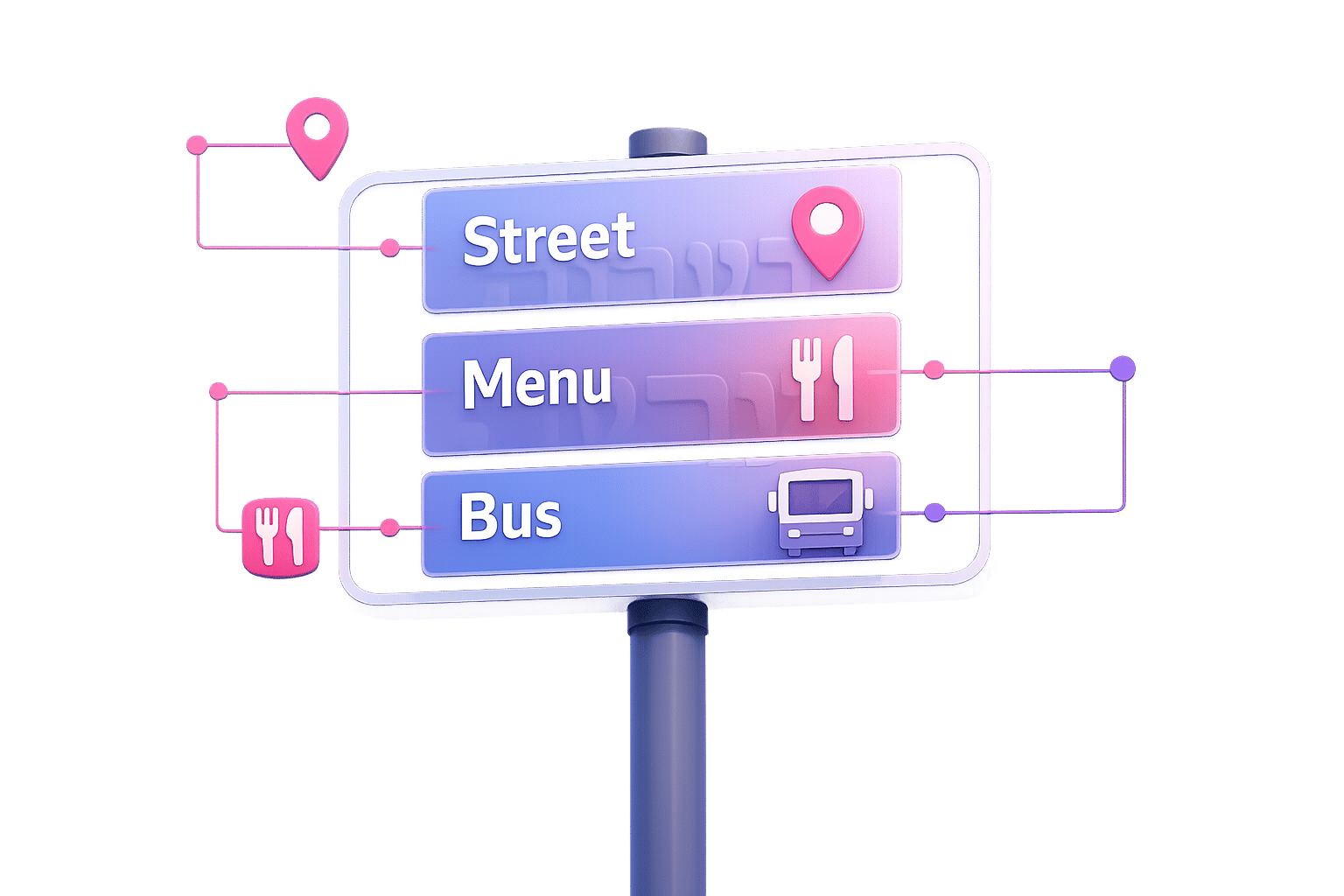
With baba’s Image & PDF feature, you can instantly translate Hebrew signs. Just point your phone’s camera at a bus schedule, train departure board, or even taxi instructions, and the app provides a real-time translation. It’s quick, efficient, and keeps you on track [2].
Need to communicate with a bus driver or taxi operator? Use baba’s Instant Playback feature to hear the correct Hebrew pronunciation of destinations like "Tel Aviv Central Station" (תחנה מרכזית תל אביב). The app even offers a transliteration - showing you how to say it: "Tachana Merkazit Tel Aviv" [2].
During busy hours at transit hubs, baba’s Fast Model ensures you get rapid translations without delays [2]. Whether you’re rushing to catch a train or navigating a crowded bus terminal, this feature keeps things moving smoothly.
These tools not only help you read signs but also make it easier to communicate directly with locals when needed.
Asking for Directions in Hebrew
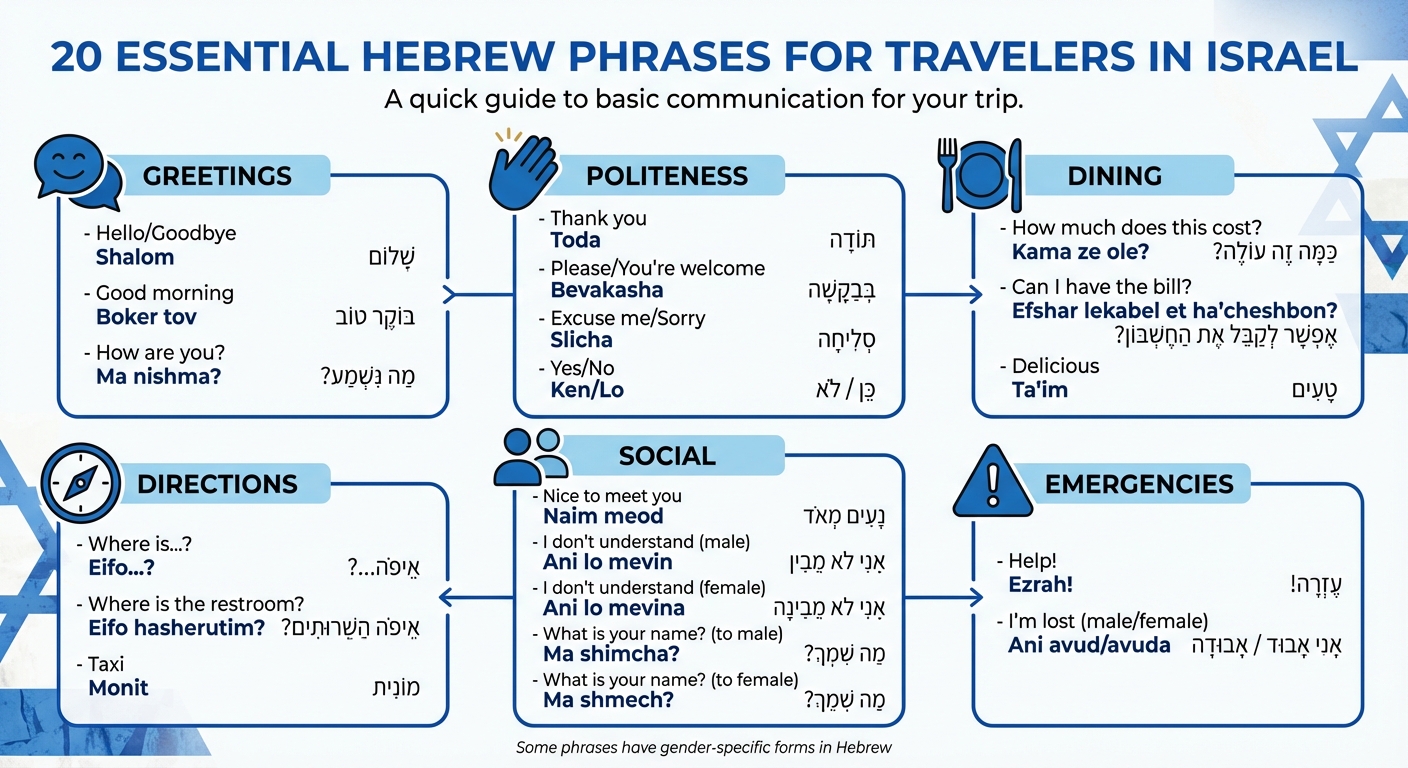
If you find yourself lost, don’t worry - locals are generally happy to assist, especially if you approach them politely. Start with "Slicha" (Excuse me) to get their attention, then follow up with "Eifo...?" (Where is...?) and your destination [3] [4].
For added convenience, use baba’s Voice Mode. Speak your question in English, and the app instantly translates it into natural, context-aware Hebrew [2].
When listening to directions, keep an ear out for key words like "Yemin" (Right) and "Smol" (Left). If you’re unsure about what you hear, baba’s Voice Mode and transliteration features can quickly clarify these terms for you [3].
Download baba here and tackle Israel’s streets and transit system with confidence and ease.
Getting around Israel - whether it's ordering food or shopping - can be tricky without knowing Hebrew. But with the right tools, like baba, you can navigate restaurants, markets, and service counters smoothly. In Israel, being concise and direct is key.
Reading Menus and Ordering Food
Many Israeli menus are primarily in Hebrew, with little to no English, especially at local eateries and street food stalls. With baba, you can point your camera at a menu, and it will instantly translate it into English [2]. This works for all kinds of menus, from printed ones to chalkboard specials and even handwritten options.
To make things easier, familiarize yourself with common menu sections like Manot Pticha (Starters), Manot Ikariot (Mains), and Kinuchim (Desserts) [5]. When you're ready to order, baba’s Gender Intelligence™ ensures your phrases are adjusted to match your gender [2].
Israeli food culture is full of unique terms that don’t always show up in standard dictionaries. For example, baba’s Real Slang Translation explains words like Hafuch (an Israeli-style latte, literally meaning "upside down") and Laffa (a type of flatbread used for wraps) [5] [2]. These translations don’t just give you the meaning - they also provide the local context.
If you have dietary restrictions, baba can help you translate and pronounce important phrases like Tzimchoni (vegetarian), Tivoni (vegan), or Ani alergi le... (I am allergic to...) [5]. With the Instant Playback feature, you can hear the correct pronunciation and confidently communicate with your server [2]. When it’s time to pay, simply say Cheshbon, bevakasha (Check, please) [5].
"baba finally translates Hebrew the way people actually speak. It understands slang, context, and gender, so I don't sound like a scholar from 1820!" - Zach Margs, Content Creator [2]
Once you’ve mastered menus, it’s time to dive into Israel’s lively markets and stores.
Israeli markets, or shuks, are lively, fast-paced, and full of vendors who often speak quickly and use casual language. Price tags and labels are usually only in Hebrew. With baba’s Image & PDF tool, you can scan tags, labels, and ingredient lists to get instant translations of product details and prices [2].
When talking to vendors, being direct is appreciated. Start with Slicha (Excuse me) to grab their attention, then ask Kama ze ole? (How much does this cost?) to inquire about pricing [3] [4]. Using baba’s Voice Mode, you can speak in English, and the app will translate your question into natural Hebrew that vendors understand [2].
Vendors often use slang that basic translators can’t handle. With baba’s slang mode, you’ll understand their responses and even negotiate prices without sounding overly formal or robotic [2]. Plus, baba’s Gender Intelligence™ ensures your phrases are grammatically correct, taking into account Hebrew’s gender-specific rules [2].
For more complex documents, like those you’d find in pharmacies or banks, baba’s Summary Mode provides quick and private translations [2].
Download baba here to navigate food, shopping, and daily services in Israel effortlessly - even without knowing Hebrew.
sbb-itb-7e51dcc
Social Interactions and Cultural Understanding
Building social connections in Israel often involves embracing a communication style that's direct and to the point. Israelis are known for their fast-paced, no-nonsense approach, which can come across as blunt but is usually well-intentioned and helpful [4]. What might seem abrupt in other places is just how conversations flow here. So, when someone skips the small talk or asks a straightforward question, try not to take it personally - it’s just part of the culture [4].
Understanding Israeli Communication Style and Customs
In Israel, people value efficiency in conversations. They tend to speak quickly, ask for what they need without hesitation, and expect the same in return [4]. This approach isn’t rude - it’s just how things get done. One unique aspect of Hebrew is its gendered structure: verbs and adjectives change depending on whether you’re speaking to a man, a woman, or a group [2]. Using the wrong form can cause misunderstandings. Thankfully, tools like baba’s Gender Intelligence™ make it easier to navigate these nuances by tailoring phrases to the correct gender or group [2].
Another key aspect of Israeli life is observing Shabbat, which affects social plans and daily routines. From Friday evening to Saturday night, many businesses, public transportation, and services either close or operate on reduced schedules [1][2]. baba helps users stay prepared with integrated Shabbat times, ensuring you can plan around these changes. On a more casual note, knowing how to greet people and use basic Hebrew phrases can make a big difference. A confident “Shalom” is a great way to start a conversation and can instantly make interactions more welcoming [4]. Israelis also appreciate when visitors try out Hebrew, even if it’s not perfect - it’s a great way to break the ice, whether you’re asking for directions or restaurant recommendations [4].
Learning Common Slang and Casual Expressions
Beyond formalities, slang plays a huge role in everyday conversations. Modern Israeli Hebrew is rich with expressions that don’t always translate well using standard tools [1][2]. Literal translations often miss the mark, but baba’s Real Slang Translation helps decode these phrases with their proper context [2].
Here are a few examples:
- Yalla: Depending on the context, it can mean “let’s go,” “come on,” or “hurry up” [3].
- Sababa: A casual way to say “cool” or “okay” [3].
- Achi: While it literally means “my brother,” it’s used like “dude” or “bro” in casual speech [3].
baba’s slang mode not only explains the meaning but also provides context and timing for when to use these expressions [1][2]. Plus, the Instant Playback feature ensures you can hear the correct pronunciation - especially useful for tricky sounds like the guttural “ch” in words like Chaver (friend) [2][3].
"baba finally translates Hebrew the way people actually speak. It understands slang, context, and gender, so I don't sound like a scholar from 1820!" – Zach Margs, Content Creator [2]
Download baba here to master Israeli slang and connect with locals in a way that feels natural - even if you’re just starting with Hebrew.
Conclusion: Managing Life in Israel Without Hebrew
Living in Israel without knowing Hebrew is entirely possible with the right mindset and tools. By learning a few key phrases and using advanced translation technology tailored to Israeli communication, you can handle daily tasks - like navigating public transport, deciphering menus, or chatting with locals - with far less stress.
One standout solution is baba, which tackles the toughest aspects of Hebrew: gender-specific grammar, modern slang, and the nuances of local context that generic translators often miss. The app is ready to go as soon as you touch down in Tel Aviv. With baba, you can easily translate street signs, decode WhatsApp messages, or finally understand what "yalla" really means [2].
"Finally, an app that teaches how people actually speak, not just biblical or formal Hebrew. My business meetings are so much smoother now."
- Chen Wei, Business Developer [2]
Make your time in Israel smoother and more enjoyable. Download baba on iOS or Android and turn challenging moments into manageable ones. Whether you're staying for a short visit or a longer adventure, baba equips you with the confidence to embrace all that Israel has to offer.
Get started with baba here
FAQs
How can I use public transportation in Israel if I don’t speak Hebrew?
Navigating public transportation in Israel without knowing Hebrew is more manageable than you might expect! A great starting point is downloading Moovit, an intuitive app that offers real-time transit routes, schedules, and updates - all available in English. It’s incredibly helpful for navigating buses, trains, and light rail systems with ease.
Be sure to pick up a Rav-Kav card, a reloadable travel card that works on most public transportation throughout Israel. You can add funds at stations, kiosks, or even through mobile payment apps. Some buses and trains also now accept mobile payments directly, adding another layer of convenience.
If you’re ever unsure about stops or directions, just ask someone nearby. Many Israelis speak English and are usually more than willing to point you in the right direction!
What are the must-know Hebrew phrases for traveling to Israel?
Learning a handful of Hebrew phrases can make your trip to Israel easier and more enjoyable. Start with the basics: Shalom works for both "hello" and "goodbye", while Toda means "thank you." Polite phrases like B’vakasha (please) and Slicha (excuse me/sorry) are helpful in everyday interactions. For casual chats, try Ma Nishma?, which translates to "how are you?" or "what’s up?"
When shopping or navigating public transportation, knowing numbers and phrases like Kama Zeh? ("how much is this?") can be incredibly useful. Even just a few words in Hebrew can show locals that you're making an effort, and they'll certainly appreciate it!
How does baba handle Hebrew slang and gender-specific grammar effectively?
baba leverages its cutting-edge AI-powered translation engine, HebrewCore™, to tackle the complexities of Hebrew slang and gender-specific grammar. This system is specially crafted to interpret and translate modern slang and idiomatic expressions, ensuring users can engage naturally in everyday Israeli conversations.
When it comes to gender-specific grammar, baba goes a step further. It adjusts translations based on the gender of both the speaker and the listener. With over 2,700 variations integrated into its system, baba ensures that translations are not only grammatically accurate but also contextually appropriate - whether you're addressing a man, a woman, or a group. It's a game-changer for navigating Hebrew's linguistic intricacies in real-world interactions.
Frequently Asked Questions
Do I need to know Hebrew to order food at local Israeli restaurants?
Not at all — many local spots have Hebrew-only menus, but pointing your phone camera at the menu and using a camera translation feature gets you an instant read. It also helps to know a few food-specific terms like Tzimchoni (vegetarian) or Tivoni (vegan) if you have dietary needs, and to say Cheshbon, bevakasha when you're ready to pay.
Will Israelis understand me if my Hebrew pronunciation is off?
Most Israelis are patient with visitors trying Hebrew and many speak conversational English, so a mispronounced phrase won't leave you stranded. That said, hearing the correct pronunciation through audio playback before you speak — especially for guttural sounds like the 'ch' in Chaver — makes a real difference in how naturally the conversation flows.
How do I handle Shabbat when planning activities in Israel?
From Friday evening to Saturday night, many businesses, restaurants, and public transport lines close or run on a reduced schedule, so planning ahead matters. Checking Shabbat start and end times for your specific location each week helps you avoid being caught off guard mid-itinerary.
Is it safe to use a translation app for important situations like emergencies or medical needs?
For basic emergencies, knowing a phrase like Ezrah (Help!) by heart is faster than reaching for your phone — memorize it before you travel. For more complex medical or legal situations, a context-aware translator that handles full sentences and gender-specific grammar is far more reliable than a word-for-word dictionary lookup.
What Israeli slang will actually help me connect with locals?
A few high-impact words go a long way: Yalla signals you're ready to move or agreeing to go somewhere, Sababa means something is cool or all good, and Achi (literally 'my brother') works like 'dude' in casual conversation. Using these in the right moment shows cultural awareness, not just vocabulary — context matters as much as the word itself.