Build your Israel starter kit with apps for transit, payments, and Hebrew. Use baba Hebrew Translator for gender-aware Hebrew that sounds natural.
The Ultimate Israel Starter Kit: Apps for Transportation, Payments, and Hebrew
Navigating life in Israel is much easier with the right apps. Public transit is cashless, Hebrew has gender-specific nuances, and local payment systems like Bit dominate. This guide highlights essential apps to help you manage transportation, payments, and language challenges.
Transportation: Use Moovit for real-time public transit planning, Gett for taxis with fixed pricing, and HopOn for seamless fare payments.
Payments: Bit is the go-to for instant transfers, while PayBox simplifies group expenses. International users may benefit from Wise for currency exchange.
Hebrew Translation: baba stands out for gender-aware translations, perfect for avoiding awkward mistakes in this language.
Start with these basics and expand your toolkit as you settle in. Life in Israel becomes smoother when you’re equipped with apps tailored to its unique systems.
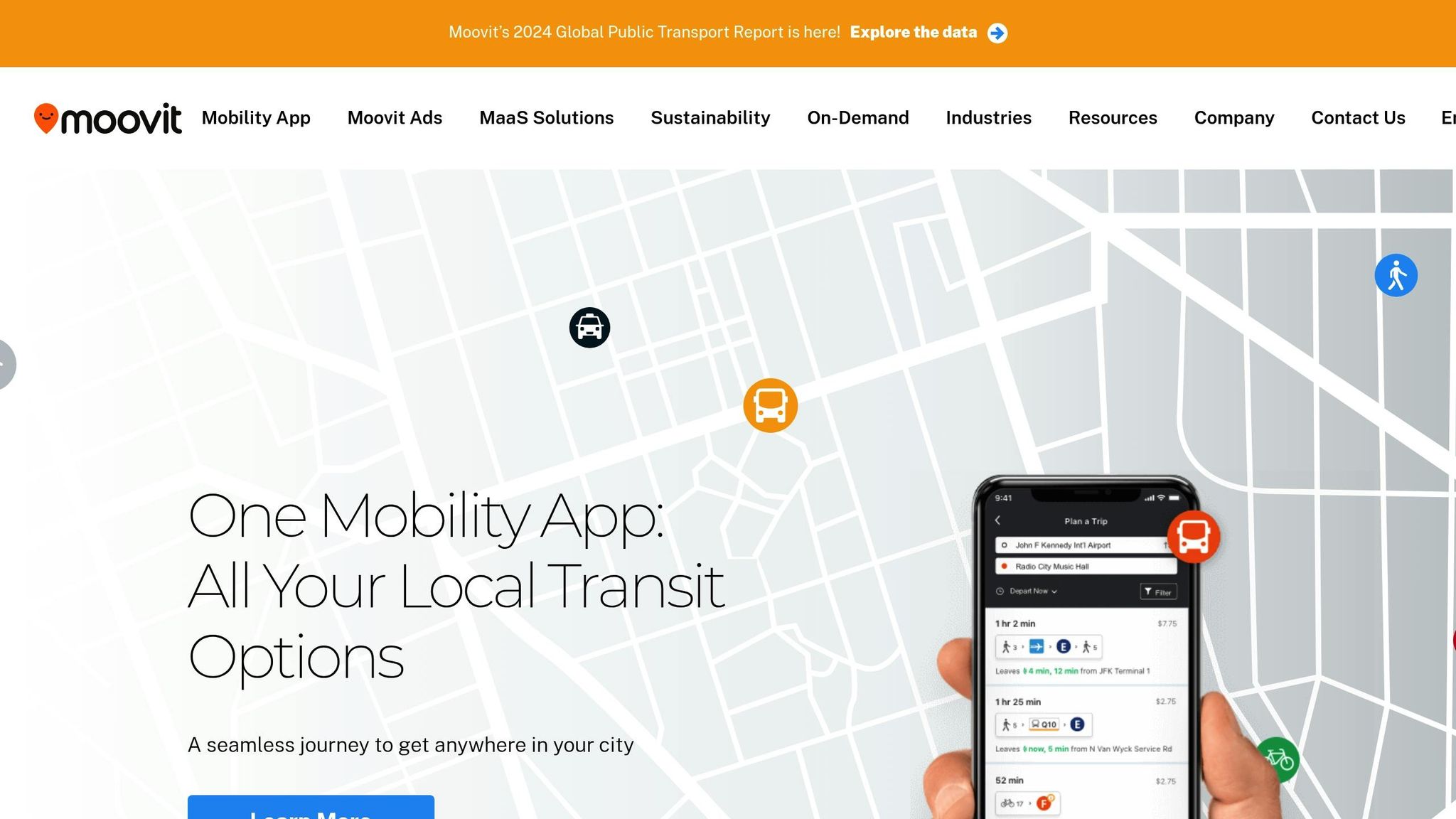
Moovit is your go-to app for navigating Israel's public transportation system, covering buses, rail, light rail, cable cars, and shuttles. It provides real-time arrival updates and features like "Live Directions" to guide you through your journey step by step [5].
That said, the free version comes with a catch: full-screen ads every time you check a route. Travel blogger Lior shares:
Without a subscription, you'll encounter persistent ads every time you check routes, which can be both annoying and time-consuming [2].
If the ads feel too disruptive, you might want to explore HopOn (Rav-Pass) or Egg instead. These apps also offer real-time tracking but come with a cleaner, ad-free interface. Plus, both apps use QR scanning for automatic fare calculations. For buses, stickers near the doors let you scan and track your fare, while for trains, the apps generate QR codes you can scan at station gates [2].
When public transit isn’t ideal, Gett is a reliable choice for booking taxis. It connects you exclusively with licensed drivers and provides upfront, fixed pricing, so you know exactly what to expect [3][6]. However, during Tel Aviv's rush hours, wait times can be longer than usual. Booking ahead is a smart move, especially if you're on a tight schedule [1]. For a broader look at digital tools, check out these essential apps for Israel.
For those looking for a more budget-friendly option, Yango operates in 11 cities, including Tel Aviv and Haifa, and offers a more affordable alternative [6].
Other Transportation Options
Beyond apps for buses and taxis, there are additional tools to make traveling across Israel a breeze.
The Israel Railways app is perfect for checking train schedules and platform details. However, note that ticket payments require a separate app [3]. The train network spans almost the entire country, making it a great option for longer trips [3].
If you prefer a physical Rav-Kav card, you can easily top it up using your phone’s NFC sensor through the Rav-Kav or HopOn apps [2][3]. Keep in mind that cash payments are no longer accepted on any public transportation in Israel [3].
For riders of Jerusalem's light rail, here's an important tip: make sure to purchase your ticket through the app before boarding. The GPS inside the train often struggles to detect your starting location, which could lead to fines [2].
Thanks to these apps and tools, traveling across Israel is now more seamless and cash-free than ever before. Whether you’re hopping on a bus, catching a train, or booking a taxi, there’s an option to fit every need.
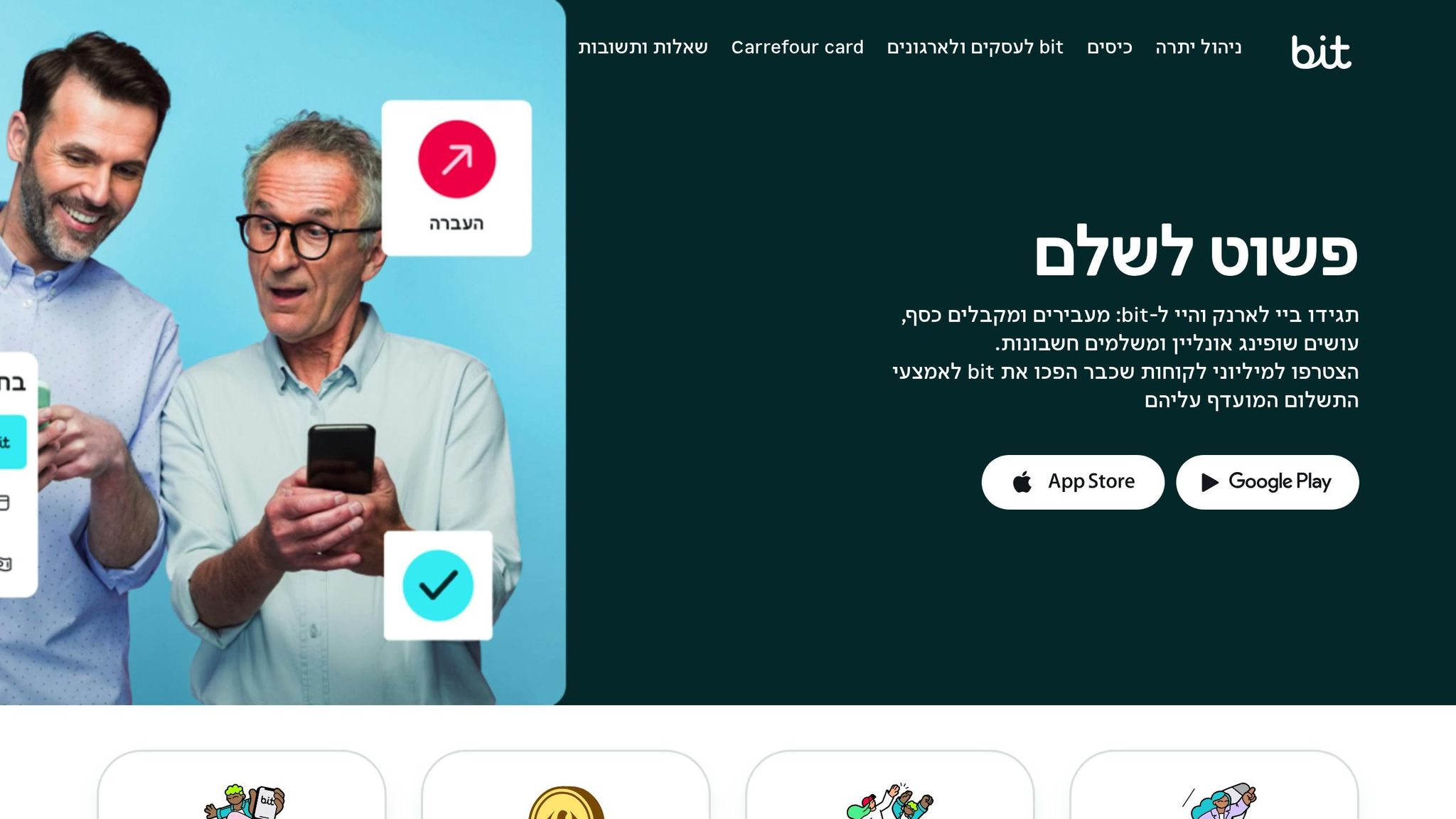
Bit is the go-to app for instant money transfers in Israel. It works much like other popular payment apps but has become a staple in the country. In fact, by 2023, nearly 55% of Israelis reported using payment apps to send money, with Bit leading the pack [9].
The app connects directly to your Israeli bank account, making it easy to transfer money instantly. Whether you're splitting a dinner bill, paying rent, or settling up after a group outing, Bit is the solution most people rely on [1]. It's also a hit with small businesses and service providers who favor it over credit cards to avoid transaction fees.
To set up Bit, you'll need an Israeli bank account and a local credit or debit card [8]. Most Israeli credit cards function as deferred debit cards, meaning the total amount is automatically deducted from your account once a month on a date you choose [8].
If Bit is perfect for one-on-one transfers, PayBox shines when it comes to managing group expenses. The app allows users to create shared "boxes" where multiple contributors can pool money for a specific purpose - whether it's a group gift, shared bills, or event planning [10].
PayBox also provides free digital VISA or MasterCard options, making online purchases a breeze [1]. It integrates smoothly with Israeli banks, ensuring hassle-free transfers between participants' accounts [7].
Other Payment Methods
While apps like Bit and PayBox dominate peer-to-peer transfers, other digital payment methods are crucial for everyday spending. In 2022, cards accounted for nearly 70% of transactions, while cash and checks made up less than 10% [9].
For international visitors and expats, Wise (formerly TransferWise) is invaluable for currency exchange between Israel and your home country, using real exchange rates [7]. For those seeking a fully digital banking experience, Pepper offers accounts with expense tracking and budgeting tools, all without needing a physical branch [7].
Most services in Israel require a linked credit card for automatic payments [6]. Meanwhile, contactless payment methods like Apple Pay and Google Pay are steadily gaining popularity [9].
A word of caution: Israeli banks are notorious for charging fees on nearly every transaction. As Gershon Kayman, Esq. puts it:
Banks charge fees for almost every transaction made... You name it, the banks charge for it! It is something that you need to get used to as a day-to-day reality [8].
If you're new to Israel, try negotiating with your bank to reduce or waive these fees during your initial months [8].
Hebrew is a language where gender plays a significant role. Verbs, adjectives, and pronouns change based on the speaker and the audience, making accurate translation a challenge. Many generic translation apps default to male forms, which can sometimes come across as awkward - or even inappropriate - to native speakers.
baba tackles this issue with AI specifically designed for Hebrew. It provides over 30,000 precise translations across 14 languages[4], allowing users to set their gender and audience preferences for translations that feel natural and contextually appropriate.
What makes baba stand out is its grasp of Israeli slang and cultural nuances. It doesn’t just translate words; it explains phrases like "אחי" (achi, meaning "dude") and "יאללה" (yalla, meaning "let's go") while clarifying when and how to use them.
The app is available on both iOS and Android, requires no login, and offers three speed settings: Standard for high accuracy, Fast for a balance of speed and precision, and Ultra-Fast for immediate results. While the free version covers basic needs, baba Pro unlocks advanced features like higher character limits, voice input, and full slang mode for a deeper understanding of the language.
For those wanting to go beyond translation and truly learn Hebrew, incorporating structured learning tools can help build a strong foundation.
Other Hebrew Learning Tools
While baba shines in real-time translation, apps focused on structured learning can help users master Hebrew vocabulary and grammar. For beginners unfamiliar with Hebrew script, some apps offer transliterations alongside the Hebrew text to simplify pronunciation. Others guide users through the Hebrew alphabet with step-by-step tutorials.
Pairing these tools with practical, everyday language exercises can help solidify your learning over time.
Tips for Using Translation Apps Daily
Set up your gender preferences at the start to ensure translations are accurate and sound natural.
Double-check the recipient type setting before sending messages to avoid mismatched gender forms.
Download offline language packs if you're traveling to areas with poor internet connectivity.
Use photo translation features to read menus, street signs, or other written text.
Make translation a daily habit - practice by translating a short phrase or sentence each morning, and save commonly used translations for quick access.
Pay close attention to cultural notes when learning slang or casual expressions to avoid using them in the wrong context.
Your Israel travel guide: 7 essential apps you need before landing
Building Your Personal App Setup for Israel
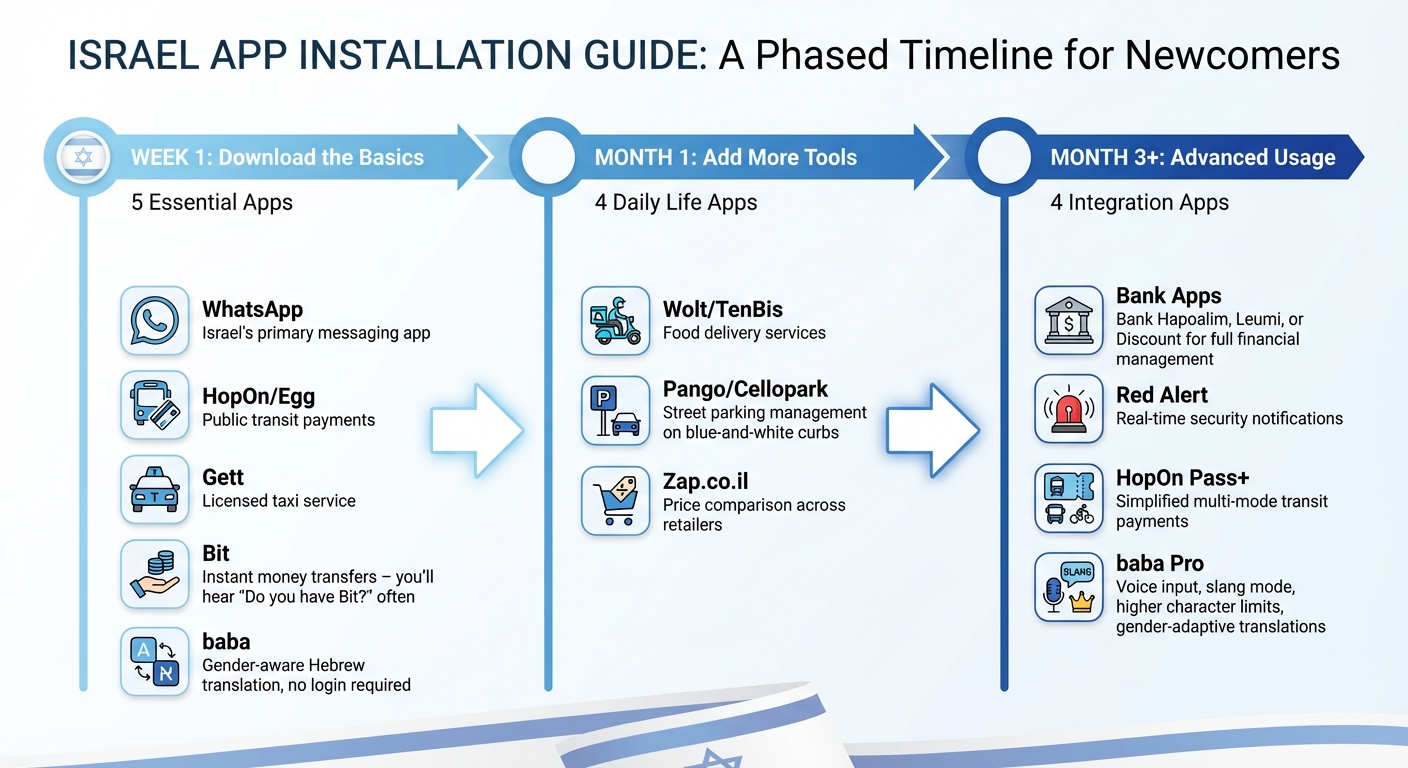
Essential Apps Setup Timeline for New Arrivals in Israel
Moving to Israel comes with its own set of challenges, and having the right apps can make a big difference. The key is to start small and expand your app collection as you settle into your new life. Begin with the essentials and add more tools as you become familiar with the rhythm of daily life in Israel.
Week 1: Download the Basics
In your first week, focus on the apps that cover your immediate needs. WhatsApp is a must for communication since it's the go-to messaging app in Israel. For transportation, install HopOn (Rav-Pass) or Egg to handle public transit payments, and download Gett for taxis.
You’ll also need Bit for instant money transfers. Trust me, the phrase "Do you have Bit?" will come up often - whether you're splitting a bill or paying someone back. Lastly, grab baba for Hebrew translation. It’s especially handy because it’s gender-aware and works without requiring a login, so you can start translating right away.
These five apps will cover your essentials: communication, transportation, payments, and language. Everything else can wait until you’ve settled in a bit more.
Month 1: Add More Tools
Once you’ve found an apartment and established a routine, it’s time to add apps that make daily life easier. For food delivery, Wolt and TenBis are lifesavers when you’re too tired to cook. If you’re driving, download Pango or Cellopark to manage street parking on blue-and-white curbs - parking tickets in Israel are no joke and tend to show up quickly.
To save money, use Zap.co.il to compare prices across retailers. This is particularly useful in a country where everyday costs can add up quickly. With these apps, you’ll be able to handle most of your day-to-day needs with ease.
Month 3+: Advanced Usage
After three months, you’ll likely feel more at home and ready to integrate deeper into Israeli life. This is when advanced apps come into play. Start by setting up your official bank app (Bank Hapoalim, Leumi, or Discount) for full financial management beyond simple peer-to-peer transfers. For safety, download Red Alert to receive real-time security notifications specific to your area.
If you’re a regular public transit user, consider HopOn's Pass+, which simplifies payments across different transportation modes. For Hebrew, upgrade to baba Pro. The Pro version offers voice input for quicker translations, a slang mode to help you understand everyday Israeli expressions, and higher character limits for translating longer texts.
One standout feature of baba Pro is its ability to adapt Hebrew translations based on Hebrew gender rules and audience. Once you set your speaker gender, you can adjust the audience type (Woman, Man, or Group) to ensure your Hebrew sounds natural in any context. For anyone looking to deepen their language skills, the Pro version is a practical upgrade.
Conclusion
Relocating to Israel becomes far more manageable when you have the right digital tools at your fingertips. Apps like Moovit and Gett make navigating the cashless transit system - with its Hebrew signage - a breeze. Payment platforms like Bit and PayBox simplify financial transactions, making them as easy as sending a quick text. And then there's baba, a tool that bridges the language gap, easing the transition during those potentially overwhelming first weeks. These apps don’t just handle daily tasks - they lay the groundwork for integrating seamlessly into life in Israel.
The best approach? Start with the basics and expand as you go. You don’t need to overload your phone with every app right away. Focus first on the essentials: communication, transportation, payments, and baba for Hebrew translations. Over time, you’ll naturally find other apps that complement your lifestyle and needs.
For tackling Hebrew specifically, baba is a standout choice. It’s designed to handle the tricky nuances of Hebrew grammar - like gender-specific language - that most generic translators miss. Available on both iOS and Android, it works instantly without requiring a login. Whether you're chatting with friends, speaking with family, or navigating a professional setting, baba adjusts translations to suit the context, making communication much easier.
The difference between a stressful start and a smooth transition often comes down to preparation. Download these apps before you arrive, take some time to explore their features, and you’ll be ready to dive into daily life with confidence. Once you're connected to Israel’s digital ecosystem, everyday tasks become second nature. These tools are your gateway to starting your new chapter in Israel on the right foot.
FAQs
Do I need a Rav-Kav card, or can I use an app only?
You no longer need a Rav-Kav card to pay for public transportation in Israel. Instead, you can use apps like Rav-Pass or the Egged app to pay directly from your smartphone. These apps simplify the process, allowing you to manage your transportation payments without the hassle of carrying a physical card.
Can I use Bit or PayBox without an Israeli bank account?
Yes, you can use PayBox and Bit even if you don’t have an Israeli bank account. PayBox allows you to link a bank account without requiring a debit or credit card. Both apps are popular in Israel for peer-to-peer money transfers, offering a simple way to send and receive funds locally.
How can I avoid gender mistakes when translating Hebrew?
Hebrew can be tricky when it comes to gender-specific grammar. Unlike English, Hebrew assigns gender to nouns, adjectives, and even verbs, which means every part of a sentence needs to match the gender of the subject or object. It's easy to trip up, but there are ways to get it right.
One helpful tool is using specialized apps like baba. These apps are designed to handle Hebrew's gender rules, making it easier to stay accurate. Beyond that, regular practice is key. Spend time learning gendered vocabulary and practicing sentence construction. The more you familiarize yourself with these patterns, the more confident you'll become - and the fewer mistakes you'll make.
Frequently Asked Questions
What's the best way to pay for buses and trains in Israel without cash?
Cash is no longer accepted on any public transportation in Israel, so you'll need either a Rav-Kav card topped up via NFC on your phone, or an app like HopOn that handles fare payments and QR code scanning directly from your smartphone. For Jerusalem's light rail specifically, buy your ticket through the app before boarding, since the GPS inside the train often can't detect your starting location.
Does baba work offline, or do I need data to translate Hebrew?
The draft mentions downloading offline language packs if you're traveling to areas with poor connectivity, so checking whether your device has those packs ready before heading somewhere without reliable data is a smart move. Having offline support is especially useful for reading signs, menus, or street text when you're out of range.
Is Gett available throughout Israel, or only in Tel Aviv?
Gett connects you with licensed drivers and is available in Israel's major cities, though during Tel Aviv's rush hours wait times can stretch longer than expected, so booking ahead helps. For a more budget-friendly alternative, Yango operates in 11 cities including Tel Aviv and Haifa.
How do Israeli bank fees work, and can I reduce them as a newcomer?
Israeli banks charge fees on almost every transaction—transfers, withdrawals, and more—so it's worth negotiating with your bank during your first months to reduce or waive some of those charges. Using peer-to-peer apps like Bit for everyday transfers can also help you sidestep some card-based transaction costs.
Why does Hebrew gender matter so much in translation, and how do I get it right?
Hebrew assigns gender to nouns, adjectives, and verbs, so the same sentence can sound completely natural or oddly off depending on whether it's addressed to a man, a woman, or a group. Tools that let you set both your own gender and your audience type—like baba's speaker and recipient settings—handle this automatically so your Hebrew doesn't default to a one-size-fits-all male form.