Core Principles of Human-AI Collaboration
The best way to approach Hebrew legal translation is by combining the speed of AI with the nuanced judgment of human expertise. Hebrew's unique challenges - like gendered grammar, right-to-left (RTL) text formatting, and jurisdiction-specific terminology - require a thoughtful balance. AI handles the heavy lifting, such as bulk translations and maintaining consistent terminology, while human experts focus on the subtleties that ensure legal accuracy and cultural appropriateness.
Using AI for Drafts and Terminology Consistency
AI is invaluable for creating first drafts quickly and maintaining consistent use of legal terminology across lengthy documents. Advanced systems analyze text to determine its subject matter and apply specialized legal vocabulary from domain-specific dictionaries. For Hebrew legal translation, this means relying on targeted glossaries instead of generic word lists, ensuring terms like din (law/statute/judgment) are translated correctly based on context.
One of the trickiest aspects of Hebrew is its gendered grammar. Verbs, adjectives, and pronouns must match the gender of both the speaker and the audience. Tools like baba address this by offering specific gender contexts, such as "To One Woman", "To Mixed Group", or "General/Formal." By setting a speaker's gender profile, these tools ensure consistent application of first-person forms - like "אני שמח" versus "אני שמחה." Specialized Hebrew AI models, trained on root-based linguistic patterns, ask who is speaking and who is listening and conjugate for that context, rather than defaulting to masculine forms the way generic translation tools often do.
While AI ensures consistency in terminology and grammar, human review is critical for achieving legal and contextual precision.
Human Review for Context and Legal Accuracy
AI-generated drafts provide a solid starting point, but human expertise is essential to meet the rigorous demands of legal translation. Translators refine ambiguous terms, choose the most contextually accurate options from AI suggestions, and ensure that modal verbs like "shall", "may", and "must" convey the intended legal weight. A single misstep can have serious consequences - like the $289 million litigation triggered by a poorly worded clause [5].
For Hebrew legal texts, human reviewers also confirm that gender contexts are appropriate and professional. They align translations with the legal frameworks of the relevant jurisdictions, ensuring compliance with local standards. Post-editing by qualified legal professionals can reduce costs by 40% and cut delivery times in half compared to traditional translation methods [5].
These expert corrections also contribute to improving AI systems over time.
AI systems continually improve when human-edited translations are fed back into their training models. This feedback allows the software to learn from professional corrections, keeping translations accurate and natural as language evolves. In Hebrew legal translation, this process involves using quality estimation systems that combine neural machine translation with private language models to flag segments needing manual review.
To ensure precise future translations, users must specify key details like gender and formality. For example, creating user profiles that capture the speaker's gender helps AI automatically correct first-person Hebrew verbs in subsequent translations. In legal workflows, these feedback loops must operate within secure, air-gapped environments to protect sensitive data related to litigation and discovery [6]. Document watermarking with notices like "AI-assisted translation – human review required" also ensures accountability and tracks which sections have been verified by experts.
Step-by-Step Workflow for Hebrew Legal Translation
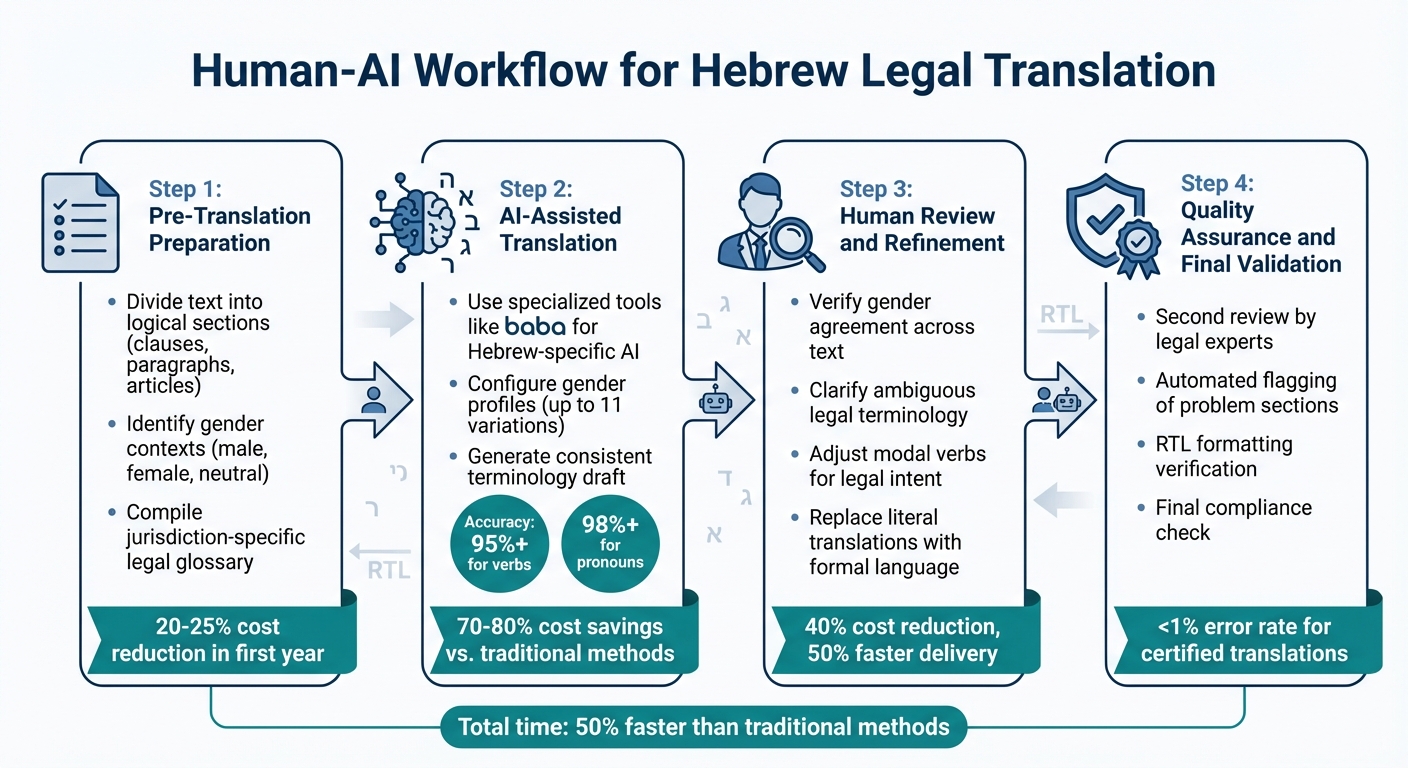
Translating Hebrew legal documents demands a methodical approach that combines the speed of AI with the precision of human expertise. Below is a four-step process designed to ensure accuracy, cultural sensitivity, and legal clarity. Each phase builds on the last, streamlining the translation process without compromising quality.
Step 1: Pre-Translation Preparation
Before diving into translation, it's crucial to prepare the document. Start by dividing the text into logical sections - contracts can be split by clauses, court documents by paragraphs, and regulatory filings by article numbers. This organization makes it easier to manage revisions and assign specific sections for review.
Next, identify the gender contexts within the text. Legal documents often refer to parties such as plaintiffs, defendants, or corporate representatives. Determine whether these references are male, female, or neutral, and note which sections require gender-specific language. This distinction is particularly important in Hebrew, where gender impacts verbs, pronouns, and adjectives.
Additionally, compile or upload a legal glossary tailored to the document's jurisdiction. This glossary should include recurring technical terms like din (law/statute/judgment), heskhem (agreement/contract), or te'udat zehut (identity document). Using a glossary ensures consistency and can significantly reduce translation costs - by as much as 20% to 25% in the first year [9]. With the text organized and key terms defined, you’re ready to move on to AI-assisted drafting.
Step 2: AI-Assisted Translation
With preparation complete, leverage AI tools to create a draft. Specialized AI platforms, such as baba, are designed to handle Hebrew's unique characteristics, including its root-based structure and gender-specific grammar. These tools can manage up to seven gender contexts, ensuring proper verb and adjective agreement [2].
Configure the AI to match the gender profile of each section, whether it requires neutrality or a specific form for personal statements. Hebrew-focused AI models ask who is speaking and who is listening and conjugate for that context, rather than defaulting to masculine forms the way generic translation tools often do.
AI-assisted translation offers significant cost savings, reducing expenses by 70% to 80% compared to traditional human translation services, which typically charge $0.15 to $0.30 per word [7]. However, the AI-generated draft is just a starting point - it provides a fast and consistent foundation but still requires human refinement.
Step 3: Human Review and Refinement
Once the AI draft is complete, expert translators step in to refine the content. This stage is critical for ensuring legal precision. Translators focus on three main aspects: gender agreement, legal terminology, and cultural nuances. They verify that verbs, nouns, adjectives, and pronouns align with the gender of the referenced parties.
Ambiguous terms are clarified, and modal verbs are adjusted to reflect the correct legal intent. Missteps in phrasing can lead to costly legal disputes - some errors have resulted in litigation worth hundreds of millions of dollars [5]. Translators also replace literal translations of idiomatic expressions with formal language appropriate for legal contexts [10].
This post-editing process can reduce costs by 40% and shorten delivery times by half compared to traditional methods [5].
Step 4: Quality Assurance and Final Validation
The final step ensures the document is error-free and ready for use. This stage involves a second review by legal experts or internal teams, particularly for high-stakes content like binding contracts or court transcripts [8][9]. These reviewers catch any remaining issues in gender agreement, terminology, or cultural nuances that might have been overlooked earlier.
Automated tools can assist by flagging sections that need closer inspection. Once the content is finalized, formatting adjustments ensure that right-to-left Hebrew text displays correctly in legal documents and filings.
After passing this thorough validation process, the document is ready for delivery. From preparation to final approval, this streamlined workflow takes about half the time of traditional translation methods while maintaining the accuracy and precision required for legal documents [5].
Best Practices for Human-AI Workflows
To ensure high-quality results in translation workflows, it's important to refine operations using these best practices.
Balancing Human and AI Contributions
Striking the right balance between human and AI input depends on the type of content being translated. For straightforward, repetitive content - like standard privacy policies or boilerplate contract clauses - AI can handle the majority of the work. Humans can then step in for a final review, achieving 30% to 50% time savings without sacrificing accuracy [3].
However, high-stakes documents require a different approach. Complex litigation files, cross-border agreements, or documents with jurisdiction-specific nuances demand significant human involvement from the outset. In these cases, AI acts as a support tool, helping with consistency checks rather than performing the primary translation.
Using a pre-translation checklist can help assess factors like document complexity, compliance requirements, and gender-sensitive sections. This preparation ensures resources are allocated effectively - whether AI takes the lead or humans remain in control. Additionally, leveraging specialized tools can further improve translation quality.
Generic translation tools often struggle with challenges like Hebrew's gender complexity and legal formality. Platforms such as baba address these issues with 11 gender-aware prompt variations tailored to both speaker and audience context. This level of precision is crucial for legal documents, where even minor gender-related errors can change meanings or harm professionalism.
baba's system ensures proper agreement for verbs, pronouns, and adjectives by asking who is speaking and who is listening and conjugating for that context, rather than defaulting to masculine forms the way generic tools often do. Moreover, baba's real-time streaming and transliteration features streamline human review, enabling translators to quickly verify the phonetic accuracy of names and technical terms, saving valuable time in the refinement process.
Monitoring and Continuous Improvement
To maintain a strong and adaptable workflow, continuous monitoring is key. Track metrics like translation accuracy (aim for over 95% post-review), speed (AI drafts should be completed within minutes), and error rates in terminology and gender agreement. For right-to-left languages, watch for formatting issues such as flipped tables or reordered fields [3] [4].
Feedback loops are another essential element. Regularly identify recurring issues - like gender mismatches, inconsistent terminology, or cultural errors - and use this data to update AI glossaries and custom prompts. Retrain models quarterly to achieve measurable improvements, with accuracy gains of 10% to 20% over time [3].
As emphasized earlier, rigorous review processes remain critical. Multi-step quality assurance ensures AI performance continues to improve, keeping error rates below 1% for certified translations [3] [4]. By combining monitoring, feedback, and human oversight, you can create a workflow that consistently delivers accurate and reliable translations.
Conclusion
Translating Hebrew legal documents effectively requires a collaborative approach where neither AI nor human experts work in isolation. Tools like baba ask who is speaking and who is listening and conjugate for that context, using gender-aware AI designed specifically for Hebrew's unique linguistic structure. This is critical in legal contexts, where even minor errors can lead to significant misunderstandings.
The outlined four-step workflow - preparation, AI-assisted drafting, human review, and quality assurance - strikes a balance between the speed and consistency of AI and the nuanced expertise of human translators. For complex contracts or litigation documents, human oversight remains indispensable, while AI plays a supportive role by managing terminology and ensuring proper formatting.
What truly sets successful workflows apart is their ability to evolve. By addressing issues like the common masculine-default bias and leveraging gender-aware AI, specialized tools ensure translations meet rigorous professional standards. Regularly tracking accuracy rates and refining glossaries and prompts further enhances the quality over time[1].
Looking ahead, the role of translators is shifting toward high-level tasks such as interpreting legal nuances, addressing cultural subtleties, and shaping legal strategies. Meanwhile, AI takes care of repetitive tasks, making the process faster, more cost-effective, and precise without compromising the legal integrity of the translations. Combining advanced Hebrew-specific AI with skilled human review delivers results that surpass traditional methods in both efficiency and accuracy.
FAQs
When is AI translation alone not safe for legal Hebrew?
Hebrew's intricate grammar and context-heavy structure make it challenging for AI translation to handle legal documents safely. The language's gender-specific verbs, pronouns, and adjectives demand precise interpretation, which AI often struggles with. Mistakes like using the wrong gender form or misinterpreting idiomatic expressions can cause major misunderstandings. When it comes to legal texts, human expertise is crucial to ensure the translation is accurate and captures all essential subtleties.
How does baba handle gender-neutral English in gendered Hebrew?
Hebrew is a gendered language, meaning verbs and pronouns shift depending on who is speaking and to whom they are speaking. This can make translation tricky, especially for tools that aren't equipped to handle these nuances.
baba’s gender-aware translation addresses this challenge by adapting to Hebrew's structure, ensuring both grammatical accuracy and cultural sensitivity. For instance, a simple phrase like “Are you coming?” could be translated as:
- "אתה בא" (male)
- "את באה" (female)
- "אתם באים" (group)
This level of precision avoids the clumsiness of generic translations and reflects the true intent of the message.
Properly managing Hebrew's right-to-left (RTL) script is crucial when working on bilingual documents. To avoid formatting issues, use tools that are designed to handle RTL text effectively and ensure the text flows correctly. It's also important to confirm that the platform or software you're using fully supports RTL languages, enabling seamless integration with left-to-right (LTR) content. This approach helps maintain consistency and prevents errors during translation and formatting.
Frequently Asked Questions
When is AI translation alone not safe for legal Hebrew?
AI alone is risky for high-stakes legal documents like binding contracts, court filings, or cross-border agreements where a misread term or wrong gender form can trigger costly disputes. Hebrew's context-dependent vocabulary—where a word like 'din' can mean law, statute, or judgment depending on the situation—requires a human expert to interpret meaning, not just convert words.
How does baba handle gender-neutral English in gendered Hebrew?
Hebrew requires verbs, pronouns, and adjectives to reflect the gender of both the speaker and the audience, which generic tools typically default to masculine. Baba offers up to 11 gender-aware variations—such as 'to one woman,' 'to a mixed group,' or 'general/formal'—so the translation matches the actual relationship and context rather than sounding like a one-size-fits-all output.
How can you avoid RTL formatting issues in bilingual legal documents?
The safest approach is a dedicated formatting review pass after translation, using tools with strong Unicode bidirectional support and, for complex layouts, desktop publishing software that natively handles RTL scripts. Pay special attention to tables, date fields, and monetary amounts, since these are the most likely elements to flip or reorder when Hebrew and English appear in the same document.
How much does the human-AI workflow actually reduce cost and time compared to traditional Hebrew legal translation?
AI-assisted drafting can cut per-word translation costs by 70–80% compared to traditional human-only rates, while post-editing by a qualified legal translator can reduce delivery times by roughly half. Using a pre-built legal glossary can shave an additional 20–25% off first-year costs by reducing repeated lookups and inconsistency fixes.
What should be in a Hebrew legal glossary before starting translation?
A solid glossary should include jurisdiction-specific terms that don't map cleanly across legal systems—like 'din' (law/statute/judgment), 'heskhem' (agreement/contract), and 'te'udat zehut' (identity document)—along with any recurring party names, entity types, and modal verb conventions that reflect the correct legal weight ('shall' vs. 'may' vs. 'must'). Building this before the AI draft runs means the AI applies consistent terminology from the first pass, reducing the volume of human corrections needed later.