Hebrew Gender Translation: Ethics and Accuracy
Hebrew grammar is deeply tied to gender, affecting verbs, adjectives, pronouns, and even nouns. This creates unique challenges for translation, where accurately reflecting the gender of both the speaker and listener is essential. Automated tools often default to masculine forms, leading to errors like misrepresentation or offense because they don't account for who is speaking or being addressed.
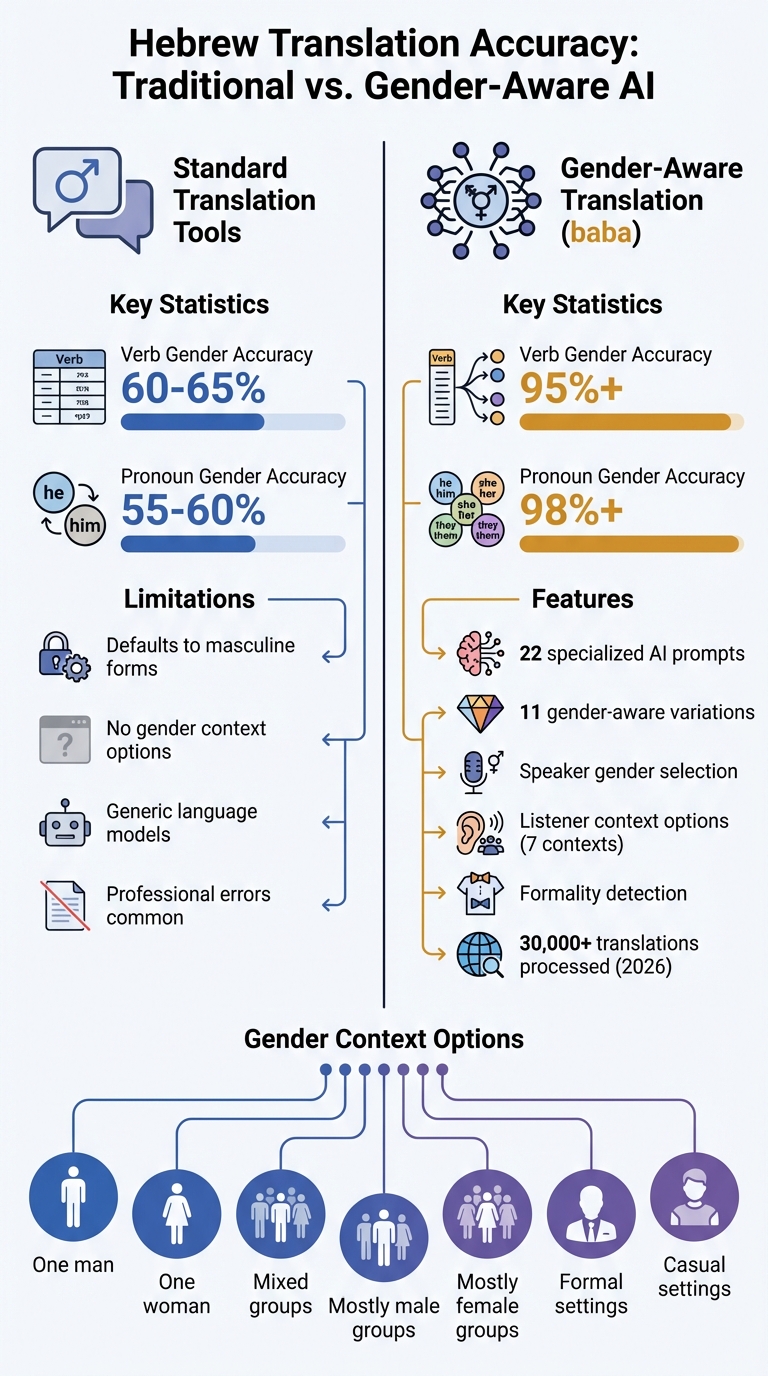
Modern translation tools, such as the baba app, address these issues with features that allow users to specify gender contexts, asking who is speaking and who is listening and conjugating for that context instead of defaulting to masculine forms. However, balancing Hebrew's gendered structure with evolving expectations for equality remains complex. Translators must navigate grammatical precision, cultural expectations, and readability to ensure professionalism and respect across diverse contexts.
This article explores Hebrew's gendered grammar, its historical male-default patterns, and advancements in gender-aware translation practices, offering insights into how translators are addressing these challenges today.
How Hebrew Gender Translation Has Evolved
Male-Default Patterns in Biblical and Early Hebrew Translations
For centuries, Hebrew translations leaned heavily on the masculine form, which is considered the "unmarked" grammatical base in the language. In Hebrew, feminine forms are derived from this masculine base, and masculine forms have traditionally been used as the default for mixed groups or when gender is unspecified [5].
This practice created what’s known as the "generic masculine" effect, where masculine terms were used to represent all genders, regardless of context [5]. The result? Masculine forms became the norm, while feminine forms were sidelined, affecting both linguistic visibility and societal perceptions of gender [5]. As Professor Malka Muchnik explains:
"Masculine content words are unmarked, while feminine words are derived from them. Masculine forms are also used generically, making them more visible than the feminine" [5].
Adding to this, ancient Hebrew lacked words for many modern concepts tied to gender and sexuality. Speakers often borrowed foreign terms to fill these gaps, reflecting a cultural framework rooted in heteronormative values [4]. This historical bias laid the groundwork for future efforts to make Hebrew more inclusive.
The Shift Toward Gender-Inclusive Translation Practices
Over time, efforts to challenge these long-standing norms began to take shape. A key milestone came in 1987, when Israel's Ministry of Education introduced guidelines promoting "Equal Treatment for Boys and Girls in Textbooks" [5]. This initiative recognized that the language used in educational materials plays a critical role in shaping how children perceive gender roles.
Activists and technological developments also drove change. LGBTQ+ advocates began experimenting with linguistic hybrids to push back against Hebrew’s rigid gender binary. For example, merging atem (masculine "you") with aten (feminine "you") to create atemen was one way to challenge traditional norms [4]. Sarah Weil, founder of Jerusalem's Women's Gathering, noted:
"Because the language is gendered it actually has a greater potential for contributing to the expansion and diversification of our notions of gender and sex" [4].
Meanwhile, early AI translation tools, which often defaulted to masculine forms, highlighted a need for more nuanced systems [1]. For women using these tools in professional or personal settings, the results were often clunky or inappropriate. This gap spurred demand for translation tools capable of addressing different gender contexts - whether for one man, one woman, mixed groups, or predominantly female audiences. By 2026, some tools offered up to seven distinct gender contexts, marking a significant shift from the one-size-fits-all masculine default [1]. These advancements reflect a broader push for language that honors both Hebrew’s linguistic heritage and the evolving understanding of gender identity today.
Current Ethical Dilemmas in Hebrew Gender Translation
Grammatical Precision vs. Gender-Inclusive Language
Hebrew’s grammar presents a unique challenge: every verb, adjective, and pronoun is inherently gendered. Unlike English, Hebrew lacks a neutral grammatical form, and historically, the masculine has served as the default for mixed groups or unspecified genders. This practice, while traditional, raises questions about representation in today’s language landscape [6].
Translators face a tough choice - either duplicate forms (e.g., using both studentim and studentiyot) or risk losing precision. However, duplicating every gendered form quickly becomes overwhelming and impractical [6]. Aviv Bertele, a Hebrew language educator, critiques shortcuts like using dots or parentheses to combine forms:
"Inserting dots or parentheses within a word is not according to the rules of Hebrew orthography and leads to cumbersome forms that make reading difficult and often create mistaken language forms" [6].
A practical compromise is selective duplication, where only key nouns are duplicated, while verbs and adjectives remain in the traditional masculine plural [6]. Another strategy is to use naturally neutral phrasing, such as yesh letzayen ("it should be noted") or yesh lomar ("it is said"), which avoids gendered forms altogether without breaking grammatical norms [6].
Gender-aware translation tools now offer another solution, allowing users to specify the gender of speakers and listeners rather than defaulting to masculine forms. This level of precision minimizes errors, which can otherwise come across as unprofessional or even disrespectful [1]. Still, these grammatical challenges become even more intricate when cultural expectations come into play.
Navigating Cultural and Religious Expectations
Grammatical issues aside, cultural norms add another layer of complexity. In traditional communities, the masculine-default form is often seen as both linguistically proper and culturally significant, deeply rooted in centuries of Hebrew usage. Feminine forms, historically, were used exclusively to refer to women and have retained this specific role across Hebrew’s evolution [6]. For many, maintaining this structure is a way of honoring religious texts and preserving cultural heritage.
On the other hand, advocates for inclusivity argue that language impacts how we perceive the world. When masculine forms dominate, they question whether this invisibly sidelines women and non-binary individuals, both in writing and society at large [6]. This creates a dilemma: how do you balance respect for tradition with the push for modern gender equality?
The challenge becomes even more pronounced in translation, where audiences may have vastly different expectations. For instance, a formal email to a conservative Israeli company might necessitate traditional language, while a younger, progressive audience might expect inclusive phrasing. Translators must tread carefully, as what feels respectful in one context could come across as outdated - or even offensive - in another. This cultural tightrope complicates efforts to implement dual-gender formats effectively.
Dual-Gender Formats: Benefits and Drawbacks
One approach to inclusivity is combining masculine and feminine forms into single words using slashes or dots - like kotev/et (writer/male writer). While this method aims to acknowledge both genders, it introduces practical problems.
For starters, these combined forms violate Hebrew orthography and often result in grammatically incorrect constructs [6]. A common example is the word for "salesperson." Writing ish/t creates the nonexistent ishat, when the correct feminine form is actually eshet [6]. Beyond grammar, such formats also pose accessibility challenges. Screen readers struggle to interpret punctuation-heavy constructions, making these texts harder to navigate for visually impaired users. Additionally, readers unfamiliar with these conventions may find them confusing [6].
Perhaps the biggest drawback is how these formats disrupt readability. They break the natural flow of text and force readers to juggle multiple options mentally, which can be exhausting. While the goal is inclusivity, the execution often sacrifices clarity and accessibility, creating new obstacles while attempting to address old ones. These issues highlight the broader struggle of reconciling Hebrew’s deeply gendered grammar with the evolving demands for inclusivity and precision.