Using Gender Grammar in Professional Networking
When engaging in professional networking in Hebrew, understanding and applying gender-specific grammar is crucial. This includes aligning verb forms and pronouns with the recipient's gender to ensure clear and respectful communication.
How to Address Men and Women in Business Settings
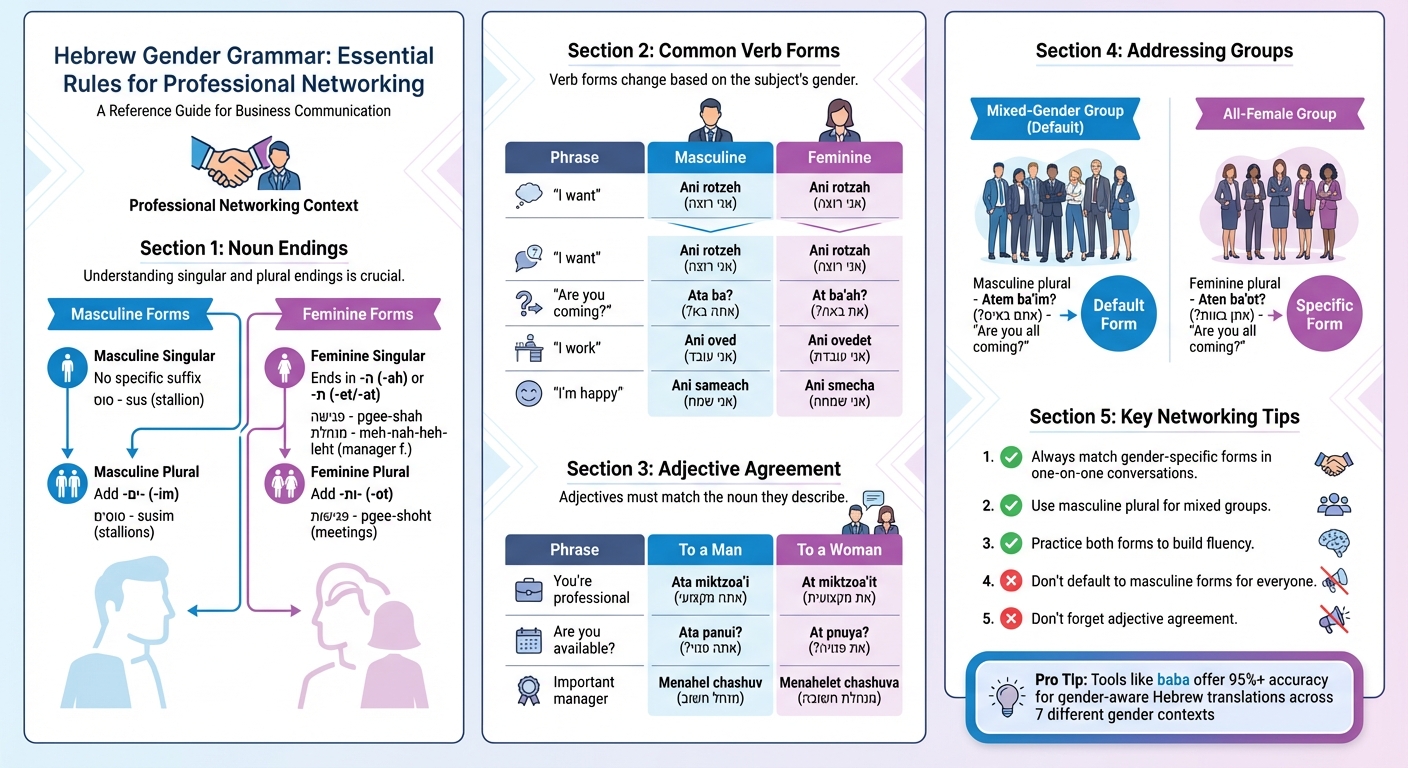
In one-on-one conversations, tailoring your language to match the recipient's gender is essential. For example, when asking a male colleague or client, "Are you available for a meeting?" you would say Ata panui l'pgisha? (אתה פנוי לפגישה?). For a female colleague, the phrasing changes to At pnuya l'pgisha? (את פנויה לפגישה?). Notice how both the pronoun and adjective adjust based on gender.
This principle extends to written communication as well. A man stating "I work in tech" would write Ani oved b'high-tech (אני עובד בהייטק), while a woman would write Ani ovedet b'high-tech (אני עובדת בהייטק). Whether in emails, meetings, or calls, using the correct forms demonstrates cultural awareness and professionalism.
Speaking to Mixed-Gender Groups
When addressing a group that includes both men and women, Hebrew typically uses the masculine plural form. For example, asking a mixed team, "Are you all coming?" would be phrased as Atem ba'im l'pgisha? (אתם באים לפגישה?). This masculine plural form is the default in most professional contexts.
However, if you're speaking to an all-female group - such as a women's panel or team - the feminine plural form is appropriate: Aten ba'ot l'pgisha? (אתן באות לפגישה?). While some modern speakers experiment with slash notation in written Hebrew, the masculine plural remains the standard for mixed groups in spoken settings.
For professionals navigating these nuances, tools like baba can simplify the process. This app offers gender-aware translations tailored to specific audiences, whether you're addressing one man, one woman, a mixed group, or a predominantly female audience. It adjusts verbs, adjectives, and pronouns automatically, helping ensure your communication is polished and respectful.
Up next: Learn how to avoid common Hebrew translation mistakes and handle them with ease.
Common Gender Grammar Mistakes and How to Fix Them
Building on the foundational rules, let’s dive into some common gender-related grammar mistakes and practical ways to fix them, especially in professional networking settings. Even experienced language learners can slip up, and these errors can unintentionally harm your credibility. By addressing them, you can communicate more clearly and respectfully.
One of the most frequent mistakes is defaulting to masculine forms for everyone, regardless of their gender. This issue stems from Hebrew’s traditional use of masculine plural forms for mixed groups. However, applying this convention to individual conversations creates significant problems. Using masculine verbs and pronouns for a female colleague, for instance, is akin to misgendering someone in English - it’s jarring to native speakers and can come across as impersonal or even disrespectful.
Take this example: asking a male colleague, Ata rotzeh lehitkadem? (אתה רוצה להתקדם?), meaning "Do you want to advance?" is perfectly fine. But using the same masculine form when speaking to a woman is incorrect. The feminine equivalent is: At rotzah lehitkadem? (את רוצה להתקדם?). The difference lies in both the pronoun (Ata → At) and the verb ending (rotzeh → rotzah). To native speakers, this distinction is crystal clear, and getting it wrong can undermine your message.
Now let’s look at how these mistakes can also affect adjectives and other common professional phrases.
Verb and Adjective Errors in Professional Phrases
In professional conversations, gender mistakes often sneak into descriptive phrases. Adjectives, like verbs, must align with the subject's gender. For example, telling a male client "You’re very professional" is: Ata meod miktzoa’i (אתה מאוד מקצועי). But for a female client, the correct phrase is: At meod miktzoa’it (את מאוד מקצועית). That small "et" ending signals the feminine form and cannot be overlooked.
Similarly, when expressing your own emotions, the adjective must match your gender. A man would say, Ani sameach (אני שמח), meaning "I’m happy", while a woman would say, Ani smecha (אני שמחה). These subtle shifts are crucial for accurate and respectful communication.
If keeping track of all these variations feels overwhelming, there’s good news. Tools like baba are designed to simplify gender grammar. This app allows you to specify both your gender and your audience’s gender, adjusting verbs, adjectives, and pronouns accordingly. It’s a lifesaver for professionals who want to focus on their message without worrying about grammatical slip-ups.
Understanding these nuances is a key step toward seamless, gender-aware communication in Hebrew.
Building on the basics of gender grammar, these tools and methods help you refine your skills for professional networking.
Practice Dialogues for Networking Events
The best way to master gender grammar is through practical application. Rehearse common networking phrases tailored to different audiences. For instance, when speaking to a male colleague, you might say "Ata ba?" (אתה בא?), which means "Are you coming?" For a female colleague, the phrase changes to "At ba'ah?" (את באה?). In mixed groups, the default masculine plural applies: "Atem ba'im?" (אתם באים?).
To build confidence, create dialogues that reflect Israeli business scenarios. When introducing yourself, use gender-appropriate verb forms. If you're male, say "Ani rotzeh lehakir" (אני רוצה להכיר), and if you're female, say "Ani rotzah lehakir" (אני רוצה להכיר). Both translate to "I want to get to know [you/the company]", but the verb endings depend on your gender, not the listener's. Practice these lines aloud, alternating between different audiences, until the patterns feel natural.
At the University of Washington, Hebrew students practiced gender-specific grammar by adapting sentences like "She/He loves Yitzhak" into both feminine and masculine forms. This exercise helped them gain fluency in inclusive language use. Many students noted that repetition within meaningful contexts made gender agreement second nature, especially during group discussions. The lesson? Consistent practice in real-life scenarios is key.
Once you've practiced manually, take advantage of a specialized tool to ensure accuracy in real time.
Using baba for Gender-Aware Hebrew Translation
While practice is essential, having a reliable tool can make a world of difference. Enter baba, an AI-powered app that simplifies Hebrew's gender grammar complexities. It offers seven gender contexts - such as "To One Man", "To One Woman", or "To Mixed Group" - allowing you to tailor translations to your audience instantly. For example, input "Introduce myself to a female colleague", and baba will generate "Shalom, ani [name], eich at?" (שלום, אני [שם], איך את?), using the correct feminine forms.
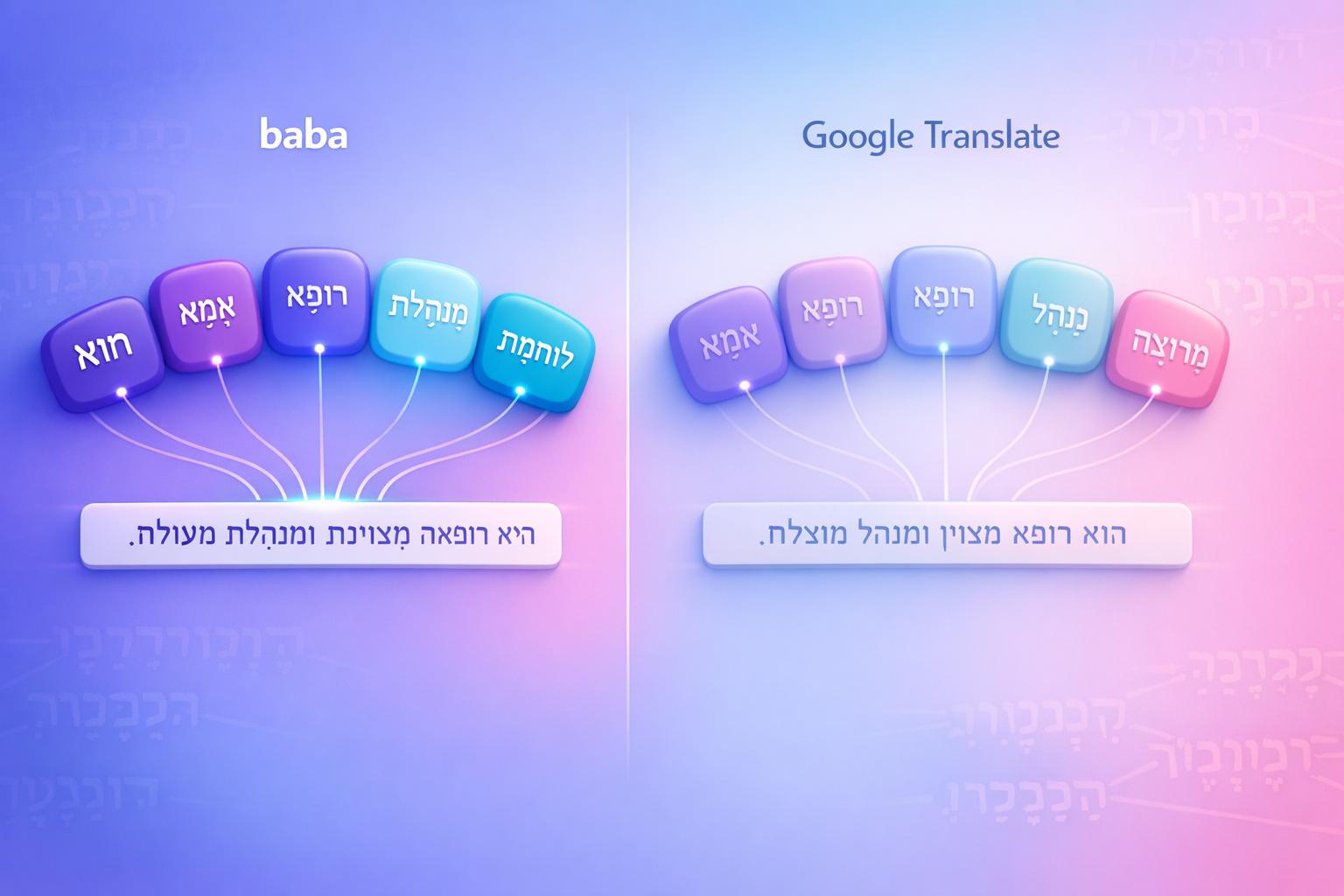
baba asks who is speaking and who is listening and conjugates for that context, outperforming traditional translation tools that often default to masculine forms. Its 22 specialized AI prompts are designed specifically for Hebrew, ensuring that your phrases sound natural to native speakers. The app, available on iOS and Android, boasts a perfect 5.0-star rating and includes features like Hebrew transliteration for pronunciation, voice mode for hands-free use, and even a slang mode to help you navigate modern Israeli business language.
Business developer Chen Wei shares: "Finally, an app that teaches how people actually speak, not just biblical or formal Hebrew. My business meetings are so much smoother now." [2]
Download baba at get.itsbaba.com/blog and use it to translate your networking scripts across different gender contexts. For instance, compare how "Follow up email to male client" produces masculine forms, while "Follow up email to female client" adjusts every verb and adjective accordingly. This immediate feedback speeds up your learning and takes your skills beyond traditional methods.
Conclusion: Building Confidence in Hebrew Networking
Mastering Hebrew's gender grammar isn't just about learning a language - it's about creating meaningful and professional connections. For example, addressing a female colleague with "At medaberet ivrit metzuyen" (את מדברת עברית מצוין – You speak Hebrew excellently) instead of the masculine "At medaber" shows that you understand the nuances of the language and respect cultural norms. This small adjustment can make conversations feel more natural and less awkward.
The key to success lies in following clear rules, practicing regularly, and using tools designed to address these challenges. Relying on masculine forms by default can come across as impersonal or even disrespectful. Paying attention to gender-specific verb forms signals your dedication to mastering the subtleties of Hebrew. These strategies aren't just theoretical - they're meant to be applied in real interactions.
Thankfully, tools like baba make navigating Hebrew's complexities much easier. By asking who is speaking and who is listening and conjugating for that context, this app ensures your phrases sound natural, regardless of gender context. Available on iOS and Android, and boasting a flawless 5.0-star rating, it simplifies the hard parts so you can focus on building professional relationships.
Business developer Chen Wei shares: "Finally, an app that teaches how people actually speak, not just biblical or formal Hebrew. My business meetings are so much smoother now." [2]
To get started, practice introducing yourself in both masculine and feminine forms. Learn to address mixed groups with the correct plural forms, and use gender-aware tools to double-check your phrases before important meetings. With the right resources and consistent effort, Hebrew's gender grammar becomes far less intimidating, paving the way for confident and effective networking.
FAQs
How can I speak correctly if I don’t know someone’s gender?
To communicate effectively in Hebrew without assuming someone's gender, you can use gender-neutral language or forms. One approach is to choose plural forms like "אתם" (atem) or "אתן" (aten) when addressing groups. Alternatively, opt for inclusive terms such as "צוות" (tzavt, meaning team). Modern Hebrew has also started incorporating more neutral expressions to accommodate this need. If you're unsure, using polite, neutral phrasing is a safe choice - or simply ask for clarification when it's appropriate.
Do I need to use masculine plural when addressing a mixed group at work?
Yes, in Hebrew, the masculine plural form is typically used when addressing a mixed group. For example, "אתם באים" (atem ba'im) means "you are coming" and serves as the standard default when speaking to groups that include both men and women.
What’s the fastest way to avoid gender mistakes in emails and meetings?
To steer clear of gender-related mistakes in Hebrew emails and meetings, adopt a gender-aware translation approach. This method tailors pronouns, verbs, and adjectives to match the gender of both the speaker and the audience. Using an AI-powered tool like baba can help ensure precise gender usage, minimizing errors and maintaining a professional tone. Alongside this, taking the time to learn and understand Hebrew gender rules can improve your communication and show greater respect in your interactions.
Frequently Asked Questions
Why does Hebrew grammar change depending on who I'm talking to?
Hebrew is a gendered language, meaning verbs, adjectives, and pronouns all shift based on the gender of both the speaker and the person being addressed. So "Are you available?" sounds different when asked to a man versus a woman—it's not optional, it's baked into the grammar.
How do I write a professional email in Hebrew to someone whose gender I don't know?
A common workaround is slash notation—writing מנהל/ת to cover both forms at once—or defaulting to the masculine plural, which is the conventional standard in mixed or ambiguous contexts. Some modern writers also rephrase to use team nouns like צוות that sidestep the issue entirely.
Does it really matter if I use the wrong gender form in a business conversation?
To a native Hebrew speaker, yes—using the wrong gender form stands out immediately and can come across as careless or impersonal, similar to misgendering someone in English. Getting it right signals genuine cultural fluency and earns more trust in professional settings.
How do feminine and masculine plural forms work in Hebrew, and when do I use each?
Masculine plurals add ים- and are used as the default for mixed-gender groups, while feminine plurals add ות- and apply when addressing an all-female group. In spoken professional settings, masculine plural is almost always the safe default unless you know the group is entirely women.
Is there a tool that automatically adjusts Hebrew for the right gender instead of me having to memorize all the rules?
baba Hebrew Translator lets you select the gender context—one man, one woman, mixed group, and more—and adjusts every verb, adjective, and pronoun accordingly, so your Hebrew comes out sounding natural rather than grammatically off.