Common Errors in Gendered AI Translation
AI translation often struggles with gender-specific grammar, leading to errors that misrepresent speakers and confuse audiences. For example, in Hebrew - where 80% of verbs are gendered - AI tools frequently default to masculine forms, even when the speaker is female. These mistakes can undermine trust, create awkward interactions, and even cause business losses.
Key Issues:
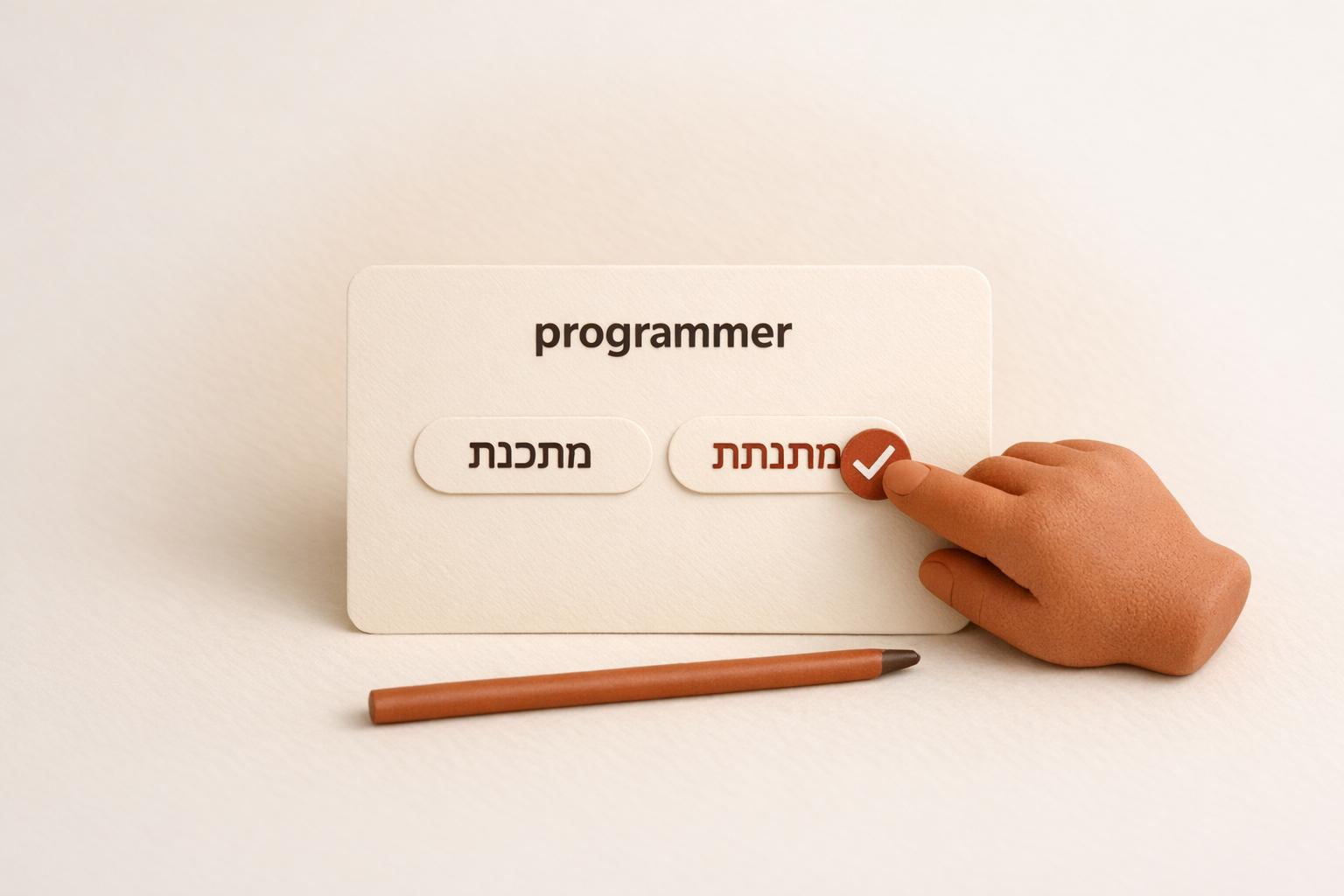
- Defaulting to Male Forms: AI often uses masculine defaults, like translating "I am going" into Hebrew as "ani holech" (masculine) instead of "ani holechet" (feminine).
- Gender Stereotyping in Job Titles: Professions like "doctor" and "nurse" are often inaccurately translated based on outdated stereotypes.
- Mishandling Gender-Neutral Hebrew Translation: English phrases like "I am a teacher" often lose context when translated into gendered languages, leading to errors.
Why It Happens:
- Biased Training Data: AI models are trained on datasets that overrepresent masculine forms.
- Lack of Context Awareness: Translation systems rely on statistical probabilities, missing speaker or audience cues.
Solutions:
- Human Review: Professional linguists ensure translations align with intended meanings.
- Gender-Sensitive Tools: Advanced systems like baba account for gender nuances, asking who is speaking and who is listening rather than defaulting to masculine forms.
- User-Specified Gender Options: Allowing users to define gender context improves translation accuracy.
Accurate gendered translations matter for clear communication, trust, and professionalism. Tools designed for gender-sensitive languages, combined with human expertise, can reduce errors and improve interactions.
Common Gender Translation Errors
AI Gender Translation Error Rates in Hebrew and Gendered Languages
These errors distort communication by misrepresenting both the speaker and the intended audience, often leading to confusion and reinforcing stereotypes.
Defaulting to Male Forms
One of the most frequent issues is the automatic use of masculine defaults. For instance, typing "I am going" into a typical translation tool produces "ani holech" (masculine) in Hebrew, regardless of whether the speaker is male or female. The correct feminine form, "ani holechet", is often ignored. This happens because AI systems are trained on datasets that lean heavily toward male-centric examples.
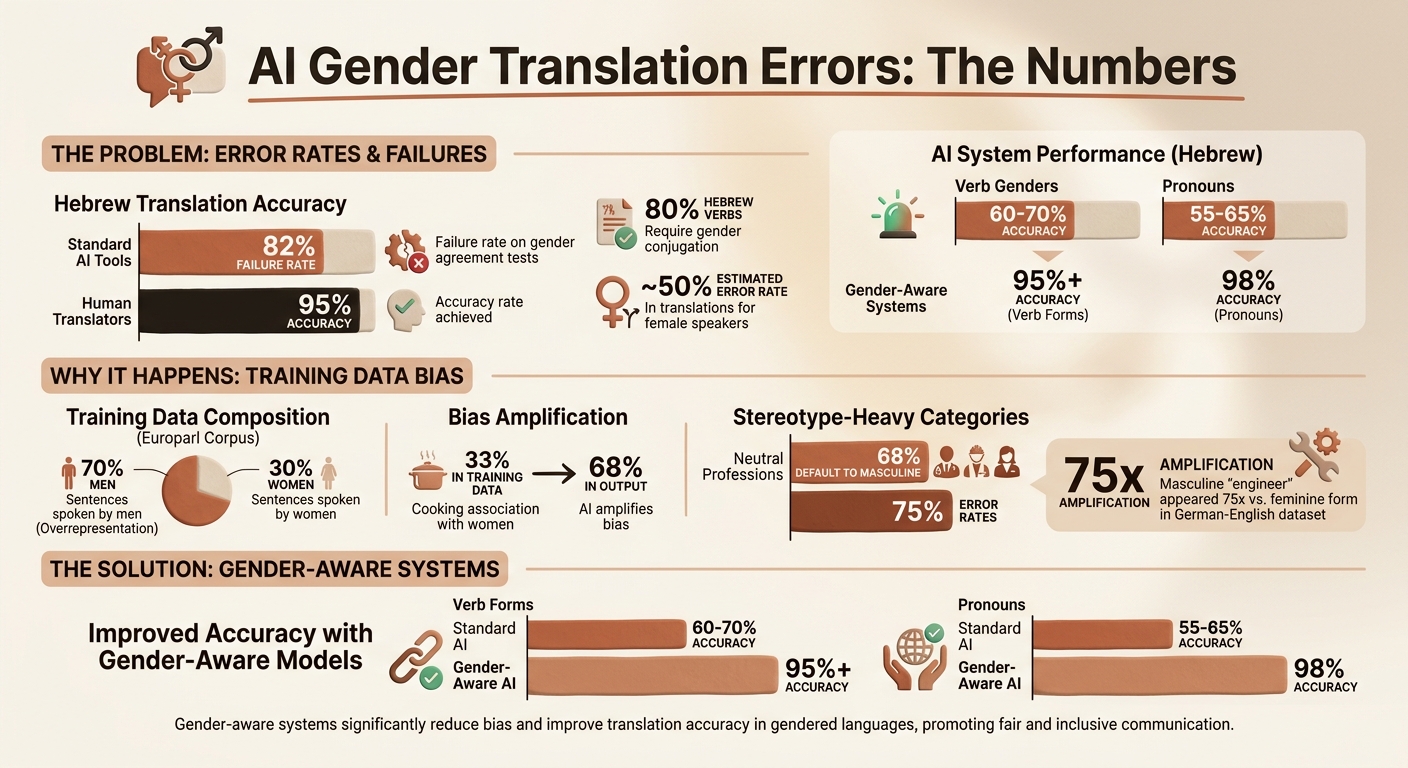
baba Technology has highlighted this problem, pointing to cases where a female voice saying "I love you" was translated as the masculine "Ani ohev otcha" instead of the feminine "Ani ohevet otcha." Standard translation tools frequently fail gender agreement tests in Hebrew. Considering that 80% of Hebrew verbs require gender conjugation, this leads to frequent errors in translations for female speakers.
But the problem doesn’t stop at verb forms. AI systems also perpetuate gender stereotypes, compounding the issue.
Gender Stereotyping in Job Titles
Translation tools often assign gender to job titles based on outdated stereotypes. For example, translating "doctor" from English to Spanish results in "el doctor" (masculine), while "nurse" becomes "la enfermera" (feminine). Despite being gender-neutral in English, these roles are skewed by the AI’s assumptions.
AI translations for neutral professions like "engineer" or "teacher" often default to masculine forms in gendered languages, especially in stereotype-heavy categories. For instance, in French, "engineer" is translated as "ingénieur" (masculine), reinforcing biases embedded in training data. These stereotypical translations highlight the urgent need for cultural context in Hebrew AI translations to ensure accuracy.
Mishandling Gender-Neutral Source Languages
English, which doesn’t mark gender on verbs or adjectives, poses a unique challenge when translated into languages like Hebrew. Take the phrase "I am a teacher" - without gender cues, AI systems default to the masculine "ani moreh" instead of the feminine "ani mora", even if the speaker is female.
In a 2026 business scenario, an English-to-Hebrew email translated "I will attend the meeting" as the masculine "ani agie", leading to a female executive being misgendered in front of Israeli clients. Similarly, in Turkish, the gender-neutral "doktor" is often translated into Hebrew as "rofe" (masculine) instead of the appropriate feminine "rofa", depending on the speaker. These missteps not only cause miscommunication but also undermine trust in professional and personal interactions where gender accuracy is critical.
sbb-itb-7e51dcc
Why These Errors Happen
To understand why these translation errors persist, we need to examine their root causes. They primarily arise from two factors: the biases in training data and the systems' inability to process contextual cues as humans do.
Biased Training Data
AI translation models are trained on massive datasets sourced from the internet, books, and public documents. Unfortunately, these datasets often reflect historical gender biases. For example, the Europarl corpus - a widely used training dataset - shows a stark imbalance, with only 30% of sentences spoken by women. This overrepresentation of masculine forms causes AI systems to default to them.
"Automated translation engines amplify the biases of their training data sets."
- Dr. Nicolas Kayser-Bril, AlgorithmWatch
The impact of this amplification is significant. A 2017 study revealed that when "cooking" was associated 33% more frequently with women in the training data, the translation engine exaggerated this association to 68%. Similarly, in a German–English dataset, the masculine form of "engineer" appeared 75 times more often than the feminine form. In languages like Hebrew, where gender conjugation affects about 80% of verbs, this bias can lead to frequent incorrect translations when the speaker is female.
The problem is compounded because standard models lack the parameters needed to account for factors like the speaker's gender, the listener's gender, or the group's composition. Even with better training data, these models struggle to overcome their reliance on statistical patterns.
Missing Context in AI Processing
Another major challenge lies in how translation systems process text. Most systems lack the ability to clearly identify the speaker or the audience, forcing them to rely on statistical probabilities rather than nuanced human context.
A common approach in AI translation involves using English as an intermediary "pivot" language. Since English has fewer gender-specific markers - terms like "teacher" or "doctor" are neutral - critical gender cues from the original language can be lost. When translating into a highly gendered language like Hebrew, the system often guesses the gender based on statistical likelihood rather than context.
"Machine translation seems prone to exploit statistical biases in its training data rather than rely on more meaningful context cues."
- Gabriel Stanovsky, Researcher
This reliance on statistical patterns explains why many translation systems struggle with verb gender and pronoun accuracy in Hebrew. Without explicit controls for factors like the speaker's gender or the group composition, algorithms tend to favor the most statistically probable output - often masculine - resulting in translations that sound awkward or unnatural to native speakers.
