AI Tools for Hebrew: What Educators Need to Know
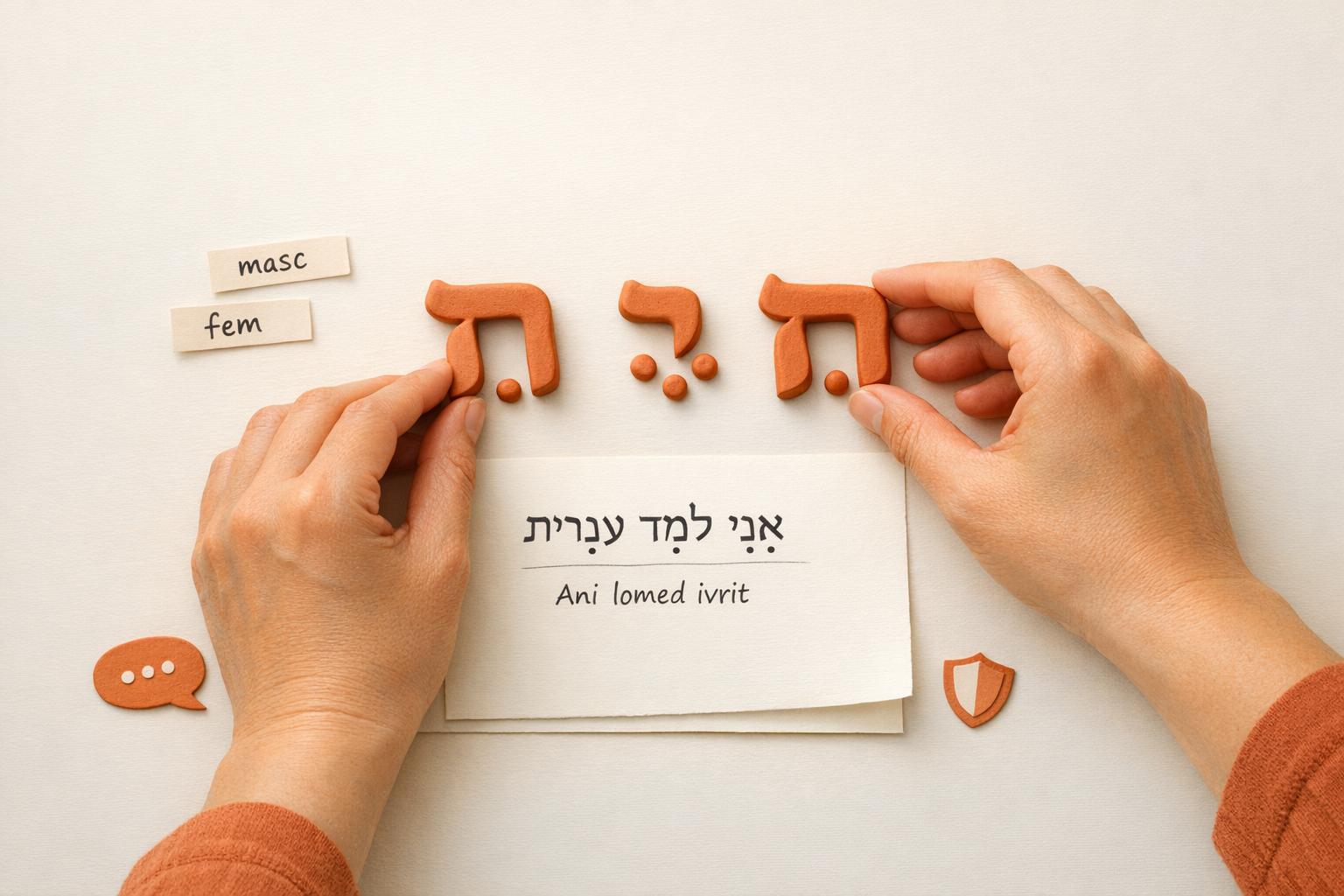
Teaching Hebrew in 2026 presents unique challenges, particularly with its gendered grammar system and the gap between formal and conversational usage. Hebrew verbs and adjectives change based on gender, making it difficult for students to master natural communication. Additionally, modern Israeli slang and idioms - used in 60% of daily conversations - are often missing from textbooks, leaving learners sounding outdated or overly formal. Generic translation tools also default to masculine forms, creating confusion.
Key Takeaways:
- Gender Grammar: Hebrew verbs have over 20 forms influenced by gender, number, and tense. Most translation tools fail to address this complexity.
- Modern Usage: Slang and idioms are critical for conversational fluency but are poorly covered in traditional resources.
- AI Solution: The baba app provides gender-aware translations, slang explanations, and transliteration for beginners, asking who is speaking and who is listening rather than defaulting to masculine forms.
Hebrew Learning Challenges and AI Solutions: Key Statistics for Educators
Common Hebrew Teaching Challenges and AI Solutions
Teaching Hebrew's Gender Grammar System
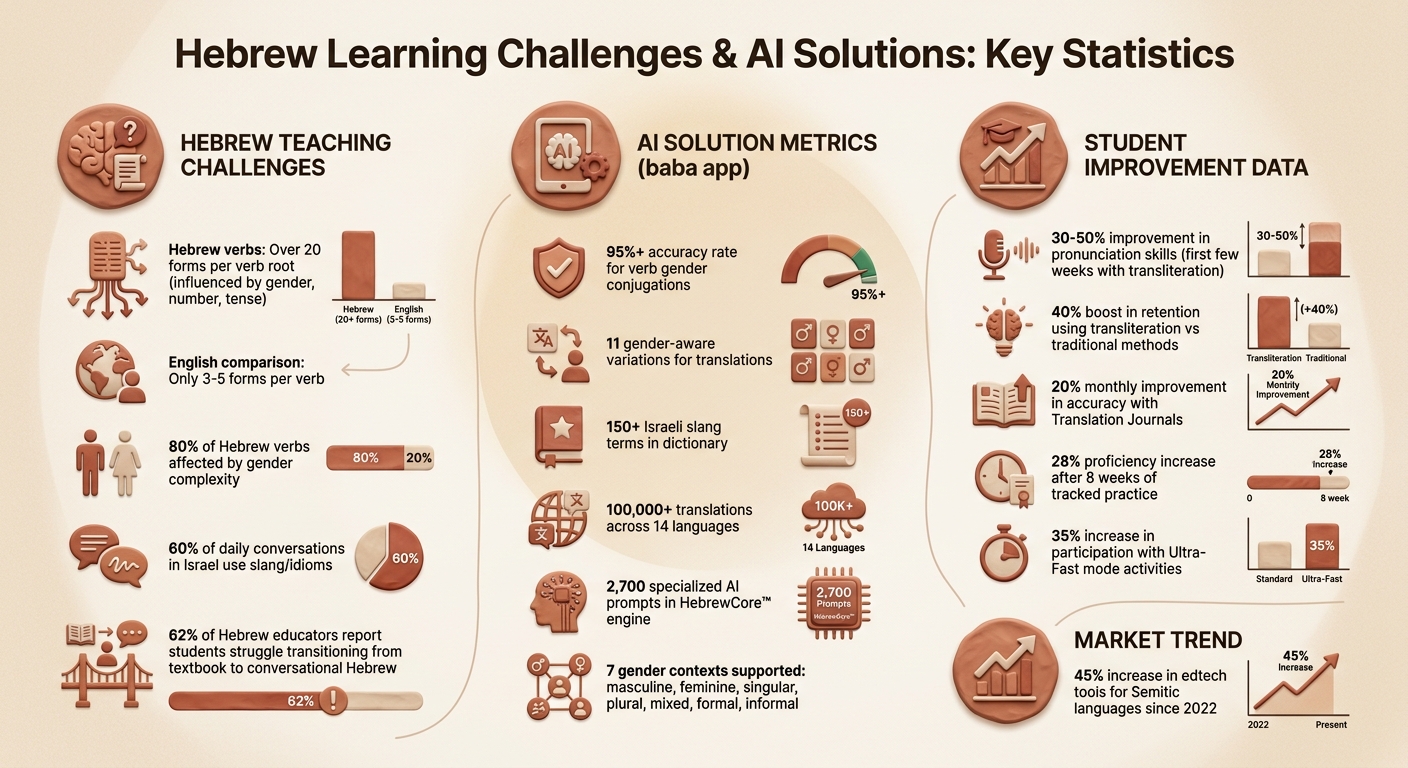
Hebrew grammar is no walk in the park - especially when it comes to verbs. Each verb root can branch into over 20 forms, depending on gender, number, tense, and aspect. Compare that to English, where you might only deal with 3–5 forms per verb, and it’s easy to see why educators find Hebrew grammar daunting [6]. This complexity impacts about 80% of Hebrew verbs [1], making it a major hurdle for students learning the language.
Here’s the twist: Hebrew doesn’t just change verbs based on the speaker’s gender - it also adjusts adjectives and pronouns depending on both the speaker and the listener. For example, saying "I went" differs depending on whether the speaker is male or female. Similarly, "you are beautiful" is expressed as at yafa (את יפה) when addressing a woman, but ata yafe (אתה יפה) when speaking to a man [5].
The challenges don’t stop there. Hebrew school teachers commonly report that students struggle to transition from biblical or textbook Hebrew to conversational Israeli Hebrew. The gender system is a significant part of this struggle, especially since most translation tools default to masculine forms [1].
AI tools are stepping in to tackle this issue. For example, baba – Smart Hebrew Translation uses 11 gender-aware variations to reflect speaker and listener gender as well as social context [5]. By showing how phrases shift based on who’s speaking and listening, these tools turn abstract grammar rules into something students can actually use in conversation. baba asks who is speaking and who is listening and conjugates for that context, giving educators reliable examples to help students grasp these tricky concepts.
But gender grammar is just one piece of the puzzle. Everyday conversational Hebrew brings its own set of challenges.
Connecting Textbook Hebrew to Real Conversations
Modern Hebrew isn’t just about grammar - it’s also about keeping up with how people actually talk. Everyday Israeli Hebrew is packed with slang and idioms influenced by languages like Arabic, Russian, and English [7]. This creates a disconnect between textbook Hebrew and the language students hear in real life. In fact, about 60% of daily conversations in Israel involve slang or idiomatic expressions [1]. And literal translations? They often miss the mark entirely.
Take the phrase "חבל על הזמן" (chaval al hazman), for instance. While it literally means "waste of time", in modern usage, it actually means "amazing." Without understanding these shifts, students risk sounding overly formal - or worse, completely miscommunicating.
AI tools with slang mode functionality are helping bridge this gap. These tools don’t just provide dictionary definitions - they offer cultural context, explaining what phrases mean, when to use them, and who typically uses them [5]. They draw from real-world sources like WhatsApp chats, social media, and everyday Israeli speech [2], giving students a more accurate picture of how Hebrew is spoken today. Teachers can use these tools to introduce modern expressions, helping students sound natural and confident in real conversations.
The demand for culturally aware AI tools is growing. Since 2022, there’s been a 45% increase in edtech tools for Semitic languages [9]. This trend highlights a clear shift in Jewish education: students need exposure to authentic, conversational Hebrew - not just textbook grammar. By incorporating AI tools, educators can ensure students are equipped to navigate both the grammatical intricacies and the slang of modern Hebrew. Together, these elements bring students closer to fluency and real-world communication.
sbb-itb-7e51dcc
What AI Can’t Teach You About Speaking Hebrew
Using baba in Hebrew Classrooms
Teaching Hebrew comes with its own set of challenges, especially when it comes to the language's intricate gender grammar and the gap between formal and colloquial usage. To tackle these issues, educators need more than just a basic translator. Enter baba – Smart Hebrew Translation, a tool specifically designed to address Hebrew's unique complexities, available on both iOS and Android [1].
What makes baba stand out is its HebrewCore™ engine, built with over 2,700 specialized AI prompts tailored just for Hebrew [1][3]. This advanced system is designed to handle the everyday hurdles of the language, including gender-specific conjugations, modern slang, and even ensuring student privacy. With over 100,000 translations across 14 languages under its belt, baba has proven its ability to meet the distinct needs of Hebrew learners [4][2].
Gender-Aware Translations for Student Interactions
One of baba's most impressive features is its ability to provide gender-specific translations, a critical need in Hebrew classrooms. Since Hebrew's gender system influences about 80% of all verbs [1], many translation tools fall short by defaulting to masculine forms, leading to awkward or even incorrect translations. baba, however, addresses this by accommodating seven gender contexts: masculine, feminine, singular, plural, mixed, formal, and informal [4][3]. This allows teachers to demonstrate how phrases like "you are beautiful" change depending on the speaker and listener's gender.
The tool's Gender Intelligence™ takes this a step further by remembering the gender of participants throughout a conversation, ensuring translations stay consistent and natural, rather than defaulting to masculine forms. baba provides educators with reliable material for teaching. Dr. Rachel Cohen, a Hebrew teacher, shares her experience:
"I'm a Hebrew teacher, and I've tried every translation app out there. baba is in a completely different league when it comes to accuracy, especially with gender and formality" [4].
Students can also set up personal gender profiles, so their first-person statements are automatically conjugated correctly. For addressing others, they can use a context selection tool to specify whether they're speaking to a man, a woman, or a mixed group. This turns what might seem like abstract grammar rules into practical, real-world skills.
Teaching Modern Hebrew with Slang Mode
The Hebrew found in textbooks often feels worlds apart from the language spoken on the streets. Everyday conversations are filled with slang and idiomatic expressions that can be tricky for non-native speakers to grasp. baba's Slang Mode bridges this gap with a dictionary of over 150 Israeli slang terms, complete with meanings, pronunciation guides, and usage examples [2]. Unlike generic translators that might misinterpret or completely miss slang, baba provides the context students need to use these expressions correctly.
The AI powering baba has been trained on real-life interactions, including WhatsApp chats, social media, and casual conversations, rather than just formal texts [3]. Teachers can enable Slang Mode to help students practice informal Hebrew and build a vocabulary that's relevant to modern life. As content creator Zach Margs puts it:
"baba finally translates Hebrew the way people actually speak. It understands slang, context, and gender, so I don't sound like a scholar from 1820!" [2].
This feature helps students not only learn the grammar but also understand the cultural nuances that make Hebrew a vibrant and evolving language.
Protecting Student Privacy in School Settings
In educational environments, privacy is a top priority, and baba was built with a Private by Design approach [2][3]. Students can use the web translator or mobile app without needing to create an account, ensuring their activities remain anonymous [2][3]. baba operates without tracking, cookies, or data harvesting, and it avoids advertising entirely [2].
For those using Pro features, such as syncing translation history across devices, baba ensures all data is protected through end-to-end encryption [2]. Schools and larger institutions can also access enterprise-level features, including SOC2 compliance, Single Sign-On (SSO), and audit logs, with options for dedicated infrastructure and data residency in regions like the US or EU [2].
The baba team emphasizes their commitment to privacy:
"Anonymous translation requires no account. Signed-in users get their history end-to-end encrypted. We never sell data, and we're not ad-supported" [2].
This privacy-first design allows teachers to integrate baba into their lessons without worrying about compromising student data. It’s a solution that makes teaching Hebrew more effective while ensuring a secure experience for everyone involved.
