Cultural Sensitivity in Translation Tools
Translation tools often struggle with Hebrew due to its unique challenges, like gendered grammar and dynamic slang. Most tools default to masculine forms, making translations sound awkward or incorrect. For example, "Are you coming?" in Hebrew changes based on gender and group dynamics, but generic tools often miss this nuance. Slang and tone further complicate translations, with many tools producing overly formal or outdated results.
Key Takeaways:
- Hebrew's Gendered Grammar: Most words in Hebrew are gender-specific, requiring precise handling for accurate translations.
- Slang and Tone: Modern Hebrew includes evolving slang and context-specific tones that generic tools struggle to interpret.
- Tool Comparison:
- baba: Handles gender, slang, and tone with precision, asking who is speaking and who is listening and conjugating for that context, rather than defaulting to masculine forms.
- Google Translate: Defaults to masculine forms, lacks gender controls, and produces inconsistent slang translations.
- ChatGPT: Struggles with gender accuracy, conversational tone, and modern slang.
Quick Comparison:
| Feature | baba | Google Translate | ChatGPT |
|---|---|---|---|
| Gender Control | Yes (7 contexts) | No | No |
| Slang Handling | Context-aware | Literal/Formal | Variable |
| Pronoun Accuracy | Explicit speaker and listener controls | Inferred from the text, often defaulting to masculine | Inferred from the text, often defaulting to masculine |
| Conversational Tone | Natural | Stiff/Formal | Robotic |
If you're learning Hebrew or need accurate translations, baba stands out by addressing these challenges directly, ensuring translations feel natural and contextually appropriate.
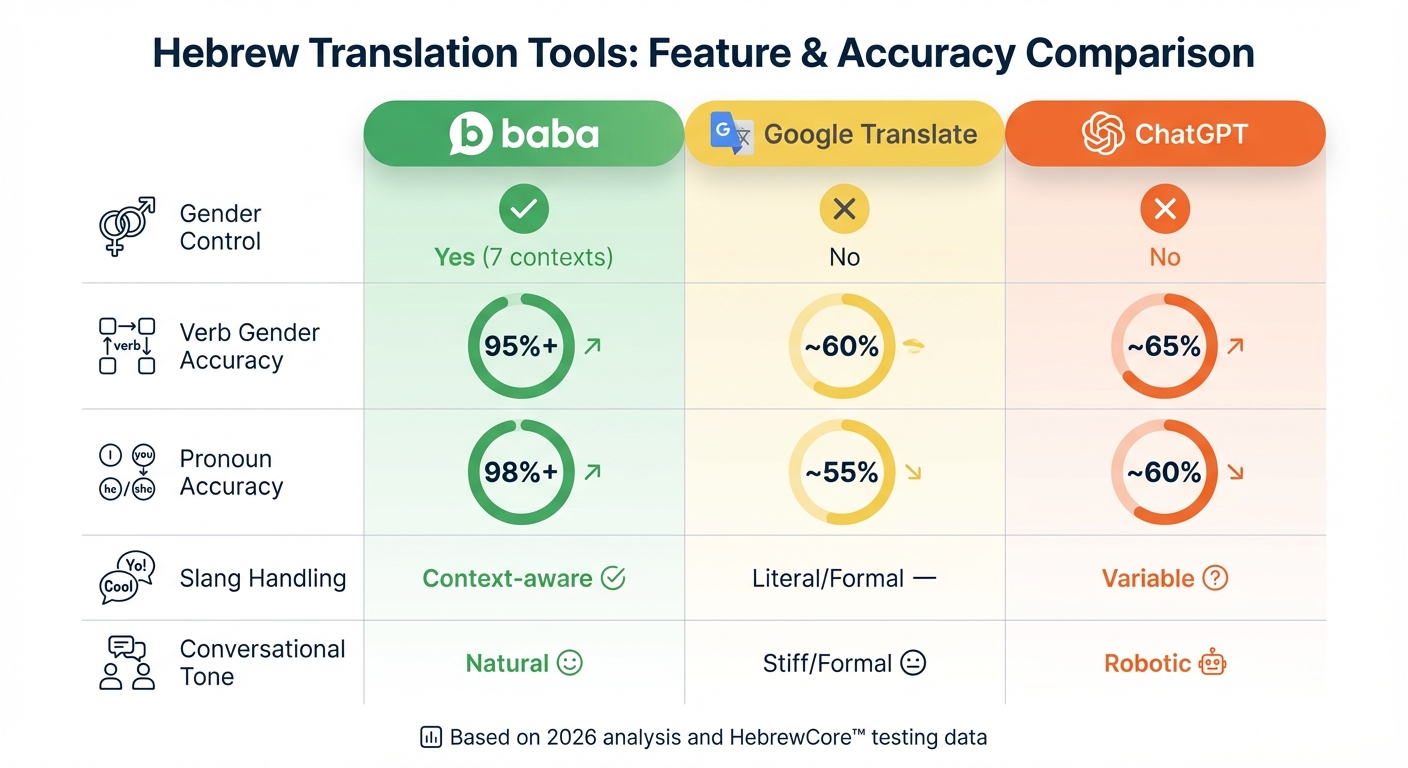
Hebrew Translation Tools Comparison: baba vs Google Translate vs ChatGPT Accuracy Rates
Top 3 AI Translation Apps in 2026 | Complete Guide
sbb-itb-7e51dcc
1. baba - Smart Hebrew Translation
baba reimagines Hebrew translation by embedding cultural awareness directly into its AI framework. Available for iOS and Android, the app incorporates over 2,700 HebrewCore™ prompts tailored to Hebrew's distinct linguistic hurdles [1][2]. Addressing these challenges head-on, baba ensures translations feel natural and fit seamlessly into context. Designed specifically for Hebrew, it excels at managing gender-neutral Hebrew translation, slang, and cultural subtleties.
Gender Sensitivity
One of Hebrew's trickiest aspects is its reliance on gender, which influences nearly every word in a sentence. baba's Gender Intelligence™ system tackles this by defining seven gender contexts: General, Personal, To One Man, To One Woman, To Mostly Men, To Mostly Women, and To Mixed Groups [4]. When users set their gender in their profile, the app automatically adjusts "I" statements to match the correct masculine or feminine forms [3]. For questions like "Are you coming?", it prompts users to specify the recipient's gender, ensuring grammatical precision.
The results speak for themselves: baba asks who is speaking and who is listening and conjugates for that context, rather than defaulting to masculine forms.
As Dr. Rachel Cohen, a Hebrew teacher, explains: "I'm a Hebrew teacher, and I've tried every translation app out there. baba is in a completely different league when it comes to accuracy, especially with gender and formality" [3].
This meticulous attention to gender lays the groundwork for addressing broader cultural dynamics.
Cultural Context
baba goes beyond grammar to understand the social settings in which Hebrew is spoken. The AI automatically distinguishes between Hebrew slang vs. formal Hebrew [2]. For example, the phrase "Please help me" is translated differently depending on whether it's a business request or a casual favor among friends. By analyzing entire conversations, the system ensures consistency in tone and formality, adapting vocabulary and phrasing to fit the situation. This makes it particularly adept at navigating the nuances of real-life communication. But mastering Hebrew also requires an understanding of slang.
Slang Handling
Modern Israeli Hebrew is rich with slang that evolves constantly. Instead of translating word-for-word, baba focuses on conveying the underlying meaning [1]. The app is trained on real-world conversations and everyday speech patterns, not just formal texts [2]. This approach ensures that translations sound natural and up-to-date, avoiding the robotic or outdated tone that can plague other tools.
2. Google Translate
Google Translate is a powerful tool, offering support for over 200 languages, including Hebrew, and features like voice, image, and document translation [5]. However, when it comes to Hebrew, it often stumbles over the subtleties of the language, particularly in gender handling and slang interpretation. Let’s dive into how these issues - gender sensitivity, cultural context, and slang interpretation - impact the tool’s effectiveness.
Gender Sensitivity
One of Google Translate's major flaws is its default use of masculine forms, regardless of the context [5]. For example, translating "I am happy" into Hebrew results in ani sameach, which is the masculine form, even if the speaker is female [3]. This happens because the tool leans on statistical patterns rather than applying clear Hebrew gender rules [5]. Unfortunately, it doesn’t allow users to specify the speaker's or audience's gender, which can lead to awkward or inappropriate translations.
Sarah Goldstein, a business traveler, shared her frustration: "As a woman using translation apps in Israel, I was always embarrassed when other apps made me sound like a man" [3].
Cultural Context
Another weak spot for Google Translate is its inability to handle the nuances of formal and informal Hebrew. The tool often defaults to informal masculine forms, even in situations where formal or gender-specific language is necessary [3]. For instance, translating "Please help me" results in bevakasha ta'azor li, which is informal and masculine. This lack of adaptability can make translations sound unnatural or even disrespectful in professional or polite settings. Native Hebrew speakers often describe the output as "robotic" or overly "textbook" [6][3].
Slang Handling
When it comes to Hebrew slang, Google Translate struggles even more. It frequently produces literal, word-for-word translations that miss the cultural nuances entirely [5]. While it sometimes manages to get contemporary Israeli expressions right, the results are inconsistent at best. This makes it suitable for basic tasks, like translating signs, but far less reliable for everyday conversations where understanding slang and tone is key [5].
3. ChatGPT
ChatGPT can translate Hebrew, but it often stumbles when it comes to gender-specific language, conversational tone, and slang. Here's a closer look at where it falls short:
Gender Sensitivity
Hebrew is a gendered language, and ChatGPT frequently defaults to masculine forms. For example, it might translate "I am tired" as Ani Ayef, even if the speaker is female, where the correct phrase would be Ani Ayefah. This one-size-fits-all approach can lead to inaccuracies and misunderstandings.
Conversational Tone
The translations often come across as overly formal or even outdated. Instead of producing natural, everyday Hebrew, the output can feel stiff and robotic, making it less useful for casual conversations or modern communication.
Slang and Wordplay
When it comes to Israeli slang or playful language, ChatGPT struggles to keep up. Slang terms are often translated too literally, losing the cultural subtleties that make them meaningful. For instance, as WJW points out, puns and wordplay rarely align with the model's predictions [7]. This leaves the translations sounding awkward or unnatural to native Hebrew speakers.
