One small country. A hundred home countries inside it.
Jews from Iraq, Morocco, Poland, Yemen, Ethiopia, Russia, Argentina — and families who never left — built a society where a market, a song, and a slang word can each carry three continents. This layer maps the cultures that made modern Israel, story by story.
Jews in Israel
~0.0M
(2023 · estimate)
Of world Jewry
~0%
(2023 · estimate)
Immigration waves
0 major aliyot
(1882–present)
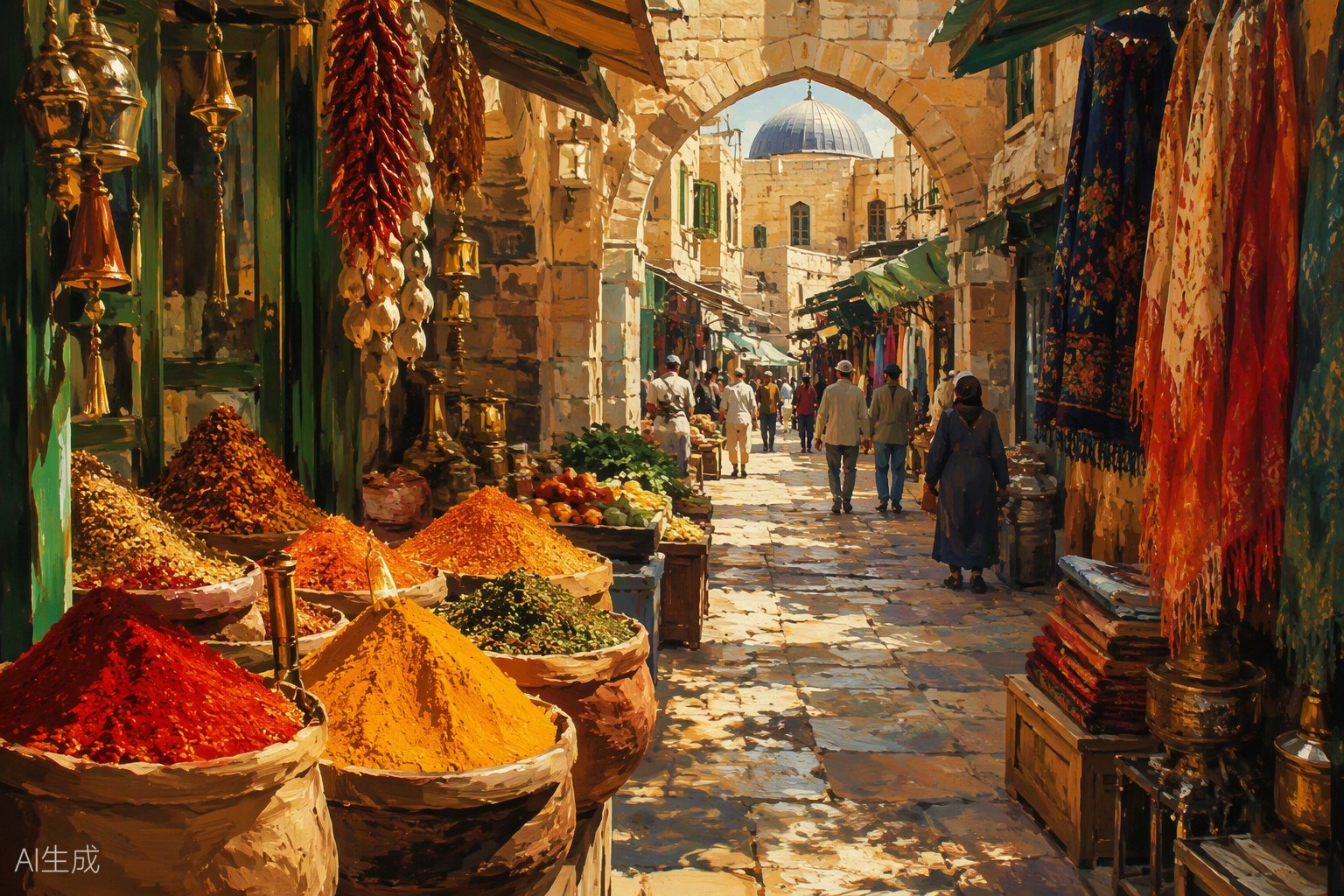
The shuk as archive — every stall records an immigration. Mahane Yehuda, est. 1887.
Where did each culture land?
Land geometry: Natural Earth 1:50m via world-atlas. Pins mark modern localities or representative regional anchors stored on Atlas place records, not historical borders and not reconstructed positions. · Sources & methods
We don't invent slang — regional records describe documented culture.
THE ARRIVAL ATLAS · 1882–PRESENT
Who arrived, when, and what they carried?
Seven documented waves built the society — each with its scale, its causes, and its cultural effects. Numbers are estimates with years, never bare.
1882-1903
First Aliyah (1882-1903)
The first numbered wave of modern immigration to Ottoman Palestine: ~25,000 arrivals (range 20,000-35,000) from Russia, Romania, and Yemen, 1882-1903 (iCenter FAQ 2024; bpb; StandWithUs).
Pogroms and revolution sent the first wave — ~25,000 people (range 20-35k per iCenter 2024, bpb, StandWithUs) — from Russia, Romania, and Yemen to Ottoman Palestine. They founded the moshavot (farming colonies, named in prose — no canon place records) and re-established a Yemenite quarter in Jerusalem's Silwan/Kfar HaShiloach (from 1882).
The pioneering wave from Russia and Poland: ~35,000-40,000 arrivals, 1904-1914 (iCenter FAQ 2024; bpb) — the generation of the first kibbutz (Degania 1909) and the founding of Tel Aviv (1909).
Roughly 35,000-40,000 immigrants from Russia and Poland (iCenter 2024; bpb) brought the labor-Zionist pioneering culture: the first kibbutz, Degania (1909, named in prose — no canon place record), and the garden suburb of Ahuzat Bayit on Jaffa's dunes — Tel Aviv (1909). This generation supplied much of the Yishuv's later leadership.
Post-WWI and post-revolution immigration: ~35,000-40,000 arrivals, 1919-1923 — 53% from Russia, 36% from Poland, the rest from Lithuania and Romania (iCenter FAQ 2024; StandWithUs).
After World War I and the Russian Revolution, ~35,000-40,000 arrived (1919-1923): 53% from Russia, 36% from Poland, plus Lithuania and Romania (iCenter 2024; StandWithUs). They built roads, drained swamps, and expanded the kibbutz and moshav movements in the early Mandate years.
The Polish middle-class wave: ~67,000-82,000 arrivals, 1924-1929 (iCenter FAQ 2024; StandWithUs; bpb counts ~80,000 for 1924-31) — driven by Polish economic exclusion and the 1924 US quota law.
Poland's economic exclusion policies and America's 1924 Johnson-Reed quotas redirected ~67,000-82,000 mostly middle-class Polish Jews to Mandate Palestine (iCenter 2024; StandWithUs; bpb counts ~80,000 for 1924-31). They urbanized the Yishuv — small shops, workshops, and cafés in Tel Aviv and Haifa.
The German and Central European wave fleeing Nazism: ~200,000-250,000 arrivals, 1929-1939 (iCenter FAQ 2024; bpb) — professionals, artists, and scientists who transformed the Yishuv's cities.
Nazism (from 1933) drove ~200,000-250,000 Jews from Germany, Austria, and Central Europe to Palestine (iCenter 2024; bpb). The "Yekke" immigration brought doctors, musicians (the future Israel Philharmonic core), architects (Tel Aviv's Bauhaus White City), and academics — a cultural transfer whose effects are still visible.
Aliyah Bet — the clandestine immigration (1920-1948)
The clandestine immigration that defied British quotas: ~100,000-110,000 people, 1920-1948, including Shoah survivors routed via Cyprus detention camps (iCenter FAQ 2024).
Alongside the numbered aliyot ran "Aliyah Bet" — clandestine immigration by ship and overland that defied British Mandate quotas: ~100,000-110,000 people between 1920 and 1948 (iCenter 2024), among them Shoah survivors intercepted and held in Cyprus camps before reaching Israel. QuietMode-adjacent content: survivor stories are dated and sourced, never dramatized.
The population-doubling wave after independence: ~684,000 total arrivals 1948-51 (est.) — 101,819 (1948), 239,076 (1949), 170,597 (1950), 172,245 (1951) — from Europe's survivor communities and the Arab lands (Bregman, Israel's Wars; iCenter FAQ 2024).
In the state's first four years its Jewish population doubled: ~684,000 arrivals 1948-51 (est.; Bregman year-by-year: 101,819 in 1948; 239,076 in 1949; 170,597 in 1950; 172,245 in 1951; iCenter 2024). Survivors of the Shoah and entire communities from Iraq, Yemen, North Africa, Romania, and Poland passed through the ma'abarot (transit camps) into development towns and cities.
The later Soviet & post-Soviet and Ethiopian waves (Operations Moses & Solomon) are told as full migration records in the era atlas — open the Migrations chapter →
Memory & Culture
Four regions, four answers
Culture here means documented food, music, institutions, and immigration history — told specifically, with sources on every card.
What does a market remember?
Jerusalem — the layered city
Jerusalem's Jewish layer is the atlas's deepest: Old Yishuv communities (Sephardi, Ashkenazi, and the Yemenite quarter of Silwan/Kfar HaShiloach from 1882), Kurdish and Bukharan neighborhoods, the Mahane Yehuda market (established 1887 by three merchants, per the cited history — verification with JVL/GoJerusalem flagged for production), and holiday observance in public space. The city is sacred to three faiths and is presented with neutrality; culture here means documented food, music, and immigration history — not invented dialect claims.
Tel Aviv was founded in 1909 as Ahuzat Bayit, a Jewish garden suburb of Jaffa, and became the First Hebrew City: the Bauhaus White City (UNESCO 2003), the secular-creative capital of modern Hebrew life, and home to Carmel Market and the Levinsky spice district — the latter built up partly by Salonika-descended merchants after Thessaloniki's 1917 fire (harrysbaked.com, "From Salonika to Levinsky Market"). Documented culture only: revival-era Hebrew life, markets, and architecture — no invented "Tel Aviv slang" claims.
The North — the mystics' mountain and the kibbutz heartland
The Galilee holds two Jewish stories side by side: Safed's 16th-century kabbalistic quarter (Karo's Shulchan Aruch, Luria's teachings) and the kibbutz heartland around the Sea of Galilee (Degania 1909, "mother of the kibbutzim," and Kinneret — named in prose; no canon place records). Peki'in carries a (partly romanticized — labeled as tradition) continuous-presence memory. The atlas does not flatten "the Galilee" into Jewish-only space: Druze, Circassian, and Bedouin neighbors are acknowledged as context.
The Negev story is the development-town story: planned from 1949-50s to settle mass immigration, ~30 towns whose populations were 85-90% Mizrahi by the 1960s-70s (by 1964, 65% of residents were of Asian-African origin, holding 37% of Israel's Oriental Jewish population — Sachar figures via the dossier). Dimona (est. 1955) and Yeruham are named in prose (no canon place records); Bedouin towns and desert research (Ben-Gurion University, 1969) are part of the region. Signature editorial line: these are specific, sourced stories — music (musica mizrahit), food, textile memory — and we do not pretend every town "has its own slang."
Tel Aviv's central market since 1920 — grown from Kerem HaTeimanim (the Yemenite quarter, est. 1906) stalls; Yemenite jachnun stalls anchor the neighborhood's food memory.
The spice-and-pickle district built up from the 1930s by Balkan immigrants — many Salonika families displaced by the 1917 fire — with bourekas, cured olives, and dried fruit: the Sephardic Mediterranean's Tel Aviv epilogue.
Musica mizrahit — from the bus station to the mainstream
Mizrahi music's journey: 1950s immigrant-ma'abara music (Jo Amar, Filfel al-Masry) → 1970s-80s cassette culture at Tel Aviv's old central bus station ("bus-station music"; Zohar Argov's "HaPerach BeGani," 1982) → 1990s mainstream — now Israeli pop's core.
Israeli rock's canon: The Churchills (1967), Arik Einstein & The High Windows (1967), Shalom Hanoch's Shablul (1970), Kaveret (1973-76, Eurovision 1974) — Western idioms Hebraized; Einstein (1939-2013) as "the voice of Israel."
From Ben-Yehuda's Va'ad ha-Lashon (Language Committee, 1890) to the Academy established by Knesset law in 1953 — the institution that still publishes rulings on new Hebrew terminology.
The five-month intensive Hebrew school for immigrants: the first ulpan (Ulpan Etzion, Jerusalem) opened in 1949; the model has taught over 1.3 million immigrants and was later copied for Welsh ("Wlpan").
Degania Alef (1909), "the mother of the kibbutzim," was founded by 12 pioneers at the Jordan's exit from the Sea of Galilee; the movement peaked mid-century (never >~3% of population, outsized in leadership, defense, agriculture); ~250-270 kibbutzim / ~120,000-130,000 members today.
movement1921-present
The moshav movement (Nahalal, 1921)
Nahalal (1921), the first cooperative smallholders' village in the Jezreel Valley — Eliezer Yaffe's 1919 blueprint, Richard Kauffmann's circular plan (1922, 75 farmsteads); 448 moshavim / ~157,000 people by the 1980s.
HEBREW IN MOTION · LENS A
The revival happened here — then the slang happened.
World Jewish Population (annual estimate series)~7.2M core Jewish population in Israel, ~45% of world Jewry (2023 estimates).
Culture & Stories Research Dossier §6 — the Israel layerAll 21 exhibit records carry their own citations; heritage entries are public-status landmarks only.