Modern Hebrew vs Biblical Hebrew: Key Differences Every Learner Should Know
Modern Hebrew and Biblical Hebrew are two forms of the same language, but they’re separated by thousands of years and serve very different purposes. If you’re exploring Hebrew, here’s what you need to know:
- Biblical Hebrew: Used in ancient religious texts like the Torah. It has a Verb-Subject-Object (VSO) sentence structure, an aspect-based verb system, and about 8,000 words. It’s ideal for theological studies or understanding scripture.
- Modern Hebrew: Revived in the 19th century for daily use in Israel. It follows Subject-Verb-Object (SVO) order, uses clear past, present, and future tenses, and has over 100,000 words. It’s essential for communication in modern-day Israel.
Quick Comparison
| Feature | Biblical Hebrew | Modern Hebrew |
|---|---|---|
| Usage | Religious texts, liturgy | Everyday communication |
| Sentence Structure | Verb-Subject-Object (VSO) | Subject-Verb-Object (SVO) |
| Verb System | Aspect-based (complete/incomplete) | Tense-based (past/present/future) |
| Vocabulary | ~8,000 words | 100,000+ words |
| Pronunciation | Complex guttural sounds | Simplified sounds for accessibility |
| Vowel Markings | Uses niqqud for clarity | Rarely uses niqqud; context-based |
Whether you’re diving into scripture or preparing to visit Israel, understanding these differences will help you choose the right form to study.
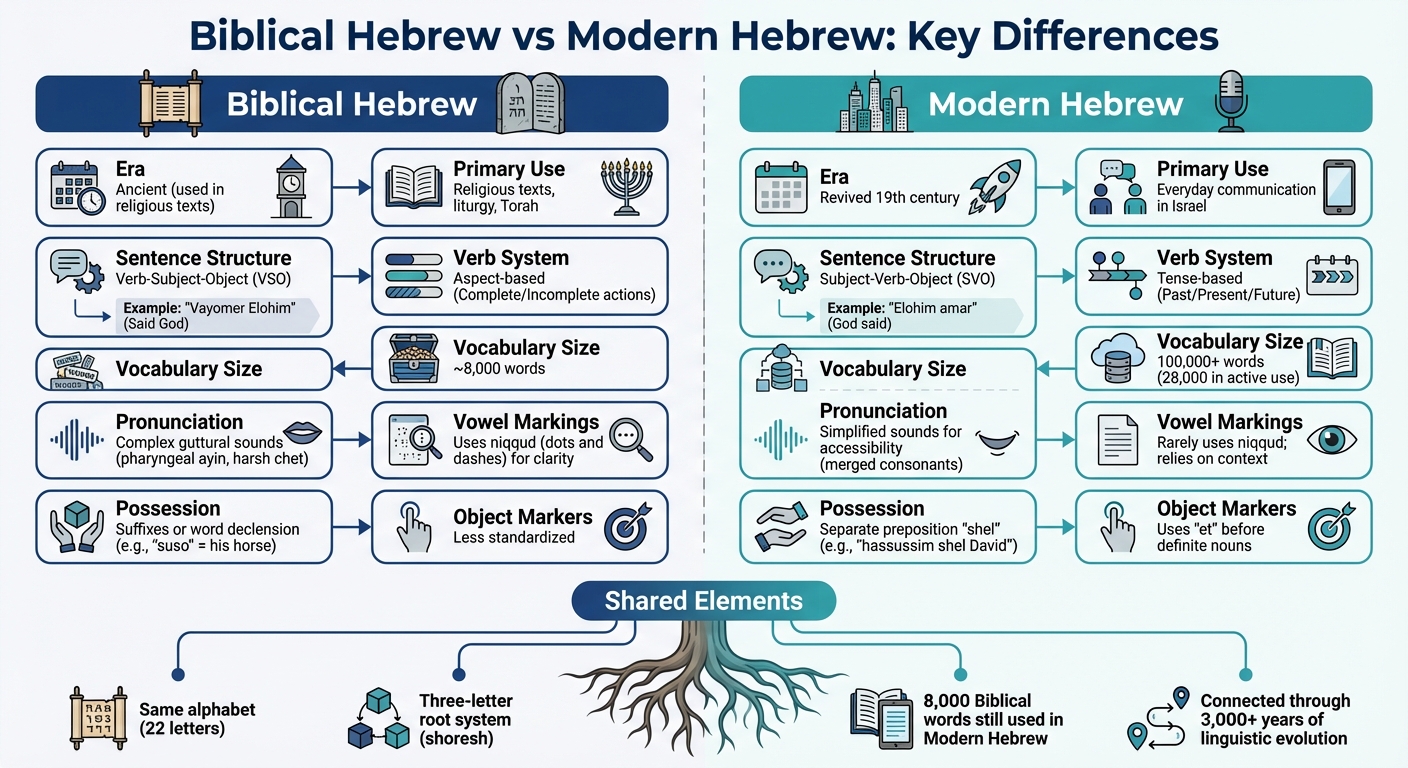
Biblical Hebrew vs Modern Hebrew: Key Differences Comparison Chart
Vocabulary Differences Between the Two Forms
Shared Roots and Modern Additions
Modern Hebrew stays connected to its ancient origins through the enduring three-letter root system, known as shoresh. Eliezer Ben-Yehuda, often called the father of Modern Hebrew, played a key role in this revival by pulling 8,000 words from the Bible and 20,000 from rabbinical commentaries [1].
The language's growth has relied on three main strategies: drawing from ancient texts, forming new words using existing Semitic roots, and borrowing from other languages like English, Arabic, Yiddish, and Russian. For example, the ancient root kh-sh-v (to think) inspired makhshev (computer), while k-u-n (established) evolved into mekhonit (car) [1]. This root-based method allows Modern Hebrew to create new terms while preserving a connection to its biblical heritage. These developments have not only expanded the vocabulary but also ushered in notable shifts in word meanings.
How Word Meanings Have Changed
One of the most striking features of Hebrew's evolution is how the meanings of words have transformed. Take hashmal, for instance - a term found in Ezekiel that now means "electricity" [1]. Similarly, tahana, which once referred to a temporary encampment, is now used for "station" (such as a bus or radio station) [2]. Even nefesh, originally meaning "soul" or "life force", has taken on the simpler meaning of "person" [5].
These changes highlight how Hebrew has adapted to meet the needs of modern life, repurposing ancient words to describe contemporary realities. While traditional terms like eretz (land), bayit (house), and shemesh (sun) have stayed consistent, entirely new or abstract concepts have required creative reinterpretation. As Jonathan Frate explained:
Modern Hebrew speaks of things that did not exist in biblical times. There is a need to express more complex ideas [4].
Today, the ancient vocabulary of the prophets exists alongside terms for modern inventions like smartphones and airplanes [5]. For students navigating the transition between biblical and modern forms, understanding these shifts is essential. Mastering Hebrew verb conjugation is another vital step in this journey.
sbb-itb-7e51dcc
Grammar and Syntax Changes
Word Order: VSO to SVO
In Biblical Hebrew, sentences often began with the verb, creating a poetic and declarative rhythm. For example, Vayomer Elohim translates to "Said God." In Modern Hebrew, this structure has shifted to a Subject-Verb-Object (SVO) order, producing sentences like Elohim amar ("God said"). This change stems from the influence of revivalists who were native speakers of European languages such as Yiddish, Russian, and German - languages that commonly use the SVO structure. This adjustment made Modern Hebrew more accessible to learners[1][2]. As Sarah Baker, Assistant Professor of the Practice of Hebrew at Duke University, explains:
The modern sentence structure is more similar to spoken English ('The man walked to the house') than to Biblical Hebrew prose ('Walked the man to the house') [3].
This evolution in sentence order also paved the way for other grammatical adjustments in Modern Hebrew.
Simplified Grammar in Modern Hebrew
Biblical Hebrew's verb system was based on aspects, distinguishing between complete and incomplete actions. This could create ambiguity, as the "perfect" form might sometimes indicate a future action if it was considered inevitable. In Modern Hebrew, the system is more straightforward, relying on clear tenses: past, present, and future[1][5].
Possession has also been simplified. In Biblical Hebrew, possession was often expressed through suffixes (e.g., suso for "his horse") or by altering the word into a construct state. Modern Hebrew, on the other hand, uses the independent preposition shel. For instance, "David's horses" becomes hassussim shel David instead of the Biblical sussei David[1][4].
Another notable change is the use of the marker et, which appears before definite objects (e.g., et ha-sefer for "the book"). This addition makes sentence roles clearer. Langfocus highlights this shift:
Modern Hebrew's syntax has been standardized and is pretty straightforward [2].
While these changes make Modern Hebrew easier for daily communication, they also mean some of the nuanced literary qualities of Biblical Hebrew are no longer present. The table below outlines these key differences:
Grammar Comparison Table
| Feature | Biblical Hebrew | Modern Hebrew |
|---|---|---|
| Sentence Structure | Verb-Subject-Object (VSO) | Subject-Verb-Object (SVO) |
| Verb System | Aspect-based (Complete/Incomplete) | Tense-based (Past/Present/Future) |
| Possession | Suffixes or word declension | Separate preposition (shel) |
| Present Tense | Uses participle for continuous action | Participle is the standard present tense |
| Definite Objects | Less standardized markers | Uses et before definite nouns |
Pronunciation Differences
Fewer Sounds in Modern Hebrew
Biblical Hebrew had a wide range of guttural and emphatic consonants, many of which have disappeared in Modern Hebrew. When European immigrants revived Hebrew in the late 19th and early 20th centuries, they found it challenging to replicate these ancient sounds. As Paul from Langfocus explains:
Modern Hebrew was first revived by Yiddish-speaking Europeans, and I'm sure they tried hard but they just couldn't easily reproduce some of the original Hebrew sounds [2].
For instance, the letter ayin (ע) originally required a deep pharyngeal sound from the back of the throat. Today, most Israeli speakers pronounce it as a silent glottal stop, effectively merging it with alef (א). Similarly, the harsh, scraping guttural sound of chet (ח) has softened into a "kh" sound, similar to the "ch" in "Bach." Other consonants have completely merged: tet (ט) and tav (ת) now sound identical, as do chet (ח) and khaf (כ) [1][2][5]. These changes simplified the language for a diverse population of new speakers but came at the cost of some of its original phonetic richness. Beyond consonants, Modern Hebrew has also altered its approach to vowel sounds.
Vowel Markings: Niqqud Usage
The evolution of vowel notation complements these consonant changes. In Biblical Hebrew, niqqud - a system of dots and dashes placed around letters - was essential. Developed by the Masoretes in the second half of the first millennium AD, these markings preserved the oral tradition of scripture and ensured accurate liturgical pronunciation [7]. Without niqqud, it would be hard to know whether a word should be pronounced with an "a", "e", or "o" sound.
Modern Hebrew, however, rarely uses niqqud in everyday writing. Newspapers, street signs, and text messages omit these markings, leaving readers to rely on context for correct pronunciation. This practice can lead to confusion, especially with unfamiliar words. Linguist Ghil'ad Zuckermann highlights this issue:
The lack of niqqud in what he calls 'Israeli' (Modern Hebrew) often results in 'mispronunciations' [7].
While niqqud still appears in children's books, poetry, and dictionaries, most modern texts use ktiv maleh (full spelling) as a substitute [7][8].
Examples of Pronunciation Changes
Everyday words provide clear examples of these shifts. The Biblical word for "I", annokhi (אָנֹכִי), has been simplified to ani (אני) [1][6]. Vowel distinctions like tzere and segol have merged into a single "e" sound, while pataḥ and qamatz have combined into an "a" sound [7][9]. Consonants have also changed: Biblical taf, which could sound like "t" or "th", is now consistently pronounced as "t" [10]. These changes are essential for learners navigating between Biblical texts and modern communication.
