How to Memorize Hebrew Conjugation Patterns
Now that the binyanim are explained, let’s dive into strategies to make memorizing these patterns less daunting and more effective.
Using Memory Tricks and Mnemonics
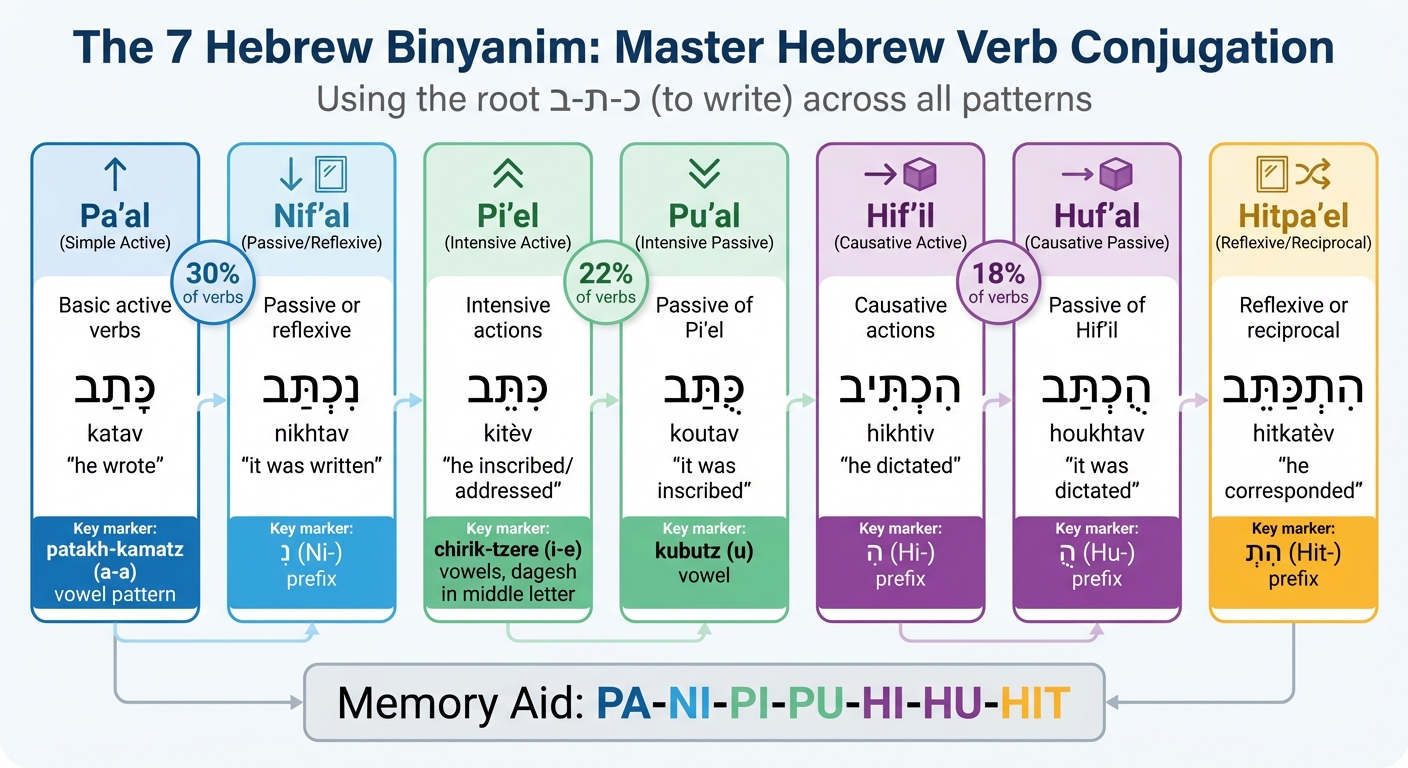
A handy mnemonic for the seven binyanim is the "PA-NI-PI-PU-HI-HU-HIT" chant. This rhythmically captures the first syllables of each binyan: Pa'al, Nif'al, Pi'el, Pu'al, Hif'il, Huf'al, and Hitpa'el. Saying the chant aloud helps reinforce the order in your memory [2].
Another helpful visual tool is the seven-branched candelabrum. Picture the binyanim arranged on a menorah, with active forms on one side and passive forms on the other [3].
You can also tap into color coding to strengthen your recall. For example:
- Blue for active verbs (Pa'al, Pi'el, Hif'il)
- Green for passive verbs (Nif'al, Pu'al, Huf'al)
- Yellow for reflexive verbs (Hitpa'el)
Use these colors on flashcards or charts to create vivid mental associations [2].
Recognizing and Grouping Patterns
To make things simpler, think of the binyanim as three active/passive pairs with one reflexive form:
- Simple: Pa'al (active) / Nif'al (passive)
- Intensive: Pi'el (active) / Pu'al (passive)
- Causative: Hif'il (active) / Huf'al (passive)
- Reflexive: Hitpa'el
As HebrewGlot puts it:
"Binyanim aren't seven random patterns. They're three pairs plus one rebel." [2]
Look for key prefixes to identify patterns:
- נִ (Ni-) marks Nif'al.
- הִ (Hi-) signals Hif'il.
- הִתְ (Hit-) always indicates Hitpa'el.
- מְ (Me-) in the present tense often points to Pi'el or Pu'al.
Vowel patterns can also guide you:
- Pa'al typically uses a patakh-kamatz (a–a) sequence.
- Pi'el often features a chirik-tzere (i–e) pairing.
- Pu'al is known for its kubutz (u) sound.
These clues make it easier to recognize and group verbs by their conjugation patterns.
Practice Drills and Exercises
The best way to master the binyanim is through consistent practice. Start with one anchor verb for each binyan, focusing first on common patterns like Pa'al and Pi'el. The root פ-ע-ל (P-A-L) is a great example to see how each binyan works [2].
To reinforce your learning, try keeping a Hebrew diary. Write sentences using different binyanim, such as, "I corresponded (Hitpa'el) with my friend", or "The letter was written (Nif'al) yesterday" [2].
Another practical exercise is to take a familiar root, like כ-ת-ב (write), and practice conjugating it across the binyanim:
- כָּתַב (wrote)
- נִכְתַּב (was written)
- הִכְתִּיב (dictated)
As HebrewGlot wisely points out:
"You don't learn binyanim by studying charts. You learn them by using verbs." [1]
How baba Helps You Master Hebrew Conjugation
Mastering Hebrew conjugation can feel overwhelming, but baba makes it easier by focusing on practical, real-world use. While conjugation charts are helpful, they don’t always prepare you for real conversations. This AI-powered Hebrew translation app, available on iOS and Android, simplifies Hebrew’s famously complex verb system and ensures you’re ready to use it in everyday situations.
Gender-Aware Conjugation Support
Hebrew verbs are unique in that they must match both the speaker's and the listener's gender - something most translation tools overlook. baba addresses this with 11 gender-specific prompts, ensuring every verb, adjective, and pronoun fits the context. For example, when translating "I went to the store", baba asks if you’re male or female and whether you’re speaking to a man, woman, or group. This ensures the app provides the correct form, such as הלכתי (halakhti) for a female speaker.
This feature is especially useful when practicing conjugations across different verb patterns, or binyanim. For instance, if you’re working with the root כ-ת-ב (write) in the Hitpa'el (reflexive) binyan, baba shows how התכתבתי (hitkatabti) changes depending on gender and number. Since every Hebrew verb has four present-tense forms based on gender and plurality [4], baba’s dynamic support eliminates the need to memorize endless tables. Instead, it demonstrates these patterns in action, helping you build a strong foundation before tackling modern Hebrew nuances.
Modern Hebrew and Slang Integration
Formal Hebrew conjugations often differ from how the language is spoken in everyday life. baba’s Slang Mode bridges this gap by showing how verbs are used in casual speech. For example, while you might learn the formal Pa'al verb ללכת (to go), baba also introduces expressions like יאללה (yalla - "let’s go") and explains when to choose informal forms over formal ones.
This approach is especially helpful because 30% of Hebrew verbs fall into Pa'al, and 22% into Pi'el [3], making these the most common patterns. By connecting these structured verb patterns to the language you’ll hear on the streets of Tel Aviv, baba helps you internalize conjugations faster. Plus, its pronunciation guides make it easier to navigate the gap between textbook Hebrew and the spoken language.
Practice with Transliteration
If you’re still learning to read Hebrew script, conjugating verbs can feel like a daunting task. baba solves this by offering Latin transliterations alongside each conjugated form. For example, when working with the Hif'il pattern, you’ll see both הִכְתִּיב and its transliteration hiktiv (dictated), making it clear how to pronounce each form.
Since Hebrew is often written without vowels (nikud), transliteration is a game-changer for beginners. It helps you recognize which binyan you’re working with and ensures accurate pronunciation [2]. This means you can start practicing Hebrew conjugations even before you’ve fully mastered reading the alphabet.
Download baba and see how its gender-aware translations, slang integration, and transliteration features can transform your Hebrew learning experience.
Building Fluency Through Conjugation Practice
Mastering Hebrew conjugation patterns goes far beyond memorizing charts - it's about unlocking the language's structure. Once you grasp how the seven binyanim (verb patterns) interconnect, Hebrew starts to feel like a beautifully organized system. As HebrewGlot put it:
"It was like suddenly being able to read music instead of just memorizing songs" [2].
To bring these patterns to life, practical exercises are key. Try writing 3–5 Hebrew sentences daily to internalize the patterns more effectively than repetitive drills ever could [2]. Focus on describing your day-to-day experiences while using different binyanim. This approach not only strengthens memory but also helps you connect the patterns to real-life contexts. Start with the four most common patterns - Pa'al, Pi'el, Nif'al, and Hif'il - since they account for about 90% of Hebrew verb usage [1]. Mastering these first builds confidence quickly.
Once you’re comfortable with these forms, dive into active/passive pairs like Pa'al/Nif'al, Pi'el/Pu'al, and Hif'il/Huf'al. These pairs allow you to express nuanced meanings using the same root [1][3]. This isn't just about grammar - it’s about moving beyond mechanical language and developing natural fluency. With consistent practice, choosing the right binyan becomes second nature. Over time, you'll find yourself writing and speaking complex sentences effortlessly [2].
For extra support, try baba on iOS and Android. It offers tools like gender-aware conjugation, modern slang, and transliteration guides. Whether you're texting friends, drafting professional emails, or ordering coffee in Tel Aviv, baba’s interactive features help turn grammar rules into confident, everyday communication.
FAQs
Which binyanim should I learn first?
The Pa'al binyan is a great starting point for learning Hebrew. It's the simplest of the verb structures and includes many commonly used verbs. This makes it an ideal foundation for beginners to begin developing their Hebrew language skills.
How can I quickly identify a verb’s binyan?
You can spot a verb’s binyan by looking at its predictable patterns of vowels, prefixes, and suffixes. These patterns indicate whether the verb is active, passive, or reflexive and stay consistent across verbs within the same binyan. Learning these patterns will help you identify them more effortlessly.
Do all Hebrew roots appear in all seven binyanim?
Not all Hebrew roots appear in all seven binyanim (verb structures). Each binyan follows a unique pattern, and while certain roots can be conjugated across several binyanim, others might only show up in one or two. This variation largely depends on the meaning and function of the root within the language.
Frequently Asked Questions
What is the difference between Piel and Hifil in Hebrew?
Both Piel and Hifil express a more forceful version of an action, but they work differently: Piel intensifies or adds deliberateness to an action (like 'inscribed' versus simply 'wrote'), while Hifil makes the subject cause someone else to perform the action, like 'dictated' meaning 'caused someone to write.' Spotting the Hi- prefix and a long 'i' vowel near the root usually signals Hifil.
How does Hebrew verb conjugation change based on gender?
Hebrew verbs agree with both the speaker's gender and the listener's gender, which means the same sentence can take a different form depending on who is speaking and who is being addressed. For example, 'I went' looks different for a male versus a female speaker, and every present-tense verb has up to four forms based on gender and number — something most generic translators get wrong.
Is it possible to learn Hebrew verb patterns without fully knowing the Hebrew alphabet yet?
Yes — working with transliterations alongside Hebrew script lets you recognize and practice binyan patterns phonetically before your reading is fully solid. Tools that show both the Hebrew form and its Latin transliteration, like 'hiktiv' next to הִכְתִּיב, help beginners connect pronunciation to pattern recognition from day one.
How is Hitpael different from Nifal if both can be reflexive?
Nifal is primarily a passive construction (something was done to the subject) that can occasionally carry a reflexive sense, while Hitpael specifically expresses a reflexive or reciprocal relationship where the subject acts on itself or in mutual exchange with others — like 'he corresponded' implying back-and-forth communication. The Hit- prefix is the clearest signal you're dealing with Hitpael rather than Nifal.
Why do some Hebrew roots not appear in all seven binyanim?
Each binyan carries a specific semantic function — causative, intensive, passive, reflexive — and not every verb root has a natural meaning in all seven roles. A root like 'to write' can stretch across most binyanim because writing has natural active, passive, causative, and reflexive uses, but many roots are semantically limited to just one or two patterns in everyday speech.