
Ashkenazi — cholent / schalet
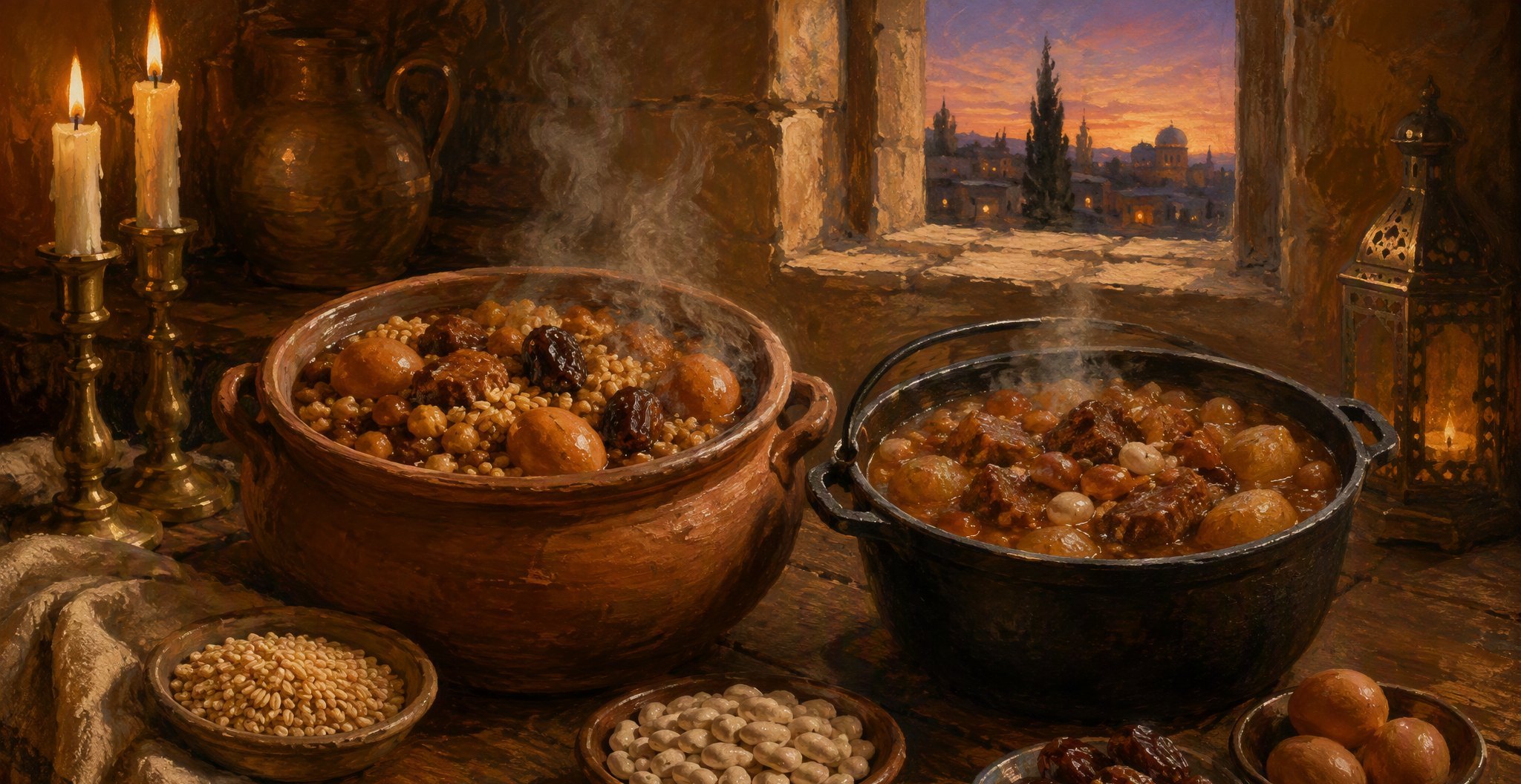
The eastern European form: barley, beans, meat, and potatoes, sealed overnight; schalet is its older western cousin.
TRADITION
food· LENS C
How did this dish travel — and whose table carries it?
One Sabbath stew, four names and counting — slow-cooked from Friday sundown to obey the fire laws, named differently in every community.
To keep the Sabbath fire laws, Jewish kitchens learned to set a stew before sundown Friday and eat it hot on Saturday — one dish with many passports. Its documented path runs from the Middle East through North Africa to Spain by the 9th century, into France by the 1300s (the folk etymology chaud lent, "warm-slow," is contested), and to Germany after the French expulsions. In Sephardi towns, delivering the pot to a communal oven on Friday was a documented neighborhood institution.
VARIATIONS · ONE TRADITION, MANY HANDS
These are documented variations — not "authentic" vs. "adapted"; each belongs to its community.
IN TEXT & MEMORY
No canon text or figure record is tied to this tradition yet — the canon grows carefully, only where a record explicitly documents the link.
IN THE ATLAS
Sources & review